
What changed this week
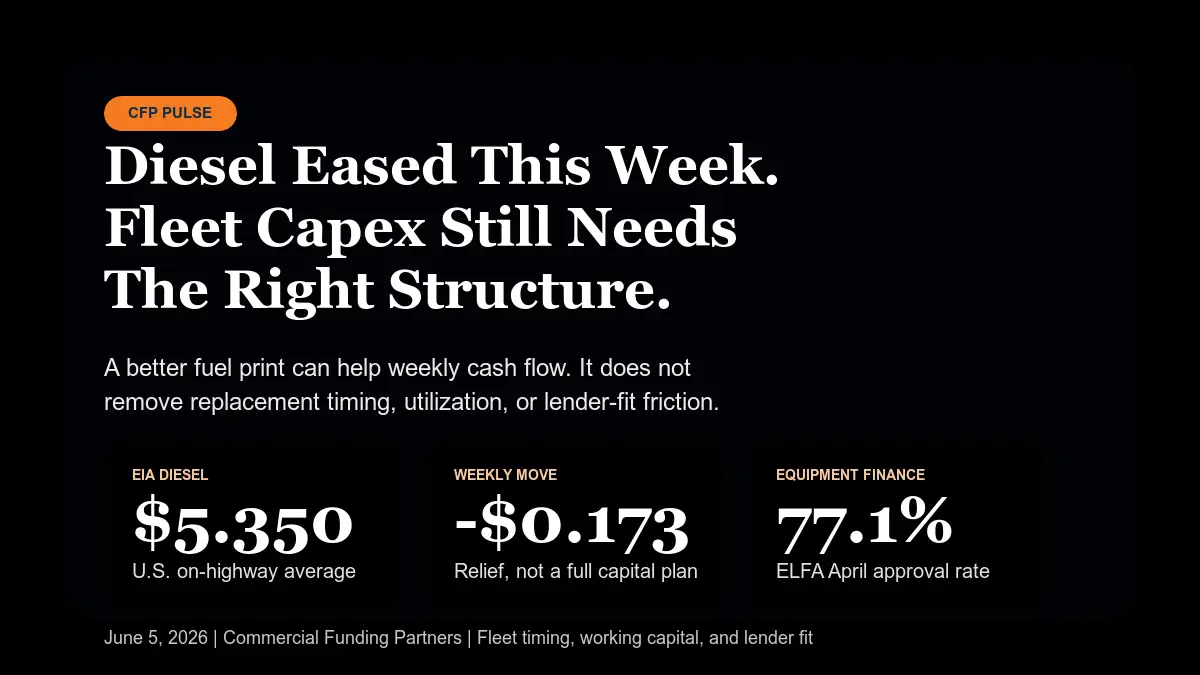
The latest U.S. Energy Information Administration diesel update gave operators some week-over-week relief. The national average on-highway diesel price came in at $5.350 per gallon on June 1, down from $5.523 the week before.
That matters for transportation, field-service, construction, energy, and distribution operators. Fuel is part of the operating math. A lower weekly diesel print can improve route economics, ease margin pressure, and give a company more room to think about replacement timing.
But a better fuel week is not the same thing as a simple capital decision.
Why structure still matters
The latest ELFA CapEx Finance Index said April new business volume among surveyed member companies was $10.6 billion on a seasonally adjusted basis, with year-to-date volume up 15.0% from the same period in 2025. Approval rates remained healthy at 77.1%.
The ELFA Monthly Confidence Index also improved to 59.9 in May from 54.6 in April.
The June 3 Federal Reserve Beige Book reinforces that point. Banking conditions were stable across most Districts, but some delinquencies were rising, and energy-related costs remained an inflation driver.
That means a fleet operator may get a little fuel relief while still facing lender caution, cash-flow stress, or uneven replacement timing.
Where fleet-capex friction shows up
Friction to plan around
- body-build or upfit timelines before delivery,
- deposits ahead of final funding events,
- old and new assets overlapping on the books,
- maintenance and fuel costs moving while assets are being replaced,
- utilization ramp timing by route, customer, or location,
- bank hold or concentration limits, and
- working-capital needs before the replacement lowers downtime or repair spend.
CFP angle
Commercial Funding Partners is most relevant when a fleet or transportation project makes operating sense, but the structure still has to account for replacement timing, utilization, collateral, and liquidity.
That can include transportation equipment financing, structured lease terms, sale-leaseback, or multi-asset transactions across locations.
What operators should do now
One better diesel print can help the weekly math. It should not become a reason to delay the financing conversation.
Practical takeaway
If fleet replacement matters, bring financing into the operating plan before the order, delivery, or rollout schedule is locked.
Transportation page
See CFP’s transportation equipment financing page.
Funding example
See the trucks and trailers funding example.
Proof library
See CFP’s case-studies archive.
Source notes
- EIA Gasoline and Diesel Fuel Update.
- ELFA CapEx Finance Index and Monthly Confidence Index.
- Federal Reserve Beige Book.
- Census Manufacturers’ Shipments, Inventories, and Orders.
- BLS release schedule for the June 5 morning refresh gate.