
What the latest signals show
Companies are still looking at equipment, capacity, and supply-chain investment. The sharper question is whether the financing path can support deposits, delivery schedules, installation timing, and working liquidity before the equipment is fully in service.
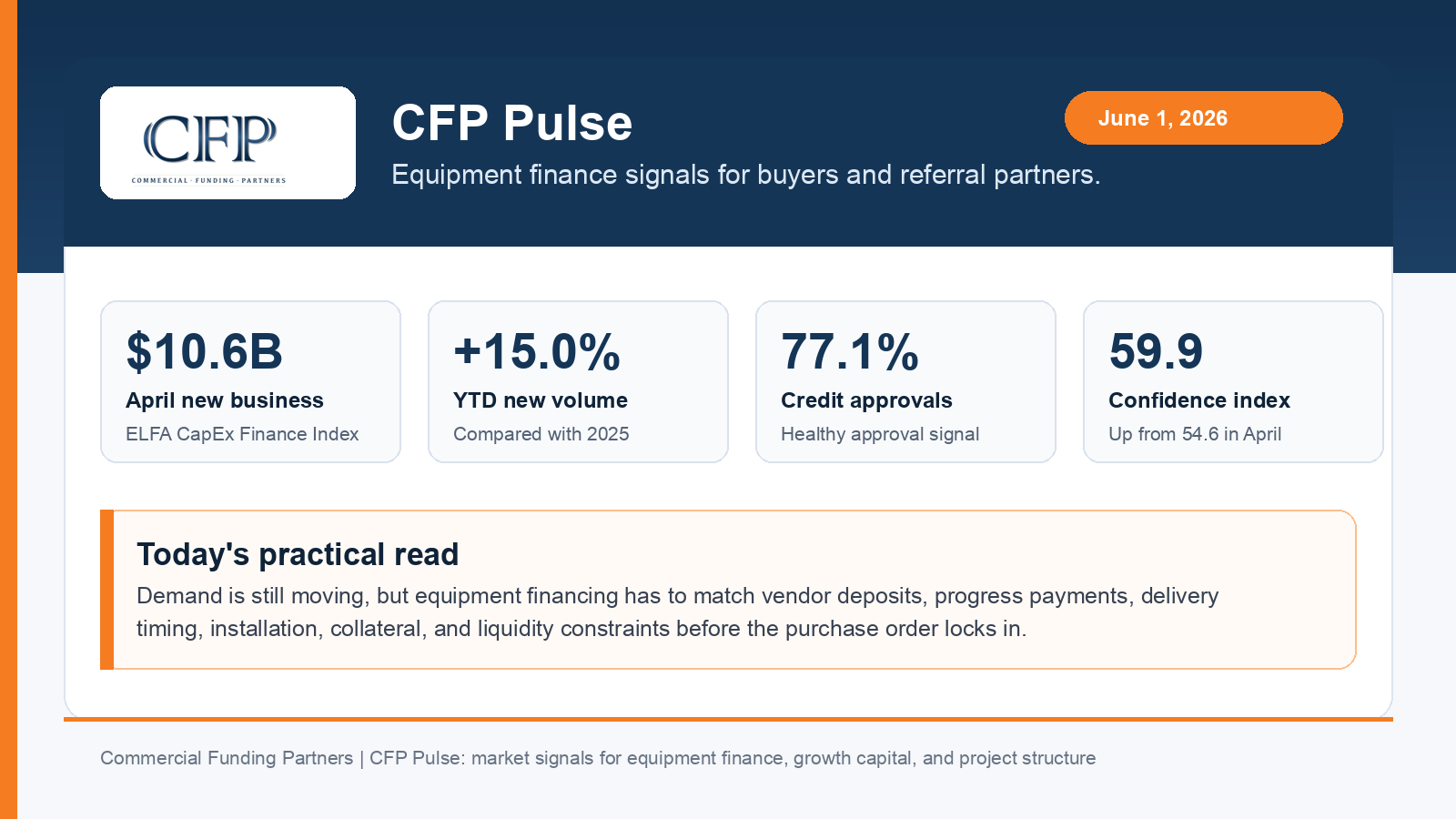
The Equipment Leasing & Finance Association’s latest CapEx Finance Index showed April equipment-finance activity still on pace for the strongest year on record. ELFA reported $10.6 billion in seasonally adjusted new business volume for April, with year-to-date new business volume up 15.0% versus the same period in 2025. Credit approvals remained healthy at 77.1%.
ELFA’s May confidence survey pointed in the same direction. Its Monthly Confidence Index rose to 59.9 from 54.6 in April. For borrowers, the most useful signal was capex demand: 26.1% of responding executives expected demand for leases and loans to fund capital expenditures to increase over the next four months, 73.9% expected demand to remain stable, and none expected demand to decline.
The broader economy is more mixed
BEA’s second estimate placed Q1 2026 real GDP growth at a 1.6% annual rate. BEA also revised the prior estimate lower, primarily because of revisions to investment and consumer spending.
ISM’s April manufacturing report showed the operating tension manufacturers already know. Manufacturing remained in expansion, new orders grew, and production expanded. At the same time, supplier deliveries slowed and prices increased sharply.
Why financing structure matters now
For equipment buyers, that combination matters. A project can make strategic sense and still stall if the financing path does not match how the equipment will be ordered, paid for, delivered, installed, and placed into service.
Watch for structure friction
- vendor deposits or milestone payments,
- imported or specialized equipment,
- progress funding before final delivery,
- used or hard-to-value collateral,
- multiple entities or operating locations,
- bank hold limits,
- liquidity pressure during expansion, or
- domestic supply-chain and onshoring initiatives.
CFP angle
These are the situations where a narrow invoice-and-delivery loan can be too rigid. The financing structure should map to the project plan, not just the equipment quote.
The onshoring and supply-chain story is still creating equipment needs. DOE’s recent critical-minerals announcement shows continued attention on domestic processing, rare-earth materials, magnesium, recycling, and advanced manufacturing inputs. Those projects require production equipment, installation timelines, utility and infrastructure planning, and capital structures that can handle real-world operating complexity.
Practical takeaway for equipment buyers
A standard equipment loan may work for a simple invoice-and-delivery purchase. It can become too narrow when capital is needed before final delivery, before installation, or before the equipment is producing.
Start the financing conversation before the purchase order is final. If the equipment supports capacity, margin, supply-chain control, or new contracts, the financing structure should be part of the project plan, not a last-step checkout item.
Related proof
See CFP’s equipment-financing case studies.
Related industry signal
See CFP’s post on mining equipment financing and critical minerals.
Source notes: ELFA CapEx Finance Index, ELFA Monthly Confidence Index, BEA Q1 2026 second estimate, ISM April manufacturing report, and DOE critical-minerals announcement.