Key Takeaways
- Equipment leasing preserves working capital by eliminating large upfront costs and spreading payments over time
- Payment structures flex to match cash flow cycles and project revenue timing
- Lease payments may be deductible, with Section 179 benefits available on some structures
- Newer equipment stays in reach without carrying obsolescence risk on the balance sheet
- Maintenance, upgrade, and disposal risk shift off your books, cutting surprise costs and admin work
What Is Equipment Leasing
What Is Equipment Leasing?
Equipment leasing is a financing arrangement where a lessor purchases equipment and leases it to a business in exchange for regular payments over an agreed term. This approach allows businesses to access essential equipment without depleting cash reserves.
Leasing is typically applied in capital-intensive industries where equipment needs are substantial and ongoing:
- Manufacturing
- Healthcare
- Construction
- Transportation
- Energy and agriculture
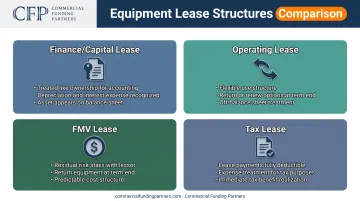
Multiple lease structures exist, each with different financial and tax implications:
- Finance (capital) leases – Treated like ownership for accounting, with depreciation and interest
- Operating leases – Keep use flexible with return or renew options at term end
- Fair market value (FMV) leases – Shift residual-value risk to the lessor
- Tax leases – Often let lessees deduct payments as ordinary business expenses
The right structure depends on your cash flow position, tax situation, and operational objectives.
Key Advantages of Equipment Leasing
The advantages below focus on measurable financial, operational, and strategic impacts. Each directly affects outcomes businesses track: cash position, operational efficiency, competitive positioning, tax liability, and risk exposure.
Preserves Working Capital and Improves Cash Flow
Equipment leasing removes the need for a large upfront capital outlay. Instead of paying $500,000 cash for manufacturing equipment, you might pay $10,000 per month over five years.
Preserving cash reserves creates a financial buffer for:
- Unexpected expenses and seasonal fluctuations
- Strategic opportunities requiring immediate capital
- Expansion, hiring, or marketing initiatives
- Emergency reserves and working capital needs
Why this matters: Stronger liquidity and more financial flexibility. According to the Equipment Leasing and Finance Association's 2024 Horizon Report, 62% of end users cited cash-flow optimization as their primary reason for financing equipment.
J.P. Morgan's 2024 Working Capital Index found that S&P 1500 companies held approximately $707 billion of trapped liquidity, 40% above pre-pandemic levels.
Preserved capital can fund revenue-generating work instead of sitting in depreciating assets. A Federal Reserve survey of 6,525 small employer firms found that 56% sought financing for operating expenses and 46% for expansion—yet only 42% of applicants received the full amount requested.
KPIs impacted:
- Working capital ratio
- Cash conversion cycle
- Liquidity ratios
- Debt-to-equity ratio
- Operational cash flow
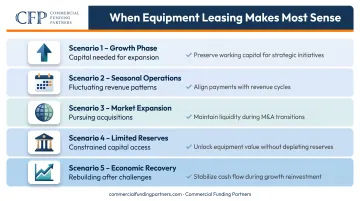
When this advantage matters most:
- Businesses in growth phase requiring capital for expansion
- Seasonal operations with fluctuating revenue
- Companies pursuing acquisitions or market expansion
- Growing companies with limited capital reserves
- Businesses recovering from economic challenges
Provides Financial Flexibility Through Customized Payment Structures
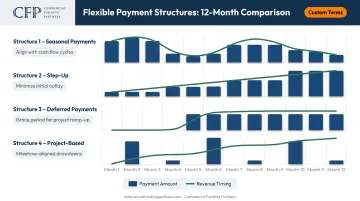
Equipment leasing offers payment flexibility that traditional equipment loans or purchases cannot match. Lease arrangements can include:
- Seasonal payment schedules – Higher payments during peak revenue months, lower during slow periods
- Step-up structures – Start low and increase as revenue grows
- Deferred payments – Delay principal payments during equipment installation or commissioning
- Payment structures tied to project cash flow – Align obligations with revenue generation
Why this matters: Payments can track the revenue the equipment produces, which eases stress in slow months. USDA forecasts show real volatility in agricultural income: inflation-adjusted 2026 net farm income is projected down $4.1 billion, or 2.6%, from 2025. That is exactly why seasonal operators need flexible schedules.
Commercial Funding Partners (CFP) structured a $15 million agricultural balloon lease with discounted early-phase payments and seasonal alignment. The company added equipment as operations and cash flow allowed, while staying inside existing loan covenants.
KPIs impacted:
- Debt service coverage ratio
- Monthly cash flow variance
- Payment-to-revenue ratio
- Financial stress indicators
When this advantage matters most:
- Seasonal businesses (agriculture, construction, hospitality)
- Project-based operations with irregular revenue
- Businesses with long equipment commissioning periods
- Companies with cyclical demand patterns
Enables Access to Latest Technology and Equipment Upgrades
Leasing allows businesses to access current technology and equipment without the risk of owning assets that become obsolete or outdated. Lease terms can include upgrade provisions or end-of-term options that facilitate transitioning to newer equipment as technology evolves.
Why this matters: Newer equipment protects productivity, quality, and efficiency without locking capital into assets that age out of competitive use. Aging fleets also drive downtime: NIST estimates discrete-manufacturing downtime at 8.3% of planned production time and $245 billion annually.
Modern equipment can deliver substantial improvements:
- Productivity gains – Newer automation reduces cycle times and labor requirements
- Quality improvements – Advanced controls reduce defect rates
- Lower operating costs – Newer equipment requires less maintenance and consumes less energy
- Compliance advantages – Latest technology meets current safety and environmental standards
The FDA notes that connected medical devices can improve care but increase cybersecurity exposure; Section 524B cybersecurity requirements took effect March 29, 2023, making equipment age a compliance issue in healthcare.
KPIs impacted:
- Productivity per labor hour
- Equipment downtime
- Maintenance costs
- Quality defect rates
- Competitive positioning
When this advantage matters most:
- Technology-driven industries (manufacturing automation, healthcare diagnostic equipment, IT infrastructure)
- Industries with rapid equipment innovation cycles
- Businesses competing on quality and efficiency
- Companies facing regulatory or cybersecurity requirements
Offers Significant Tax Benefits and Accounting Advantages
Equipment lease payments are typically fully tax-deductible as operating expenses, often reducing taxable income more effectively than depreciation schedules on purchased equipment. Different lease structures offer different tax and accounting treatments.
Section 179 deduction limits:
| Tax Year | Maximum Deduction | Phaseout Begins |
|---|---|---|
| 2024 | $1,220,000 | $3,050,000 |
| 2025 | $2,500,000 | $4,000,000 |
| 2026 | $2,560,000 | $4,090,000 |
Tax treatment is a primary deal driver, not a side benefit. Lease structure can lower the after-tax cost of equipment and change how the obligation appears on financial statements. According to ELFA's Horizon Report, 51% of end users cited tax advantages as a key financing reason.
Important considerations:
- True leases allow current deduction of rental payments as business expenses
- Capital leases may allow depreciation and interest deductions
- Section 179 eligibility depends on tax ownership and business-income limits
- Consult a tax advisor to optimize lease structure for your specific situation
KPIs impacted:
- Effective tax rate
- Taxable income
- After-tax cost of equipment
- Earnings before interest and taxes (EBIT)
When this advantage matters most:
- Profitable businesses seeking to reduce tax liability
- Businesses benefiting from immediate expense deductions rather than multi-year depreciation
- Companies managing debt covenants affected by balance sheet treatment
Transfers Maintenance Risk and End-of-Life Responsibilities
Many equipment leases include maintenance provisions or transfer responsibility for equipment disposal, reducing unexpected costs and administrative burden. Leasing eliminates concerns about equipment residual value, resale challenges, and environmental disposal requirements at end of useful life.
Why this matters: This reduces operational risk, eliminates surprise maintenance expenses, and removes the burden of managing equipment disposition. NIST reports US manufacturing maintenance and repair expenditures totaled $58.6 billion in 2021.
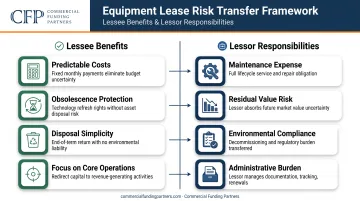
Risk transfer benefits include:
- Predictable costs – Fixed monthly payments replace variable maintenance expenses
- Obsolescence protection – FMV lease structures let lessors bear residual-value risk
- Disposal simplicity – Lessor handles environmental compliance and equipment removal
- Focus on core operations – Administrative burden shifts to the lessor
ELFA notes that in FMV lease structures, the lessee may return equipment without further obligation or buy it at fair market value, with obsolescence risk borne by the lessor.
KPIs impacted:
- Unplanned maintenance expenses
- Equipment uptime
- Administrative overhead
- Disposal costs
When this advantage matters most:
- Businesses with limited maintenance staff or expertise
- Equipment with high maintenance requirements
- Industries with strict environmental disposal regulations
- Companies seeking predictable operating costs
When Equipment Leasing Makes the Most Sense
Equipment leasing works best when you need to preserve capital for other priorities, technology is changing quickly, or cash flow is seasonal or uneven.
Leasing advantages peak in situations like these:
- Large-scale projects that would lock up multi-million-dollar capital reserves
- Growth phases when cash is needed for hiring, inventory, and market expansion
- Seasonal revenue cycles where payments can track cash generation
- Rapid tech change where upgrade options limit obsolescence risk
- Immediate equipment needs when capital reserves are limited
Leasing also helps you fund projects beyond typical equipment loan limits. That matters for full systems that bundle soft costs—installation, training, software integration, and commissioning—that traditional lenders often exclude.
CFP structured a $20 million, 36-month facility covering equipment, installation, software, engineering, and integration for a manufacturing automation project. That is the kind of full-project financing most banks will not book.
How to Maximize Value from Equipment Leasing
Equipment leasing delivers more value when you work with financing partners who know your industry and structure terms around cash flow and strategic goals.
Practical ways to get more from each lease:
- Compare lease structures on total cost, tax treatment, and end-of-term options before you commit
- Choose lenders who know your sector and can tailor terms to how you operate
- Bundle soft costs (installation, training, software) into one facility when the project needs it
- Match payments to cash flow with seasonal, step-up, or deferred structures
- Lock in end-of-term options (purchase, return, upgrade, or extend) before you sign
- Keep financing relationships active so the next equipment need is easier to fund
Review equipment needs and lease performance on a regular cycle instead of treating each deal as a one-off.
Frequently Asked Questions
Is it better to lease or buy equipment for a business?
It depends on cash flow, how fast the equipment becomes obsolete, tax treatment, and whether ownership matters. Lease when you need to preserve capital and stay flexible; buy long-life assets with stable technology.
How does equipment leasing work?
A financing company buys the equipment and leases it to your business for fixed monthly payments over an agreed term. At the end, you can usually return it, purchase it, extend the lease, or upgrade.
Can I write off equipment leases on my taxes?
Lease payments are generally tax-deductible as business expenses. Depending on structure, you may also qualify for Section 179. Consult a tax advisor—treatment depends on lease classification and tax ownership.
How do you record an equipment lease in accounting?
Treatment depends on lease classification under current standards. Operating leases are expensed; capital/finance leases appear on the balance sheet as assets and liabilities. Confirm proper treatment with your accounting advisors.
What types of equipment can be leased?
Most business equipment can be leased—manufacturing, medical, and construction gear, vehicles, technology, plus soft costs such as installation and training. Availability depends on equipment value, useful life, and your qualifications.
What happens at the end of an equipment lease?
Your options—return, buy at fair market value or a set price, extend, or upgrade—are fixed in the original contract. Confirm residual value, return conditions, and notice periods before you sign.