Introduction
Aircraft are among the most capital-intensive assets a business can own. A single narrowbody commercial jet can cost $50–$100 million, and even mid-size corporate aircraft carry multi-million dollar price tags. For airlines, charter operators, and corporate flight departments, that capital sits locked in the asset — unavailable for debt reduction, fleet investment, or operational reserves.
Sale and leaseback (SLB) solves this problem directly. An operator sells the aircraft to a lessor and immediately leases it back — converting a fixed asset into liquid capital while keeping the plane in service.
This article covers the full picture: how the transaction works mechanically, what operators actually gain (and give up), how major airlines have used SLBs to generate hundreds of millions in liquidity, and the key questions to answer before moving forward.
Key Takeaways
- Aircraft SLBs transfer ownership to a lessor while the operator retains full operational use under a lease agreement
- The primary benefit is immediate liquidity — equity built up in the aircraft becomes deployable cash
- SLBs can improve balance sheet ratios and transfer residual value risk to the lessor
- Total long-term lease costs typically exceed continued ownership costs, so modeling the full financial picture before committing is essential
- Suitability depends on the operator's capital needs, fleet strategy, and the aircraft's current market value
What Is Aircraft Sale and Leaseback?
An aircraft sale and leaseback is a two-part transaction: the aircraft owner sells the asset to a third-party lessor and simultaneously executes a lease agreement to continue operating that same aircraft. Ownership transfers. Operations do not.
The two parties each get something distinct:
- The lessee (original owner, now operator) receives a lump-sum cash payment and retains full use of the aircraft under the lease
- The lessor (new owner) acquires a revenue-generating asset and collects regular lease payments over the term
This differs from a traditional aircraft lease, where the operator never owned the aircraft at all. In a sale and leaseback, the operator has built equity in the asset and is monetizing that ownership position while maintaining the operating relationship.
Who Uses This Structure?
SLB is not exclusive to major carriers. Commercial airlines get the headlines, but the structure works equally well for corporate flight departments, charter operators, fractional ownership programs, and transportation businesses that carry aircraft on the balance sheet. Any operator that has built meaningful equity in an aircraft can put that equity to work — regardless of fleet size or transaction dollar amount.
Market Context
That breadth of use reflects a broader market shift. Aircraft leasing — with sale-leaseback as a core mechanism — has expanded significantly over the past decade. According to Fortune Business Insights, the global aircraft leasing market was valued at $194.40 billion in 2025 and is projected to grow at 7.60% CAGR through 2034. IATA data shows leased aircraft accounted for 51% of narrowbodies and 35% of widebodies globally in 2022, up from 42% and 27% respectively in 2010. SLB transactions account for a meaningful share of that leased-fleet growth — turning operator-owned equity into working capital while keeping aircraft in service.
How Aircraft Sale and Leaseback Works
The transaction follows a clear sequence, though structuring the details takes real negotiation.
The Transaction Mechanics
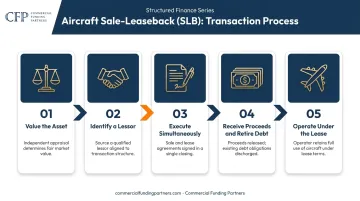
- Value the asset — The operator determines the aircraft's current market value and calculates built-up equity (market value minus any remaining debt)
- Identify a lessor — The operator approaches a lessor or financing partner and negotiates a sale price, ideally at or near current market value
- Execute simultaneously — The sale agreement and lease agreement close at the same time, establishing payment schedule, term, maintenance obligations, and return conditions
- Receive proceeds and retire debt — The operator receives the lump-sum payment, pays off any remaining aircraft financing, and retains the net cash
- Operate under the lease — Flight operations continue without interruption; the operator now pays rent instead of loan payments
The Equity Calculation
How much equity has been built determines what this transaction actually delivers. Take a straightforward example: an operator purchased an aircraft for $30 million, financed $25 million, and has paid the balance down to $12 million. If the aircraft's current market value is $28 million, the operator receives approximately $28 million in sale proceeds, retires the $12 million debt, and nets roughly $16 million in working capital.
The math breaks down when market value has eroded significantly or remaining debt is still close to the aircraft's current value. Thin equity transactions rarely justify the long-term cost of leasing.
Lease Terms and Maintenance Obligations
Once the equity case is confirmed, lease terms become the next negotiation — and they vary considerably based on aircraft type, lessor requirements, and the operator's fleet strategy. Southwest Airlines completed a 2024–2025 SLB of 36 Boeing 737-800s with lease terms ranging from just 26 to 37 months, well below the 7–10 year terms many operators expect.
Key lease provisions to negotiate include:
- Maintenance reserves — Calculated on flight hours, cycles, or calendar time; held by the lessor as a security buffer against maintenance exposure
- Return conditions — Specifies the aircraft's physical and maintenance status at lease end, covering parts replacement and records traceability
- Usage restrictions — Geographic limits, modification prohibitions, and utilization caps that can meaningfully constrain operational flexibility
Balance Sheet Treatment
The accounting treatment matters and is not uniform. Under ASC 842, if the leaseback qualifies as an operating lease and the sale meets control-transfer criteria, the operator derecognizes the aircraft, recognizes the sale result, and records a right-of-use (ROU) asset and lease liability. A finance leaseback under ASC 842 generally prevents sale accounting entirely.
IFRS 16 differs: a qualifying sale results in recognition of an ROU asset for only the retained right, with gain recognition limited to rights transferred. Either way, SLB does not automatically remove leverage from the balance sheet. Professional accounting guidance is essential before structuring the transaction.
Key Benefits of Aircraft Sale and Leaseback
Immediate Liquidity at Meaningful Scale
The numbers from documented transactions demonstrate what's possible. Spirit Airlines completed a 25-aircraft SLB in 2024, generating approximately $419 million in net cash and retiring roughly $465 million in aircraft debt. Southwest Airlines generated $815 million in cash proceeds from 20 aircraft SLBs in 2020, recording a $222 million gain on the transaction.
For middle-market operators, the scale is smaller but the strategic logic is identical: convert a fixed, illiquid asset into capital that can be deployed where it creates the most value — debt reduction, fleet reinvestment, or operational reserves during volatile periods.
Balance Sheet and Credit Profile Improvement
When sale accounting applies and the aircraft debt is retired, the transaction removes a heavily financed asset from the balance sheet. The practical effects often include:
- Lower total debt and improved debt-to-equity ratios
- Predictable, fixed lease payments replacing variable ownership costs
- Simpler cash flow forecasting compared to unscheduled maintenance and insurance cycles
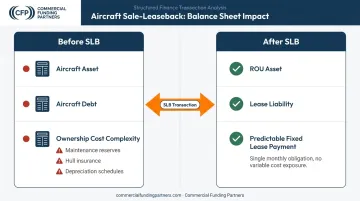
That said, lease liabilities recognized under modern accounting standards (IFRS 16 and ASC 842) do appear on the balance sheet. The improvement is real but depends on the transaction structure.
Transfer of Residual Value Risk
Once the aircraft is sold, the lessor bears the exposure to future depreciation in market value. Aircraft values can drop sharply and quickly — data from Collateral Verifications showed an average 11% decline in monitored aircraft values in just the first half of 2020, with significant variation by type. An operator whose core business is transportation, not asset speculation, has little reason to carry that exposure.
Access to Newer, More Efficient Aircraft
Offloading residual value risk is only part of the picture. SLB transactions can also facilitate active fleet modernization — an operator sells an aging aircraft, uses the proceeds to fund operations or acquisition costs, and structures subsequent leases on newer models. The fuel efficiency advantage is real: Airbus states the A320neo delivers at least 20% fuel and CO2 savings per seat versus its predecessor, and Boeing cites comparable improvements for the 737 MAX. The efficiency gains come from the aircraft technology itself. The SLB structure simply makes accessing that technology financially viable.
Potential Tax Advantages
In many U.S. jurisdictions, lease payments may be deductible as ordinary and necessary business expenses when the arrangement qualifies as a genuine lease. This can be more favorable than standard ownership depreciation schedules.
Tax outcomes vary significantly by jurisdiction, business structure, and how the IRS classifies the arrangement — lease versus conditional sale. Consult a qualified tax advisor before treating any tax benefit as a given.
Potential Drawbacks to Consider
No transaction structure is universally advantageous. The SLB trade-offs are real and worth modeling carefully.
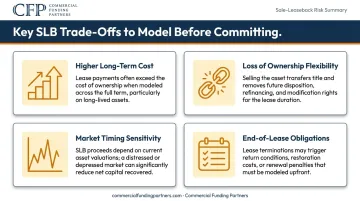
Higher total long-term cost. Cumulative lease payments over a multi-year term will, in most cases, exceed the cost of continued ownership. The SLB is a liquidity tool, not a cost-reduction tool. Leasing costs more over time. The real question is whether the immediate capital is worth that premium given the operator's specific situation.
Loss of ownership and operational flexibility. Once sold, the operator forfeits title and any future appreciation in the aircraft's value. Lease covenants typically govern geographic operation, maintenance standards, permitted modifications, and usage hours. Operators accustomed to full ownership flexibility sometimes find these constraints more limiting than anticipated.
Market timing sensitivity. An SLB executed during a depressed market yields lower proceeds. The early months of COVID-19 demonstrated this clearly. Aircraft values dropped materially, reducing or eliminating the liquidity advantage for operators who had no choice but to transact. The inverse holds in supply-constrained markets, where SLB pricing improves significantly.
End-of-lease obligations. Return conditions can generate substantial costs if the aircraft's maintenance status at lease end doesn't match contractual requirements. Operators need to plan for redelivery costs and fleet continuity well before the lease term expires.
Is an Aircraft Sale and Leaseback Right for Your Operation?
Before pursuing an SLB, work through these core questions honestly:
- Is there meaningful equity to unlock? If the aircraft's market value barely exceeds remaining debt, the net proceeds may not justify the transaction costs and long-term lease commitment.
- Is there a genuine capital need? SLB makes most sense when there's a specific, near-term use for the proceeds — debt reduction, fleet investment, expansion capital — not just as a general liquidity exercise.
- Can the operation commit to a multi-year lease? The lease term represents a real obligation. Operators with uncertain fleet strategies or volatile revenue profiles should model downside scenarios carefully.
- What are current market conditions for this aircraft type? Aircraft in strong demand generate better sale prices and more favorable lease terms.
Current Market Conditions Favor Sellers
The supply environment for commercial aircraft is constrained. Airbus delivered 766 aircraft in 2024 and ended the year with an 8,658-aircraft backlog. Boeing delivered just 348 aircraft in 2024, its lowest since the pandemic. Reuters reported that shortages have enabled some airlines to sell newly delivered aircraft to lessors for substantially more than the purchase price — directly strengthening SLB economics for operators with in-demand aircraft types.
For operators holding newer narrowbody jets in particular, this is an unusually favorable window — and timing matters when lease rates and sale prices are both moving in sellers' favor.
Working With CFP on an Aircraft SLB
Commercial Funding Partners (CFP) arranges sale-leaseback transactions for operators across transportation and related sectors, with deal sizes ranging from $250,000 to over $100 million. CFP's team evaluates transaction feasibility based on an operator's specific aircraft, capital objectives, and financial position — and responds to new inquiries within one business day. If an SLB fits your situation, you'll know quickly.
Frequently Asked Questions
What is aircraft sale and leaseback?
An aircraft sale and leaseback is a financial transaction where an aircraft owner sells the aircraft to a lessor and immediately leases it back under a negotiated agreement. The operator retains full use of the aircraft while converting the asset into liquid capital.
Why do airlines use aircraft sale and leaseback?
Airlines use SLBs primarily to unlock equity tied up in high-value aircraft, improve cash flow, and reduce balance sheet debt. This lets carriers access capital for operations or growth without grounding aircraft or disrupting schedules.
What types of aircraft qualify for a sale and leaseback?
Commercial jets, regional aircraft, and corporate aircraft can all qualify. Lessors evaluate market demand for the aircraft type, age, physical condition, maintenance status, and remaining useful life when determining whether a deal is viable.
What are the downsides of an aircraft sale and leaseback?
The operator loses ownership and any future appreciation in the aircraft's value. Total lease costs over the term typically exceed continued ownership costs, and lease agreements often impose operational restrictions on geography, modifications, and usage.
How long does an aircraft sale and leaseback lease typically last?
Lease terms vary considerably based on aircraft type, lessor requirements, and operator needs. Southwest's 2024–2025 SLB used terms of just 26–37 months, and longer multi-year terms are equally common.
What is the difference between an aircraft sale and leaseback and a traditional aircraft loan?
A traditional loan lets the operator retain ownership while financing the asset, with both the debt and the asset recorded on the balance sheet. A sale and leaseback transfers ownership entirely; when sale accounting applies, the asset and associated debt are removed from the balance sheet, replaced by an ROU asset and lease liability.