The answer affects more than monthly payments. It shapes your balance sheet under ASC 842, changes how you deduct expenses at tax time, and determines whether you'll own the asset when the term ends. Get it wrong, and you could face a front-loaded expense pattern you didn't budget for, or lose flexibility on equipment you'll want to upgrade in two years.
Commercial Funding Partners structures both finance (capital) and operating leases for businesses across the country, from $250,000 equipment purchases to $300 million capital projects. This guide breaks down exactly how these two lease types differ and how to figure out which one fits your business.
Key Takeaways
- Finance leases transfer ownership-like risks and rewards to you; operating leases work like rentals
- Under ASC 842, both types appear on the balance sheet — only expense recognition differs
- Choose based on ownership intent, cash flow, asset lifespan, and tax strategy
- A lease is a finance lease if it meets any one of five classification tests
Finance Lease vs Operating Lease: Quick Comparison
| Factor | Finance Lease | Operating Lease |
|---|---|---|
| Ownership & risk | Lessee assumes ownership-like risks/rewards; often ends in transfer or bargain purchase | Lessor retains ownership and associated risk throughout |
| Accounting (ASC 842) | ROU asset amortized separately from interest; front-loaded expense | Single straight-line lease expense; ROU asset still recorded |
| Tax treatment | Lessee may claim depreciation and interest deductions | Full lease payment generally deductible as an operating expense |
| Lease term | Long-term, covering most of the asset's useful life | Shorter term, more flexibility to upgrade or exit |
| End of term | Often ends in ownership transfer or buyout | Asset returned to lessor, no further obligation |
Before 2019, operating leases mostly stayed off the balance sheet entirely. That's no longer true.
The SEC once estimated that off-balance-sheet operating-lease commitments across active U.S. issuers could approach $1.25 trillion in undiscounted, noncancelable future payments. That scale of hidden liability helped push FASB to require ROU assets and lease liabilities for nearly every lease over 12 months.
That doesn't mean the two lease types look the same on your books today. It just means both now show up. What changes is how the expense flows through your income statement.
What is a Finance Lease?
A finance lease — called a "capital lease" before ASC 842 took effect — functions economically like a purchase. You're financing the use of an asset with the expectation that you'll eventually own it or use up nearly all of its useful life.
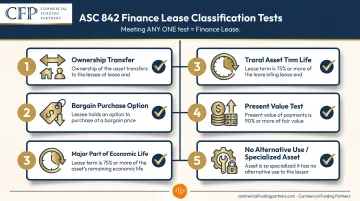
A lease qualifies as a finance lease if it meets any one of these five criteria:
- Ownership of the asset transfers to you by the end of the lease term
- The lease includes a purchase option you're reasonably certain to exercise (commonly called a bargain purchase option)
- The lease term covers a major part of the asset's remaining economic life (commonly treated as 75%+, though ASC 842 doesn't mandate a hard threshold)
- The present value of lease payments approximates the asset's fair value (commonly treated as 90%+)
- The asset is specialized enough that it would have no alternative use to the lessor once the term ends
Where Finance Leases Fit Best
Finance leases make the most sense for capital-intensive, long-life assets you intend to keep well past the initial term: manufacturing lines, heavy machinery, specialized production equipment, and aircraft.
Industries like manufacturing, construction, heavy equipment, and aviation rely on finance leases often. ELFA's 2024 survey data confirms transportation, construction, and industrial/manufacturing assets remain among the most heavily financed equipment categories nationally.
CFP structures several variations under this umbrella:
- Tax leases — structured for potential tax benefits, including deals like a $1.5 million, 48-month tax lease and an $8.5 million transaction split across seven tax-lease schedules
- Non-tax (capital) leases — built for ownership-oriented depreciation treatment, sometimes with a $1 buyout at term end
- Sale-leasebacks — sell owned equipment to CFP and lease it back immediately to free working capital; CFP has structured deals as large as a $36 million manufacturer recapitalization
One recent example: CFP arranged a $1,000,000 capital lease for a modular clean room for an aerospace and defense manufacturer in Michigan. The structure folded installation, mechanical, and electrical soft costs into the deal and set a clear path to full ownership.
What is an Operating Lease?
An operating lease works more like a long-term rental. The lessor keeps ownership of the asset throughout the lease term, and typically afterward. You pay for the use of the equipment, not the equipment itself.
That structure creates a few practical advantages:
- Lower upfront costs compared to financing a full purchase
- Easier upgrades, so you're not stuck with equipment that's becoming obsolete
- Simplified expense recognition with one straight-line lease cost instead of separate interest and amortization entries
CFP offers operating-lease variations built around those advantages. FMV (fair market value) leases keep the lessee's cost lower because the lessor expects to recover residual value through resale or re-lease. Master lease programs let a business add equipment under one umbrella agreement over time, rather than negotiating a fresh contract for every purchase.
ASC 842 did not leave operating leases off the balance sheet. You'll still record a right-of-use asset and lease liability. The difference from a finance lease shows up in how the expense hits your income statement, not whether the lease appears at all.
Where Operating Leases Fit Best
Operating leases suit fast-evolving technology, vehicles, seasonal equipment, and anything with a short useful life relative to your business cycle. Technology, retail, transportation fleets, and rental equipment companies rely on this structure often. ELFA's research on FMV lease structures points to reduced obsolescence exposure and more accurate budgeting as core reasons businesses choose this route.
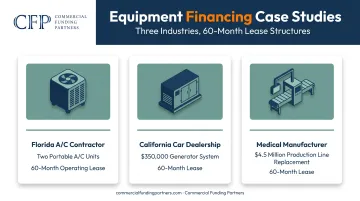
CFP client results show how this plays out in practice:
- A Florida A/C contractor used a 60-month operating lease for two portable units it had been renting at a steep cost, improving project margins immediately
- A California car dealership financed a $350,000 generator system on a 60-month operating lease and reported positive cash flow from day one
- A medical manufacturer replaced outdated production lines through a $4.5 million, 60-month operating lease
Which Lease Is Right for Your Business?
There's no universal answer. The right structure depends on four factors:
- Ownership intent — do you want to own the asset eventually, or just use it?
- Expense and payment pattern — can you absorb front-loaded interest and depreciation, or do you need level, predictable cost?
- Asset type and lifespan — is this a 20-year machine or a 3-year technology refresh?
- Tax strategy — would your business benefit more from depreciation and interest deductions, or from deducting the full lease payment?
Choose a finance lease if you're acquiring specialized, long-life equipment you intend to own outright once the term ends. Choose an operating lease if you need flexibility, lower upfront costs, and a way to avoid obsolescence on fast-changing assets.
Many middle-market and large businesses don't pick just one. They put core, long-life production equipment on finance leases and run seasonal or short-cycle assets (rental fleets, portable equipment, IT hardware) on operating leases.
That blend matches each asset's financing structure to its economic life instead of forcing every purchase into one model.
How Commercial Funding Partners Helps You Structure the Right Lease
CFP structures the full range of lease types — capital leases, operating leases, tax leases, FMV leases, master lease programs, and sale-leasebacks — around your specific equipment, cash flow, and tax objectives rather than pushing a one-size-fits-all product.
A few things set the process apart:
- Up to 100% financing on eligible project costs, including soft costs like installation, engineering, software, freight, and commissioning
- Custom amortization, including seasonal payment structures, step-up schedules, and interest-only periods during construction or installation
- A dedicated structuring specialist who responds within one business day to walk through finance vs. operating structures before you commit to either
In January 2026, CFP closed a $40 million, 36-month equipment lease for an Idaho-based manufacturer producing cell phone casings. The client's auditor mandated a specific lease rate, and the project carried a strict three-week funding deadline.
CFP accelerated underwriting and documentation to hit that window, coordinated vendor payments to keep the automation rollout on schedule, and structured the lease to meet the auditor's requirements without slowing the capacity expansion.
Getting the structure right before you sign means the right accounting treatment and a partner who can move at the speed your project demands.
If you're weighing a finance lease against an operating lease for an upcoming purchase, talk to CFP's team before you finalize the deal.
Conclusion
Neither lease type wins in every situation. A finance lease makes sense when ownership and tax depreciation matter more to your business than flexibility. An operating lease makes sense when lower upfront costs and the ability to walk away or upgrade matter more than eventual ownership.
The decision depends on your cash flow, your balance sheet, and how long you expect to use the equipment before it needs replacing. Working with an experienced equipment finance partner like CFP can simplify that structuring process, since the right answer often isn't obvious until someone walks through your specific numbers.
Frequently Asked Questions
How can I tell if a lease is an operating lease or a finance lease?
Under ASC 842, a lease is a finance lease if it meets any one of the five classification tests. If none apply, it is an operating lease. The tests cover ownership transfer, purchase options, lease term, payment present value, and alternative use.
What are the criteria for classifying a lease as a finance lease?
The five ASC 842 criteria are:
- Ownership transfers to the lessee by the end of the lease term
- A purchase option the lessee is reasonably certain to exercise
- Lease term covers a major part of the asset’s remaining economic life
- Present value of lease payments amounts to substantially all of the asset’s fair value
- The asset is so specialized the lessor has no alternative use at lease end
Is a capital lease the same as a finance lease?
Yes. "Capital lease" was the term used under the old ASC 840 standard. ASC 842 renamed it "finance lease," though the underlying concept and classification logic remain largely the same.
Which lease type offers better tax benefits?
Finance leases let you deduct depreciation and interest separately, while operating leases let you deduct the full lease payment as an operating expense. Which one benefits you more depends on your business's specific tax strategy and asset mix.
Do operating leases appear on the balance sheet under ASC 842?
Yes. Since ASC 842 took effect, operating leases longer than 12 months must be recorded as a right-of-use asset and lease liability on the balance sheet, unlike the largely off-balance-sheet treatment they received under the old ASC 840 standard.
Can a business switch from an operating lease to a finance lease mid-term?
Lease modifications can sometimes trigger reclassification, but it is not automatic. Confirm with your accountant or equipment finance partner before assuming an existing lease can be converted mid-term.