That's the backdrop. But most business owners don't want a lecture on macro conditions — they want to know if a sale-leaseback actually fits their situation. Does it make sense for a manufacturer sitting on $10 million in owned production equipment? A trucking company with a fleet that's fully paid off?
This article breaks down the real reasons companies pursue sale-leasebacks, where the trade-offs show up, and how to structure one so it pays off rather than becomes a long-term headache.
TL;DR
- Sell an owned asset, lease it back, and convert trapped equity into working capital without losing use of the asset.
- Unlock liquidity and keep operational control while avoiding many covenants tied to traditional term loans.
- Skip it for short-term needs, volatile asset values, or a pending business sale—the math shifts quickly.
- A strong structuring partner builds a lease around your cash flow instead of against it.
What Is a Sale-Leaseback (Brief Context)
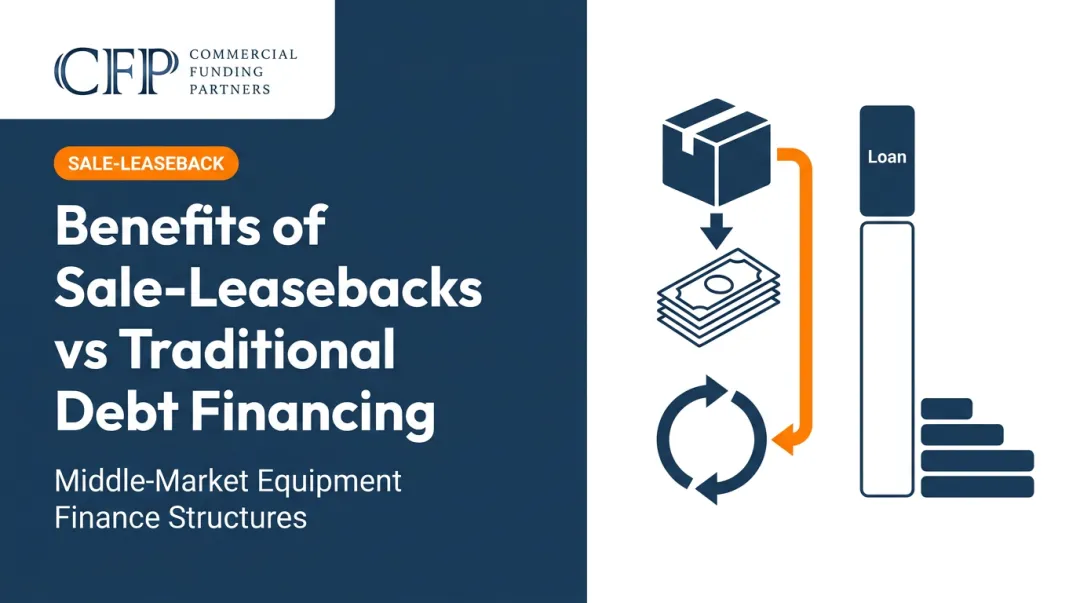
A sale-leaseback is a transaction where a company sells an asset it owns (a facility, production line, or fleet of trucks), then immediately leases it back to keep using it. Nothing changes operationally. The equipment stays on the floor. The trucks keep running routes.
It's used most often for:
- Commercial real estate and manufacturing facilities
- Heavy machinery and production equipment
- Fleet and transportation assets
A sale-leaseback isn't a distress signal. It's a deliberate capital allocation move that healthy, growing companies use to unlock equity sitting idle on the balance sheet.
Key Reasons Businesses Choose a Sale-Leaseback
The reasons below aren't abstract theory. They come down to liquidity, balance sheet health, and cost of capital. In practice, most companies pursuing a sale-leaseback are driven by two or three of these factors at once, not just one.

Reason 1: Convert Illiquid Assets Into Immediate Working Capital
Owned real estate or equipment sits on the balance sheet as a low-yielding asset. It's valuable, but it doesn't generate cash on its own. A sale-leaseback frees that trapped equity for redeployment, and proceeds typically go toward:
- Paying down higher-cost debt
- Funding expansion or new locations
- Purchasing additional equipment
- Bridging a working capital gap during growth
A negotiated asset sale can monetize equity differently than a collateral-backed loan. Traditional equipment or real estate financing usually caps how much of an asset's value a lender will advance.
A sale-leaseback is priced against the full appraised value of the asset, which is why companies use it when they need more liquidity than a loan against the same asset would provide.
KPIs impacted: cash position, liquidity ratios, return on capital reinvested.
This matters most in capital-intensive industries such as manufacturing, transportation, and healthcare, where equipment and facilities eat up a large share of total assets but generate a lower return than the core business itself.
CFP has seen this play out directly:
- A $36 million manufacturer recapitalization unlocked liquidity in under three weeks through a facility-level collateral review
- A masonry contractor converted $6 million in existing equipment into working capital in under 30 days
Reason 2: Maintain Full Operational Control Without Ownership
Here's what surprises a lot of owners: the leaseback doesn't change how the business runs. Structures like capital leases, FMV leases, or triple-net arrangements are written so the seller keeps the same day-to-day control, maintenance responsibility, and usage rights it had as the owner.
This avoids the disruption that comes with other financing paths: relocating a facility, renegotiating access to a production line, or interrupting service to customers mid-contract.
KPIs impacted: operational uptime, production continuity, customer service levels.
This is most critical for mission-critical assets: anything where a disruption to use would directly hit revenue.
A CNC and robotics sale-leaseback CFP structured for a manufacturer supported a 38% increase in production capacity, precisely because the equipment never stopped running during the transaction.
Reason 3: Strengthen the Balance Sheet and Avoid Restrictive Covenants
Traditional term loans come with financial covenants, balloon payments, and refinancing risk tied to rate cycles. Sale-leasebacks are structured differently, and lease payments can often be treated as an operating expense rather than debt service.
There's a tax angle too. Rent on a true lease can be more fully deductible than interest, which is subject to limits. Under Section 163(j), U.S. companies generally can't deduct business interest beyond 30% of adjusted taxable income, a cap that doesn't apply to rent payments in the same way.
KPIs impacted: debt-to-equity ratio, net leverage, cost of capital, tax liability.
A word of caution: rating agencies increasingly treat lease liabilities as debt-like when calculating leverage, so a sale-leaseback isn't automatic covenant relief. Model it against your specific loan agreements.
This matters most when you are preparing to refinance, planning a capital raise, or operating under lender covenants that restrict new borrowing.
When a Sale-Leaseback May Not Be the Right Fit
Sale-leasebacks solve real problems, but they're not universal. A few situations where the trade-offs cut the other way:
- You give up future appreciation. Once you sell, any upside in the asset's value belongs to the buyer—worth weighing for equipment in rising markets.
- You trigger a taxable event. The sale generally recognizes gain (amount realized vs. adjusted basis), and depreciation recapture can make part of it ordinary income. Model the after-tax impact with your tax advisor before you sign.
- You lose flexibility. A multi-year lease is harder to exit early than ownership. That's a poor fit for non-core assets near end of life, or if you plan to sell the business soon.
How to Get the Most Value From a Sale-Leaseback
The value of a sale-leaseback depends almost entirely on how it's structured, not just whether you do one. A few things to get right:
- Match payments to actual cash flow. Step-up, seasonal, or deferred-principal terms often beat a flat lease. CFP built a $100 million sale-leaseback with 12 months interest-only, then a three-year step-up timed to the client's cash-flow recovery.
- Bring in your CPA early. Lease treatment and depreciation strategy depend on your tax position, and the structure needs to be built around that, not adjusted afterward.
- Negotiate renewal and escalation terms upfront. Know what happens at lease end (buyback, extension, or upgrade options) before you sign, not when the term expires.
- Work with a lender that structures these regularly. Choose a partner that does capital, FMV, and master lease sale-leasebacks often—and can fund up to 100% of eligible costs. CFP handles transactions from $250,000 to $300 million and will re-underwrite a declined or poorly priced deal at no cost through its Second Opinion Review™.

Getting this right from the start avoids the common trap: a lease that solves today's liquidity problem but creates a cash-flow mismatch three years down the road.
Conclusion
The real value of a sale-leaseback is the combination of immediate liquidity, retained operational control, and a balance sheet free of new loan covenants. Those advantages compound when the lease is structured correctly from day one, not patched together after the fact.
If you're sitting on owned equipment and wondering whether that equity should be working harder, get a professional assessment before deciding. A no-obligation structuring review, like the one CFP offers, can tell you within days whether a sale-leaseback fits your capital strategy or whether another structure serves you better.
Frequently Asked Questions
What are the accounting implications of a sale-leaseback?
The deal must first qualify as a "sale" under current accounting standards. If it does, you generally recognize gain or loss upfront and record the leaseback as a new lease liability and right-of-use asset—confirm the treatment with your accountant, since the rules are highly fact-specific.
Is a sale-leaseback considered debt or a loan?
No. It raises capital through an asset sale rather than a loan. The lease obligation still appears on your balance sheet, but it is not structured or underwritten like traditional debt.
What types of assets qualify for a sale-leaseback?
Heavy machinery, manufacturing equipment, production lines, and fleet vehicles are common candidates, along with commercial real estate. The asset generally needs meaningful equity and should remain essential to daily operations.
How long is a typical sale-leaseback lease term?
Terms vary by asset. Equipment sale-leasebacks often run 3 to 7 years, while commercial real estate deals commonly run 15 to 20 years or more, often with renewal options.
Does a sale-leaseback affect my ability to borrow in the future?
Usually it helps. By improving cash and, in some structures, reported leverage, a well-structured sale-leaseback often supports future borrowing capacity rather than limiting it.
Can a sale-leaseback be used for equipment as well as real estate?
Yes. Companies regularly use sale-leasebacks on equipment they already own and still need to operate, unlocking cash without interrupting production across capital-intensive industries.