Equipment collateral loans solve this problem directly. Instead of giving up equity or relying on unsecured debt with steep rates, you pledge machinery, vehicles, or other business assets you own (or are buying) to secure better financing terms.
This guide covers how these loans actually work, what equipment qualifies, the real benefits, what lenders look for during approval, and how to pick a financing partner suited to your deal size — whether that's $250,000 or $250 million.
Key Takeaways
- Equipment collateral loans use machinery as security, unlocking lower rates than unsecured financing
- Both new purchases and already-owned, unencumbered equipment can serve as collateral
- Approval standards are more flexible than unsecured loans since the equipment reduces lender risk
- Deal size matters: community banks and small lenders cap out early, while larger projects need institutional capital
What Is an Equipment Collateral Loan?
An equipment collateral loan is financing secured by a lien on business equipment. If you default, the lender has the legal right to repossess and sell that asset to recover its money. That security is the entire reason these loans exist, and it's why they tend to come with better terms than unsecured alternatives.
There are two common structures:
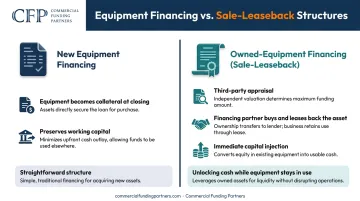
- New equipment financing: you're buying a piece of equipment, and it becomes the collateral the moment the deal closes.
- Owned-equipment financing: you already own equipment free and clear (or with substantial equity) and pledge it for working capital or expansion funding. This often takes the form of a sale-leaseback, where a financing partner buys the asset and leases it back to you, turning a fixed asset into cash while you keep using it.
This isn't a niche financing tool. The equipment finance industry saw 3.1% growth in new business volume during 2024, continuing a run that's made it a $1.3 trillion sector in the U.S. alone, according to the Equipment Leasing and Finance Association.
Why Collateral Changes the Math
Pledging a tangible asset shifts risk away from the lender. If something goes wrong, there's a recoverable asset behind the debt, not just a promise to repay. That reduced risk typically translates into:
- Lower interest rates than unsecured business loans
- Longer repayment terms
- Higher approval odds, especially for businesses with thinner credit files
This model scales remarkably well. The same basic structure that finances a $30,000 forklift also finances a $40 million automation line; the underwriting gets more complex, but the core mechanics stay the same. That scalability matters later when you're choosing which lender fits your deal.
How the Loan Process Works
Loan-to-Value (LTV) and What It Means for Your Borrowing Power
Lenders don't typically finance 100% of an asset's value on a straight loan — they lend against a percentage of it, known as loan-to-value. New equipment generally supports higher LTVs than used equipment because there's less uncertainty about condition and remaining useful life. Age, physical condition, and how deep the resale market is for that specific asset type all affect where a lender lands on the percentage they'll offer.
Technology equipment is a good example of why this matters. Because it depreciates fast and cycles through refresh periods quickly, lenders build obsolescence risk directly into their valuation. A two-year-old server rack might carry a lower LTV than a five-year-old forklift, simply because the resale market for the forklift is deeper and more predictable.
A simple illustrative example (hypothetical, not an industry benchmark):
| Step | Example Figure |
|---|---|
| Appraised equipment value | $200,000 |
| Lender's LTV offer | 80% |
| Loan amount | $160,000 |
| Term | 60 months |
| Estimated monthly payment (illustrative rate) | Roughly $3,000–$3,300 |
Your actual numbers will depend on your credit profile, the specific asset, and the lender's underwriting. This table is just meant to show how the math flows, not to promise a rate.
From Application to Funding
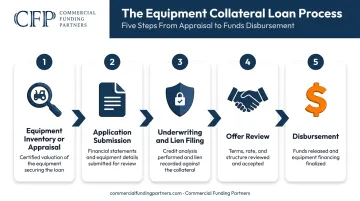
Once you know how LTV shapes your loan amount, the next question is how fast that number turns into funded cash. The general path looks like this:
- Equipment inventory or appraisal: the asset (or assets) gets valued, either through an invoice for new equipment or a third-party appraisal for owned equipment.
- Application submission: you provide business financials, equipment documentation, and basic company information.
- Underwriting and lien filing: the lender reviews credit, cash flow, and collateral quality, then files a UCC lien against the equipment.
- Offer review: you get a term sheet outlining rate, term, and structure.
- Disbursement: funds are released or the vendor is paid directly.
Secured equipment loans generally move faster than unsecured financing or SBA-backed loans, largely because the collateral simplifies part of the risk assessment lenders would otherwise need to do manually.
Types of Equipment That Qualify as Collateral
Almost any equipment with a verifiable resale value can serve as collateral. The categories that come up most often for growing businesses include:
- Construction and heavy machinery — excavators, cranes, loaders
- Manufacturing and production equipment — CNC machines, robotic welding systems, packaging lines
- Medical and healthcare devices — imaging systems, diagnostic equipment, surgical technology
- Transportation and fleet vehicles — trucks, trailers, specialized vehicles
- Technology and automation systems — servers, control systems, industrial automation
Regardless of category, lenders evaluate the same core factors:
- Resale value — what could this asset realistically sell for today?
- Physical condition — has it been maintained, or run into the ground?
- Age — how much useful life is left?
- Secondary market depth — is there an active market of buyers for this exact type of asset, or is it so specialized it would be hard to move?
Assets like wheel loaders, trailers, and forklifts tend to be easier to finance because they're commodity-like and trade readily in secondary markets. Integrated manufacturing systems can be trickier — they might be fully productive for the business but genuinely hard to resell if repossessed, since they're often built for one specific process.
Both newly purchased equipment and equipment you already own across any of these categories can typically serve as collateral, not just fresh purchases.
Key Benefits of Using Equipment as Collateral
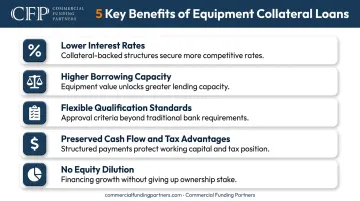
Lower interest rates. Because the lender has a recoverable asset backing the loan, pricing generally reflects that reduced risk, often meaningfully better than what you'd see on unsecured business debt.
Higher borrowing capacity. Loan amounts scale with equipment value rather than being capped by a generic credit limit. Some equipment lenders, including flexible structured finance providers like Commercial Funding Partners, can finance up to 100% of eligible project costs on qualifying deals, preserving cash you'd otherwise need to put down.
More flexible qualification standards. Collateral can offset a shorter operating history or a weaker credit profile that might otherwise sink an unsecured application. The asset itself does some of the heavy lifting in the lender's risk calculation.
Preserved cash flow and potential tax advantages. Rather than paying cash upfront, you keep working capital available for payroll, inventory, or other needs. Depending on how the deal is structured, there can be tax benefits too:
- Section 179 lets businesses deduct the full cost of qualifying equipment in the year it's placed in service, up to $2,560,000 for tax years beginning in 2026, phasing out once purchases exceed $4,090,000, per current IRS guidance.
- True lease payments (where the lender retains title) are often deductible as ordinary business expenses.
- Talk to your accountant before assuming a specific deduction applies; structure matters here.
No equity dilution. You keep full ownership of your company. The lender has a claim on the equipment, not on your cap table, and you keep using the asset throughout the loan term.
Qualification Requirements: Credit Score, Revenue, and Approval Odds
Credit Score Expectations
Most equipment-collateral lenders work with personal credit scores somewhere in the 550 to 650-plus range, though this varies by lender and deal size. A stronger score generally unlocks better pricing, but it's rarely a hard cutoff the way it can be with unsecured lending — the equipment itself does real work in offsetting a thinner credit file.
Business History and Revenue
Lenders typically want to see:
- Time in business (often at least a year or two, though this shifts by lender)
- Consistent monthly or annual revenue
- Bank statements showing cash flow stability
A business with strong equipment value and clean documentation can often offset a shorter track record or softer financials than an unsecured lender would tolerate.
Documentation Lenders Require
Lenders also verify the equipment itself. Expect to provide:
- Clear title or proof of ownership
- Appraisal (for owned equipment) or invoice (for new purchases)
- Maintenance records
- Proof of insurance
These records shorten underwriting time.
How Hard Is Approval, Really?
Equipment-collateral loans have historically higher approval odds than unsecured financing, simply because the asset absorbs some of the lender's downside risk.
For context on business financing broadly, the 2026 Federal Reserve Report on Employer Firms found that 42% of applicants received all the funding they requested, 36% received some or most, and 22% received none. Small banks approved 57% of applicants in full.
Those figures cover all financing types, not equipment-secured loans specifically, but they illustrate how much approval odds vary by lender type and structure. Collateral tends to move the odds in your favor.
At six, seven, or eight figures, underwriting expands. Lenders start looking at project scope, cash flow projections, and industry-specific risk factors, not just the credit score and the invoice. This is exactly where lender fit starts to matter more than qualification checkboxes.
At CFP, underwriting looks at business financials and project viability alongside collateral value, not just a credit-score cutoff.
Choosing the Right Equipment Financing Partner
Not every equipment lender is built for the same deal size. Community banks and small online lenders often do fine with straightforward, smaller-ticket transactions, but they can hit a ceiling fast when a project gets complex, specialized, or simply large.
A $9 million transaction, for instance, might be well within one bank's comfort zone and completely outside another's: it depends entirely on that institution's balance sheet and risk appetite.
Businesses with larger, more complex, or specialized equipment needs generally do better with a partner that has institutional capital behind it.
Commercial Funding Partners is a direct lender and institutional capital source built for exactly that gap. CFP structures equipment financing from $250,000 to $300 million, with flexible lease options including capital, operating, FMV, and sale-leaseback structures.

That includes senior finance professionals who respond quickly and handle each request personally, rather than routing you through a call center.
A few things worth knowing:
- CFP's Second Opinion Review™ offers a free, no-obligation re-underwriting for businesses whose equipment financing request was declined or priced poorly elsewhere.
- The firm works across manufacturing, construction, medical, transportation, and energy, among other sectors, matching payment structures to actual project cash flow rather than forcing every deal into the same template.
- Structuring specialists respond within one business day, with same-day preliminary reviews available for vendor partners.
When you're evaluating any potential lender, look for:
- Transparency: do they explain terms clearly, or bury the details?
- Industry experience: have they actually financed equipment like yours before?
- Willingness to structure around your cash flow: a rigid, one-size-fits-all payment schedule is a red flag for anything beyond a simple, small deal.
Frequently Asked Questions
Can equipment be used as collateral for a loan?
Yes. Both new and already-owned equipment with clear title and verifiable value can secure a loan. The lender places a lien on the asset until the debt is fully repaid.
What credit score is needed for an equipment loan?
For transactions in CFP's typical range, underwriting weighs business financials, time in operation, and cash flow more heavily than a single personal credit score. Strong equipment value and consistent revenue can offset a lower credit profile.
How hard is it to get an equipment loan?
Generally easier than unsecured financing, since the equipment itself reduces the lender's risk. Larger or more specialized deals involve deeper underwriting, but approval odds still tend to favor secured borrowers.
What is the monthly payment on a $250,000 equipment loan?
It depends on rate, term, and any down payment. As a rough illustration, a 60-month term might run somewhere around $5,000–$5,300 per month at common secured commercial rates. Get an actual quote before relying on any estimate.
Can I use equipment I already own as collateral, or only new purchases?
Existing equipment with clear title or substantial equity can typically be pledged, often through a sale-leaseback structure. It's not limited to new purchases.
What happens if I default on an equipment collateral loan?
The lender can repossess and sell the equipment to recover the balance owed. If the sale doesn't cover the full debt, you may still owe the shortfall. That's why matching repayment terms to your actual cash flow matters from day one.