No-money-down equipment financing solves that specific problem: it lets you acquire equipment now while spreading 100% of the cost, sometimes soft costs included, into structured payments. This article covers how it works, what it costs, who qualifies, and how to pick the right lending partner.
Commercial Funding Partners (CFP) is a direct lender financing up to 100% of eligible project costs on transactions from $250,000 to $300 million, working with middle-market and enterprise businesses across North America.
Key Takeaways
- Zero-down financing preserves working capital, often in exchange for higher payments or tighter underwriting
- Well-qualified borrowers can finance up to 100% of equipment cost, including soft costs like installation and freight
- Lease type, term, and payment design change total cost and end-of-term options—compare structures, not just rate
- CFP's Second Opinion Review™ re-underwrites deals that were declined or underpriced elsewhere, at no cost
What Is No Money Down Equipment Financing?
Instead of paying a deposit before delivery, you roll the full equipment cost into your monthly, quarterly, or seasonal payment schedule. You get the asset working now; the lender recovers its investment over the loan or lease term.
Loans vs. leases matter here. A few common structures:
- Equipment loan — you hold title immediately; the lender takes a security interest
- Capital/finance lease — structured like ownership, often with a $1 buyout at term end
- Operating or FMV lease — lower monthly commitment; you return, renew, or buy at fair market value
- Sale-leaseback — you sell owned equipment to a lender and lease it back, freeing up cash while keeping the asset in use
Each treats ownership, tax deductions, and balance-sheet accounting differently under ASC 842's lease classification rules.

Payment Structure Is Not Automatic Approval
"No money down" describes payment mechanics, not automatic approval. Lenders still evaluate creditworthiness, collateral quality, and cash flow before extending 100% financing. Weak financials or unproven equipment resale value can still trigger a down-payment requirement.
Specialized lenders can still fund 100% when credit and collateral support it. CFP finances up to 100% of eligible project costs on deals from $250,000 to $300 million, including non-admitted assets many banks won't book: software licenses, engineering services, controls integration, freight, commissioning, and training.
In one $20 million manufacturing automation expansion, CFP structured a 36-month facility covering equipment, installation, software, and integration. Vendor milestone payments tracked project progress instead of a single lump-sum disbursement.
Advantages of $0-Down Equipment Financing for Businesses
The core benefit is simple: cash stays in your business instead of sitting in a vendor's account before the equipment even arrives.
- Preserves liquidity for payroll, inventory, and growth opportunities
- Speeds deployment — equipment starts generating revenue before a major cash outlay
- Builds credit history through consistent, on-time payments
- Covers soft costs that would otherwise come out of working capital
Financing equipment is now the norm, not the exception. According to the Equipment Leasing & Finance Foundation's 2024 Horizon Report, 82% of businesses that acquired equipment or software in 2023 used at least one financing method.
Roughly 57.7% of all U.S. equipment and software investment was financed rather than purchased outright.

That preference for financing shows up in real deals when a large down payment would otherwise drain reserves. For example, a Florida medical-device manufacturer faced an urgent 50% down-payment demand from its equipment vendor. CFP advanced funds directly to the vendor and secured approval in two business days, letting the client acquire the machinery without touching cash reserves.
The Trade-Offs You Need to Understand Before Signing
Zero down doesn't mean zero cost. Removing the upfront payment typically shifts risk elsewhere in the deal.
Common trade-offs:
- Higher monthly payments — the full asset value gets financed, so payments run higher than a deal with 20% down
- Longer terms — lenders may extend duration to keep payments manageable
- Tighter credit requirements — stronger financials are often expected to offset the lack of equity in the deal
Those trade-offs show up most clearly in pricing. On middle-market and large-ticket equipment deals, rate depends on credit profile, collateral, industry risk, and deal structure—not a published rate card.
Industry data points the same way. The 2024 Survey of Equipment Finance Activity found new business volume grew 3.1% industry-wide even as approval and booking rates tightened, a sign of more cautious underwriting according to ELFA's equipment finance industry report.
Watch for Hidden Costs
Before signing anything, ask about:
- Balloon payments due at term end
- Origination fees baked into the deal
- Prepayment penalties if you want to pay off early
- End-of-term obligations — return conditions, buyout pricing, or renewal terms
Request a full amortization schedule and total cost of ownership summary from any lender before you commit. If a lender hesitates to provide one, that's a red flag worth noting.

How to Qualify for No Money Down Equipment Financing
There's no universal FICO cutoff for large-ticket equipment financing. Lenders evaluate the whole picture instead.
Underwriters typically look at:
- Personal and business credit history
- Time in business and industry experience
- Annual revenue and cash flow strength
- Debt-service coverage and existing leverage
- Equipment type and resale value—brand-name assets with active secondary markets usually qualify more easily
Stronger results across these factors make 100% financing—and true no-money-down structures—more achievable.
For larger transactions, a single credit score rarely tells the full story. CFP's underwriting weighs project cash flow alongside credit and can structure milestone, progress-payment, or deferred-principal terms rather than forcing every deal into the same repayment mold.
In one $20 million automation project, CFP built a flexible funding schedule tied to vendor milestones. Accelerated vendor payments kept the project moving instead of waiting for full delivery before funding began.

Which Businesses and Industries Benefit Most
Equipment financing fits best where equipment directly drives revenue and delays are expensive.
| Industry | Why it fits | Financing propensity |
|---|---|---|
| Construction | Project timelines demand fast equipment deployment | 85% finance rather than buy outright [1] |
| Healthcare | Diagnostic equipment is capital-intensive and revenue-generating | 70% financing propensity [1] |
| Agriculture | Seasonal cash flow needs payment flexibility | 19.5% of 2024 surveyed volume |
| Manufacturing | Automation and modernization projects are often multimillion-dollar | Top financed asset category |
| Transportation | Fleet assets have strong resale value | Top financed asset type |
Businesses scaling quickly, completing acquisitions, or automating production lines benefit most from preserving capital rather than tying it up in a down payment.
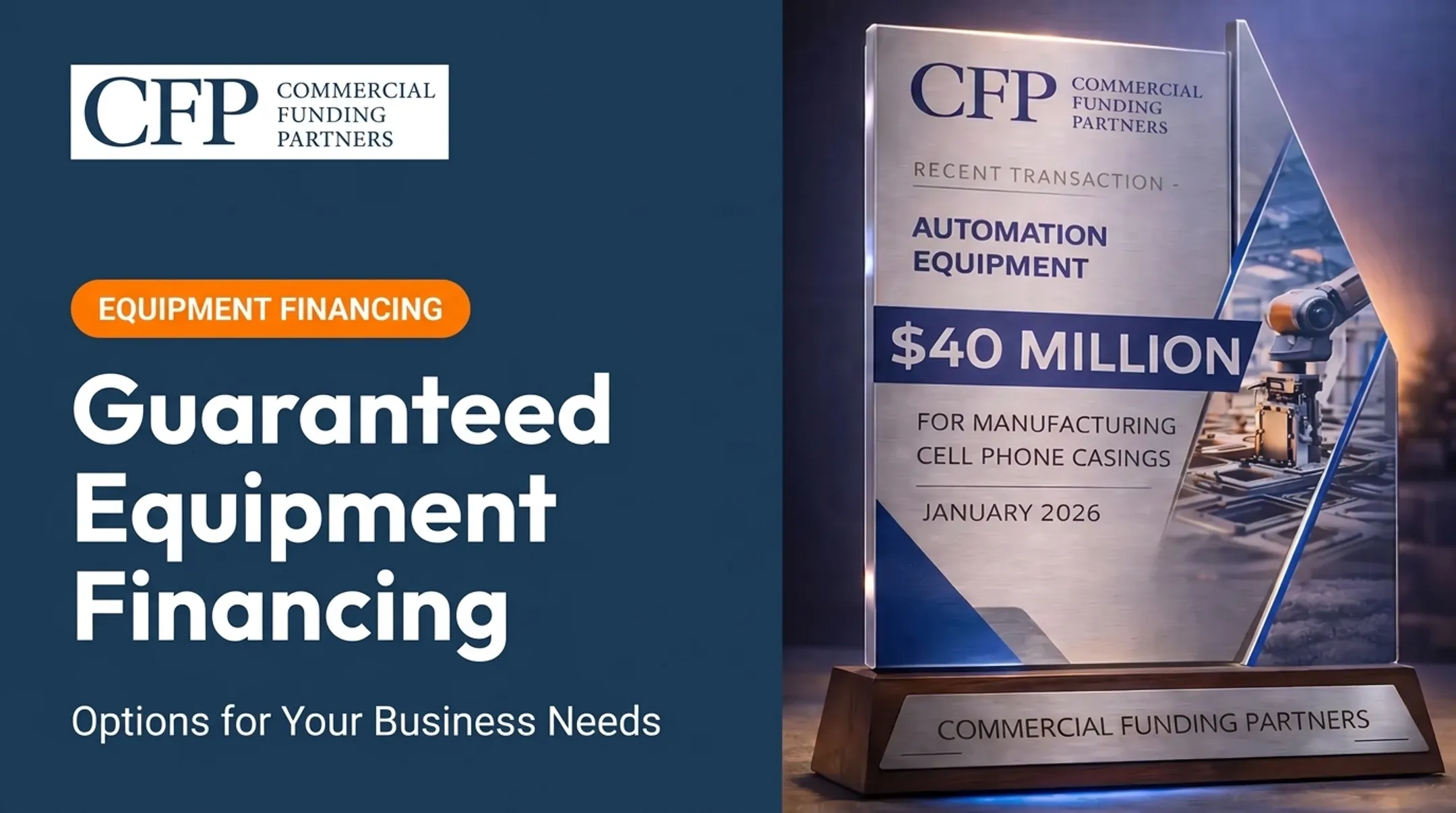
A January 2026 example shows why speed matters: an Idaho technology manufacturer needed a $40 million, 36-month equipment lease for robotic manufacturing systems. Vendors required payment within three weeks. Traditional banks couldn't meet that timing or the lease-rate structure the client's auditor required. CFP coordinated underwriting, documentation, and vendor payments to keep the project on schedule.
Middle-market and larger companies pursuing complex equipment projects often need a financing partner that goes beyond a standard bank credit box. CFP's role as a bank overflow resource fills that gap. Banks frequently decline or refer viable deals when equipment is specialized or imported, the project needs progress payments, or leverage exceeds internal policy limits.

How to Choose the Right Equipment Financing Partner
Not every lender structures deals the same way. Before signing, compare:
- Transparency: are rates, fees, and total cost clearly disclosed upfront?
- Funding speed: how quickly can they move once documentation is in?
- Soft-cost coverage: will they finance installation, freight, and software, or only the equipment itself?
- Repayment flexibility: can they offer seasonal, step-up, or deferred-principal schedules matched to your cash flow?
Check industry reputation and whether the lender has direct experience with your specific equipment category. A lender who understands CNC machinery underwriting isn't necessarily equipped to price a data center buildout.
Ask directly about flexible structures, response times, and whether they will re-underwrite a deal another lender declined or poorly priced. CFP's structuring specialists respond within one business day, and its Second Opinion Review™ is a free, no-obligation second look at those projects.
Frequently Asked Questions
Can I get a loan against my equipment?
Yes. Owned equipment can secure a sale-leaseback or refinance so you unlock cash and keep using the asset. CFP has structured deals from $650,000 mobile MRI units to $36 million manufacturing recapitalizations.
What is the difference between an equipment loan and an equipment lease?
A loan gives you immediate ownership with a security interest held by the lender. A lease typically involves lower monthly payments, with end-of-term options to return, renew, or purchase the equipment at fair market value.
Does no money down mean no credit check?
No. Approval still requires a full credit and financial review, even without a down payment. Lenders assess creditworthiness and cash flow to offset the added risk of financing 100% of the cost.
What credit score is needed for zero-down equipment financing?
There's no universal minimum score, especially for larger transactions. Complex or multimillion-dollar projects are evaluated holistically, factoring in cash flow, collateral, and industry experience rather than credit score alone.
Can startups get no money down equipment financing?
Early-stage firms may qualify with strong personal credit or a guarantor, but deals need established financials as size grows. CFP’s floor is $250,000 per transaction, not a set revenue minimum.
How fast can equipment financing be approved?
Small-ticket deals can be approved in days. Larger, complex projects need more thorough structuring, though CFP has closed transactions like a $300,000 tax lease in two business days when timing was critical.