Financing removes that barrier. Instead of draining cash reserves, businesses can spread costs over time while the system pays for itself through lower utility bills. Commercial solar installations totaled 523 MWdc in Q1 2026 alone, per SEIA — proof that businesses across the country are finding ways to fund these projects without waiting for a cash windfall.
This guide breaks down the financing paths available today, from traditional loans to equipment leasing, so you can pick the structure that fits your tax position and cash flow.
TL;DR
- You can fund commercial solar without paying cash upfront via loans, leases, PPAs, C-PACE, or equipment financing
- The right choice depends on your ownership goals, tax appetite, credit profile, and cash flow
- Equipment financing fits teams that want to own large systems while keeping working capital free
- Compare rates, terms, fees, and speed to funding before you sign
Overview of Solar Panel Financing in the US Business Market
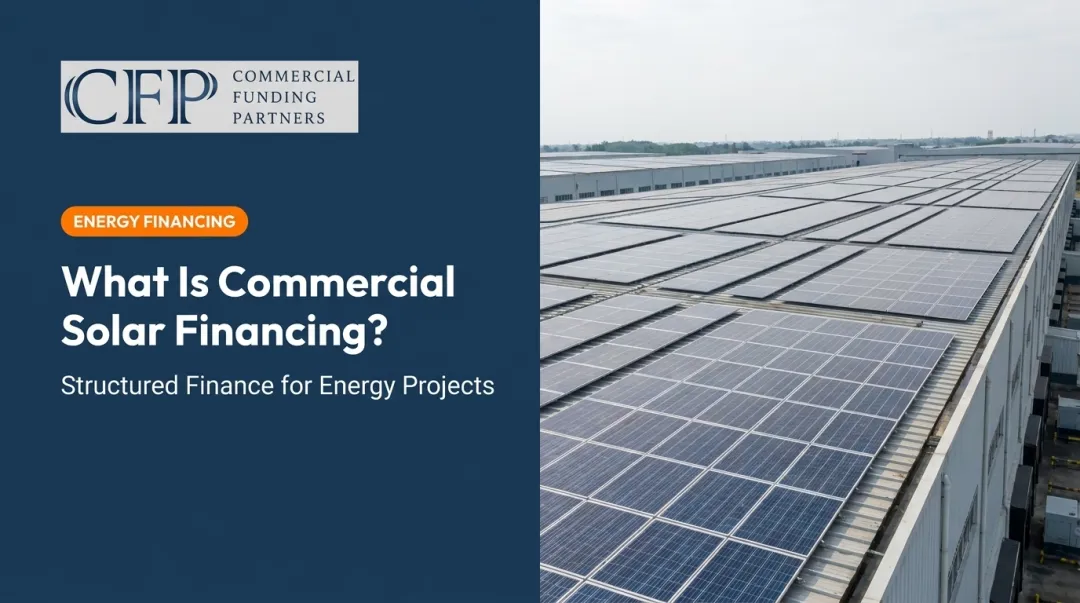
Commercial solar financing is the set of funding structures that let businesses install solar without paying the full cost in cash. Commercial systems often cost anywhere from $250,000 to several million dollars, so financing is the realistic path for most companies.
Below, we cover the main financing routes available to US businesses right now: equipment financing and leasing, solar loans, PPAs, solar leases, and C-PACE.
Top Solar Panel Financing Options for US Businesses
When comparing options, weigh four things: flexibility, ownership benefits, cost structure, and how fast you can get funded. Here's how the major paths stack up.
Commercial Funding Partners (CFP) – Equipment Financing & Leasing
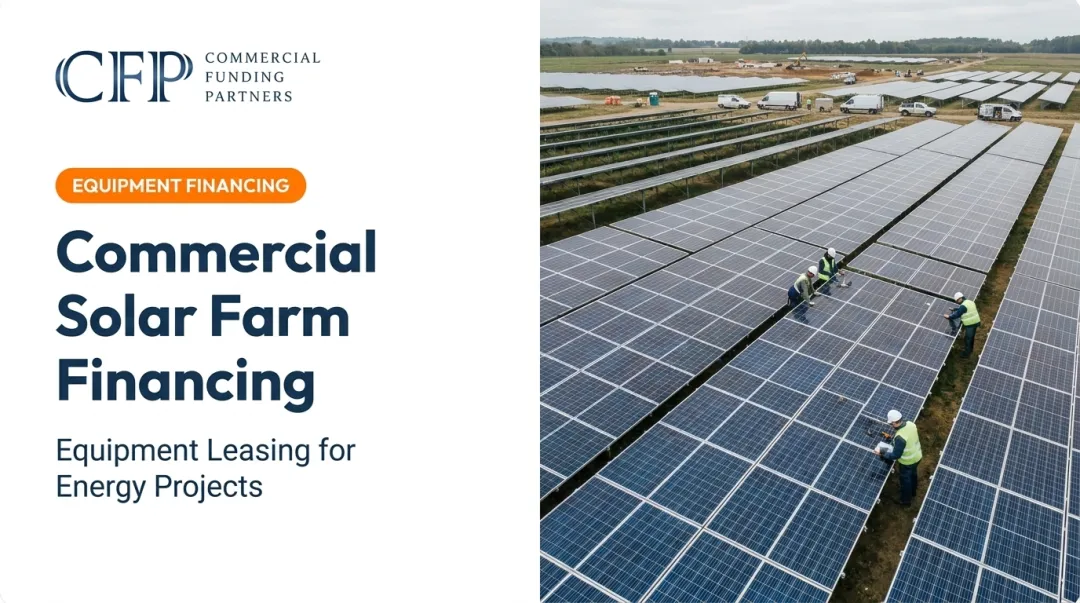
CFP is an independent direct lender specializing in large-scale equipment financing, including solar and energy storage systems, with deals ranging from $250,000 to $300 million-plus. The firm has funded a $6 million solar farm financing for a US solar developer that leases energy directly to consumers and municipal governments, helping the company deploy capital faster and scale operations. What sets CFP apart:
- Finances up to 100% of eligible project costs, preserving cash for other business needs
- Offers flexible lease structures — FMV, capital, and sale-leaseback — tailored to tax and accounting goals
- Matches payments to project cash flow with seasonal, step-up, or deferred-principal schedules
- Structuring specialists typically respond within one business day
Financing Type Funding Range Key Advantage Equipment Lease/Loan $250K–$300M+ Preserves cash, potential tax write-offs, custom amortization CFP also runs a Second Opinion Review, a free re-underwriting for projects that were declined or priced unfavorably elsewhere — a useful backstop if a bank turned down your solar request.

Solar Loans (Banks, Credit Unions, SBA & USDA REAP)
Traditional and government-backed loans let a business own its system immediately while paying it off over time. Because the business owns the asset from day one, it keeps every available tax benefit.
- Full eligibility for the federal Investment Tax Credit and depreciation
- USDA REAP grants ($2,500–$1M) cover up to 50% of eligible costs for rural small businesses and ag operations, per USDA
- REAP-guaranteed loans: terms up to 40 years with an 80% guarantee (up to 75% coverage when stacked with a grant)
Factor Detail Ownership Business owns system Tax Benefits Full ITC and depreciation eligibility Best For Businesses with strong credit and tax appetite Note: REAP grant applications aren't currently being accepted, though guaranteed-loan applications are still open.
Power Purchase Agreements (PPAs)
Under a PPA, a third-party developer designs, installs, and owns the system. The business simply buys the electricity it generates, often at a rate below the local utility's retail price. SEIA notes contracts typically run 10 to 25 years, with a fixed escalator often raising the rate 2%–5% annually.
| Factor | Detail |
|---|---|
| Upfront Cost | $0 |
| Ownership | Third-party |
| Best For | Businesses without tax liability or capital |
| This structure works especially well for municipalities and nonprofits that can't use tax credits directly — the developer captures those benefits instead. |
Solar Leases (Capital & Operating)
With a solar lease, a business pays a fixed monthly fee to use a system it doesn't own. Under ASC 842, leases classify as operating or finance (capital) leases based on ownership transfer, purchase options, and asset life, according to Plante Moran.
- Operating leases keep maintenance responsibility with the lessor
- Capital leases can transfer some ownership-like benefits to the business
Factor Detail Monthly Cost Fixed fee Maintenance Lessor (operating lease) Best For Businesses prioritizing predictable expenses
Commercial PACE (C-PACE) Financing
C-PACE financing gets repaid through a property tax assessment rather than a traditional loan payment. PACE-enabling legislation exists in 40 states plus D.C., with active programs running in 36 states plus D.C., per PACENation. Terms can run 10-30 years, and the debt stays with the property rather than the business.
| Factor | Detail |
|---|---|
| Repayment | Annual property tax assessment |
| Eligibility | Property-based, not credit-based |
| Best For | Businesses with limited credit history |
| One caveat: C-PACE still requires an approved program in your county and lender-specific underwriting. It's not a credit-free option, just a differently secured one. |

How We Chose the Best Financing Options
We evaluated each option against how it actually affects a business's bottom line, not just the headline rate. Common mistakes we see: ignoring total cost of ownership, overlooking who's responsible for maintenance, and assuming the cheapest advertised rate is the best deal.
Factors we weighed:
- Funding flexibility: can payments match seasonal or uneven cash flow?
- Credit accessibility: does the business need strong credit, or can property value substitute?
- Tax treatment: who captures the ITC and depreciation?
- Ownership structure: does the business end up owning the asset?
- Lender responsiveness: how fast can the deal actually close?
CFP's approach to solar deals follows the same lens. We review collateral, tax position, cash flow, and management strength first. Only then do we recommend equipment financing, a tax lease, or a sale-leaseback, rather than forcing every client into one product.

Conclusion
The right solar financing partner is the one whose structure fits your cash flow, tax position, and long-term energy goals—not the lowest advertised rate alone.
Match the structure to the business:
- PPA: Often fits tax-exempt nonprofits that cannot use tax credits
- Loan: Better when you have strong tax appetite and want full ownership
- Equipment financing: Suits companies that want ownership without tying up capital
Before committing, compare funding speed, structural flexibility, and how the lender treats total cost of ownership.
Commercial Funding Partners structures large-scale solar equipment financing built around each client's cash flow, from $250,000 projects up to $300 million-plus, with structuring specialists typically responding within one business day.
Frequently Asked Questions
What are the interest rates for solar business loans?
Rates vary widely by lender, credit profile, and loan type. One lender example shows 7.99% with up to 100% financing, but that is a single offer, not a market-wide benchmark. Always request multiple quotes.
Is it hard for a business to get approved for a solar loan?
Approval depends on credit score, cash flow strength, and available collateral. Businesses with weaker credit often turn to C-PACE or equipment leasing instead, since those options weigh property value or asset structure more heavily.
What are the 20% and 33% rules for solar panel financing?
These aren't standardized industry rules. No major lender or government source documents a universal 20% down payment or 33% debt-ratio requirement. Treat any figure you hear as lender-specific, not an industry standard.
How do I apply for a free solar program in 2026?
"Free solar" usually means a PPA or lease with no upfront cost, not free panels or free electricity. Work with a commercial solar developer or equipment finance partner to compare offers—you'll still pay for power generated, often with a 2%–5% annual rate increase.
Can businesses install solar panels?
Yes. Businesses of any size can install commercial solar, and financing exists for nearly every budget: from small rooftop systems to multi-million-dollar solar farms funded through equipment financing or sale-leaseback structures.