That scale creates a problem. Most conventional bank loans aren't built to hold multi-year construction risk, non-standard collateral, or the soft costs that come with engineering, permitting, and commissioning. Developers frequently get a decline, or a term sheet that only covers equipment while leaving the rest of the project unfunded.
This guide breaks down how solar farm financing actually works: the capital structures available, the deal lifecycle from development to Commercial Operation Date, what lenders require to qualify a project, the tax incentives that improve project economics, and how to pick a financing partner who won't leave gaps in your capital stack.
Key Takeaways
- Capital stacks blend construction debt, permanent debt, tax equity, and sponsor cash equity
- Banks often decline soft costs like engineering, controls, and commissioning, leaving funding gaps
- Lenders require a signed offtake agreement or interconnection approval before releasing capital
- The Investment Tax Credit and accelerated depreciation both reduce a project's effective cost basis
- Engaging a financing partner early, alongside EPC firms, prevents mid-construction funding shortfalls
Understanding Commercial Solar Farm Financing
Commercial and utility-scale solar financing is a different animal than a residential solar loan or a small behind-the-meter system on a warehouse roof. The federal government defines utility-scale generation as any plant with at least 1 MW of capacity, and Berkeley Lab's utility-scale dataset focuses specifically on ground-mounted projects larger than 5 MWac.
At that scale, financing isn't a simple loan against a home. It's project finance: a structured capital stack built around a specific asset, its contracted revenue, and its construction timeline.
What Actually Drives the Cost
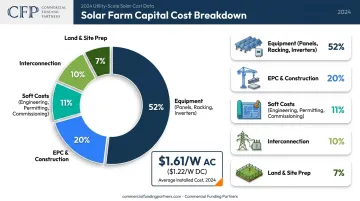
A solar farm's price tag comes from several major buckets:
- Land and site prep: clearing, grading, access roads
- Equipment: panels, racking, inverters
- Interconnection: utility studies, network upgrades
- EPC and construction: labor, fieldwork, project management
- Soft costs: engineering, permitting, controls, commissioning
Berkeley Lab's 2025 utility-scale solar market update reported an average installed cost of $1.61 per watt AC ($1.22 per watt DC) for projects entering service in 2024, a benchmark that helps developers sanity-check budgets before approaching lenders.
Why Banks Struggle With These Deals
Traditional bank underwriting wasn't designed for 20-plus-year payback horizons, construction risk, or collateral that's essentially a field full of panels tied to a power contract. Banks want clean, quickly amortizing assets with conventional collateral. Solar farms rarely fit that mold.
That gap is exactly where independent direct lenders and institutional capital sources have stepped in. Private credit has become a meaningful funding source for energy-transition infrastructure precisely because it can move with more flexibility than a depository bank's credit box allows.
Financing Structures & Options for Solar Farm Projects
Most solar farm deals aren't financed with one instrument. They're financed with several, layered to match risk, timing, and tax benefit.
Debt Financing
Construction loans and permanent loans are sized and secured differently:
- Construction loans are short-term, multiple-draw facilities that fund EPC work as it's completed. Terms typically run six months to two years.
- Mini-perm (bridge) loans bridge the gap between construction completion and permanent takeout, typically running two to five years.
- Permanent loans replace construction debt once the project is operating, often structured around 18-year terms tied to the offtake contract.
Lenders gate cash distributions using Debt Service Coverage Ratio (DSCR) covenants. NREL's modeling found utility-scale PV projects underwritten to roughly a 1.30x DSCR under a base-case scenario, with lenders often stress-testing down to near 1.0x under a downside case. Construction leverage commonly reaches approximately 80% of project cost.
Tax Equity Financing
Tax equity investors monetize the federal Investment Tax Credit alongside sponsor equity, typically through one of three structures:
| Structure | How it works |
|---|---|
| Partnership flip | Investor and sponsor co-own the project; investor gets most tax benefits until reaching target yield, then allocations flip |
| Sale-leaseback | Tax investor buys and owns the asset, then leases it back to the developer |
| Inverted lease | Sponsor keeps depreciation; lessee-investor receives the passed-through ITC |
Third-party ownership structures such as power purchase agreements (PPAs) and solar leases shift capital risk away from the host entirely. A third party owns the system while the host purchases power or capacity at a fixed rate, appealing to municipalities or businesses that want solar output without owning the asset.
Cash Equity & Hybrid Structures
Cash equity fills the remaining gap once debt and tax equity are sized. Almost every solar farm blends multiple instruments into one stack — construction debt converting to term debt, tax equity layered on top, and sponsor cash covering what's left. CFP structures this kind of blended stack directly, financing equipment, soft costs, and staged draws so developers can preserve cash for additional projects and expand renewable delivery to consumers and municipalities alike.
The Solar Farm Financing Deal Lifecycle: From Development to Permanent Funding
Solar farm financing isn't a single event. It follows the project through distinct phases, each with its own funding needs.
Development stage. Early costs include interconnection deposits, site control payments, permitting fees, and feasibility studies. These costs come out of pocket well before construction financing closes, and they're rarely covered by traditional bank products.
Construction phase. Lenders track specific milestones:
- Notice to Proceed (NTP) : the EPC contractor is authorized to start work
- Mechanical Completion : the facility is electrically and mechanically complete, though testing may remain
- Commercial Operation Date (COD) : the contractual date when the project can begin delivering power under the PPA
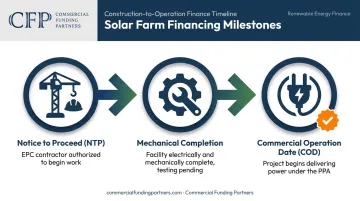
Lenders disburse funding during this phase through progress-payment or construction-draw structures, tying each draw to EPC invoices and completion milestones rather than releasing it in one lump sum.
The soft-cost gap. This is where many developers get stuck. Banks routinely won't finance non-admitted assets, engineering, controls, automation integration, or commissioning, treating them as unsecured cost rather than bankable collateral. Structured capital lenders like CFP fund these gaps alongside equipment and hard construction costs, financing installation, freight, software integration, and commissioning as part of one cohesive facility.
Term conversion. With those soft-cost gaps closed and hard costs funded, the deal enters its final stage. Once the project reaches COD and satisfies completion conditions, construction debt converts, or is refinanced, into permanent financing. This "term conversion" typically happens in a single draw once the offtake agreement is active and the asset is generating contracted revenue.
What Lenders Look for When Qualifying a Solar Farm Project
Before releasing meaningful capital, lenders want proof the project will generate reliable, contracted revenue — not just that it'll work technically.
Revenue certainty comes first. A signed offtake agreement, whether a PPA or a confirmed interconnection agreement, is usually non-negotiable. Without it, lenders have no basis for projecting cash flow.
Sponsor equity and leverage expectations matter too. NREL's modeling found construction debt commonly reaching about 80% of project cost, with sponsors contributing the first 10% to 25% of spend. Every deal is different, but lenders want to see the sponsor has real capital at risk.
Documentation lenders typically request includes:
- Financial history and entity structure
- Permitting status and site control documents
- Executed EPC and equipment contracts
- Interconnection agreements
- Projected cash flow and DSCR analysis under base and downside scenarios
Weak or incomplete documentation is one of the fastest ways a deal gets shelved, not necessarily declined outright, just stuck in limbo while a lender waits for information that never fully arrives. CFP's free Second Opinion Review re-underwrites stalled deals like these at no cost.
Tax Incentives That Improve Solar Farm Financing Economics
Tax incentives don't just reduce a tax bill. They directly reshape the size and structure of the capital stack.
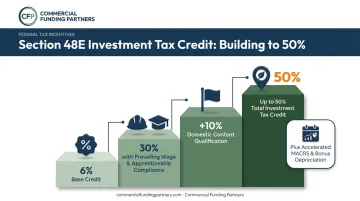
The Investment Tax Credit. Under Section 48E, qualifying facilities placed in service after 2024 start with a 6% base credit, rising to as much as 30% when prevailing-wage and apprenticeship requirements are met. Domestic-content and energy-community qualifications can each add up to 10 additional percentage points. This credit can also be transferred to unrelated taxpayers for cash under Section 6418, which is part of why tax equity and credit-transfer markets have grown so quickly.
Accelerated depreciation (MACRS). Solar property has historically qualified for accelerated depreciation, with basis reduced by half of the claimed ITC. The One Big Beautiful Bill Act, signed in 2025, changed the depreciable category for projects beginning construction after December 31, 2024, and restored 100% bonus depreciation for qualifying property acquired after January 19, 2025.
Lease structures, particularly tax leases and FMV leases, let the party best positioned to use these benefits claim them, and Commercial Funding Partners structures deals around that outcome.
State and rural programs. Many states run their own incentive programs through mechanisms tracked by the DSIRE database. USDA's Rural Energy for America Program (REAP) offers grants up to 50% of eligible project cost for qualifying agricultural and rural small business projects.
Incentive rules shift with policy changes more often than most developers expect. Confirm current eligibility with a tax advisor before building it into your project pro forma.
Choosing the Right Financing Partner for Your Solar Farm Project
Not every lender is equipped to handle a solar farm's complexity. A few traits separate the ones who can from the ones who'll stall your project mid-construction:
- Flexibility on deal structure: willingness to finance soft costs, not just equipment
- Experience with structured capital projects: a track record in large equipment and infrastructure deals, not just standard commercial loans
- Speed of response: a structuring specialist who replies within a business day, not weeks
CFP finances between $250,000 and $300 million in project costs, including the soft costs most banks won't book: engineering, controls, automation integration, and commissioning. As a direct lender with an extensive network of banks, institutional investors, and specialty finance partners, CFP can also structure deals a single bank simply can't fund alone.
For projects already declined or poorly priced elsewhere, CFP's Second Opinion Review™ offers a free, no-obligation re-underwriting to see whether a different structure changes the outcome.
Timing matters as much as fit. Bring your financing partner in early, alongside your EPC and engineering firms, during initial development when funding gaps are still cheap to fix.
Frequently Asked Questions
What is the 20% rule for solar?
The "20% rule" is a sizing guideline used by certain net-metering programs, capping a system's expected output at roughly 120% of a site's historical consumption. It has nothing to do with sponsor equity contribution requirements in project financing.
What's the minimum acreage for a solar farm?
Utility-scale ground-mount projects typically need 5 to 7 acres per megawatt, according to SEIA. Actual acreage varies based on panel technology, tracking systems, and site layout.
What is the profit of a 1 acre solar plant?
There is no universal per-acre profit figure. Returns depend on the contracted PPA rate, available tax incentives, financing costs, and site-specific yield — all of which vary considerably from project to project.
What is the age limit for solar loan?
Commercial solar farm financing is underwritten on the project's and sponsor's creditworthiness, cash flow, and collateral, not an individual borrower's age. This is a distinction from some residential solar loan products, which may factor in personal age limits.
How much of a solar farm's total project cost can be financed?
Many structured capital lenders, including CFP, can finance up to 100% of eligible project costs, including soft costs like engineering and commissioning, when the deal is structured properly. The exact percentage depends on collateral, sponsor strength, and offtake terms.
What loan terms are typical for commercial solar farm financing?
Construction loans generally run six months to two years, while permanent financing is often structured around 18-year terms. Payment schedules can be matched to project cash flow using seasonal, step-up, or interest-only structures during construction.