This isn't a small issue, either. Days sales outstanding for large companies climbed to 40.1 days in 2023, up 3% from the prior year, according to The Hackett Group's 2024 working capital study. Every extra day between finishing work and getting paid puts more strain on cash flow.
"WIP" shows up in two different conversations: one about accounting classification, one about financing. Business owners managing growth need to understand both. This article covers how WIP is recorded and calculated, how WIP financing actually works, and how to evaluate funding options depending on project size.
Key Takeaways
- WIP is a current asset on the balance sheet, not an expense, until goods or services sell
- Borrow against unfinished work through WIP financing instead of waiting on a final invoice
- Calculate available funds as: Total Contract Value × Percentage Complete − Amount Invoiced to Date
- Manufacturing, construction, and aerospace rely most heavily on this type of funding
- Large equipment and infrastructure projects often need milestone-based structures instead of a standard WIP facility
What Is Work in Progress (WIP) Financing?
WIP financing is a funding arrangement that advances capital against the value of partially completed products or projects, not against finished inventory or a completed invoice. It fills the space between "we started the work" and "we got paid for the work."
You'll often see the terms "work-in-process" and "work-in-progress" used interchangeably. In practice, "work-in-process" tends to describe shorter manufacturing runs, while "work-in-progress" usually refers to longer-cycle builds like construction or custom fabrication. There's no formal accounting rule drawing that line. It's more of a usage convention than a strict distinction.
Structure of WIP Financing
WIP financing is typically structured as a revolving line of credit or a short-term loan, with how much you can borrow tied directly to how far along the project is.
This type of financing fits:
- Businesses with long production or project cycles (think months, not weeks)
- Companies billing against milestones rather than a single delivery
- Operations carrying large upfront material and labor costs before any invoice goes out
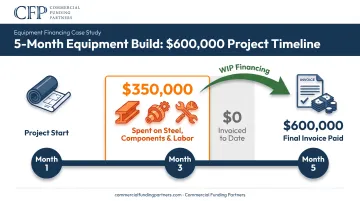
Example: A custom equipment manufacturer lands a $600,000 order that will take five months to build. By month three, they've spent $350,000 on steel, components, and labor, but haven't invoiced a dollar yet. A WIP facility lets them borrow against that in-progress value to keep paying suppliers and payroll without draining their own cash reserves.
WIP in Accounting: Recording, Valuation & the Formula
Before you can finance WIP, you need to know how it's tracked on the books. How it's recorded: Costs for raw materials, direct labor, and allocated overhead get posted to a WIP inventory account as production happens. Once the goods are finished, those costs move to finished goods inventory. When the product actually sells, the costs shift again, this time to cost of goods sold (COGS) on the income statement.
Is WIP an asset or an expense? WIP is classified as a current asset (inventory) on the balance sheet. It only becomes an expense once the related goods or services are sold and recognized as COGS. Until that point, it represents value you've created but haven't yet converted to revenue.
What WIP means in a lending context: For a lender, WIP is the unbilled, in-progress value of a contract or production run that can serve as collateral. This is a narrower, more practical definition than the pure accounting one, because a lender cares about what that WIP is actually worth if things go sideways, not just how it's categorized.
The WIP Valuation Formula
A common working formula finance teams and lenders use to estimate the current, unbilled value of a contract is:
Total Contract Value × Percentage Complete − Amount Invoiced to Date
Here's a simple worked example:
- Total contract value: $1,000,000
- Percentage complete: 40%
- Earned value: $1,000,000 × 0.40 = $400,000
- Amount invoiced to date: $250,000
- Unbilled WIP value: $400,000 − $250,000 = $150,000
That $150,000 represents work you've completed and earned but haven't billed for yet — and it's the figure a lender would look at when sizing an advance.
Accurate WIP valuation matters to two audiences. Accountants need it for compliant statements and correct revenue recognition. Lenders need it to size advances without betting on work that may miss schedule or budget.
How WIP Financing Works: From Application to Repayment
The mechanics follow a fairly consistent pattern, regardless of lender.
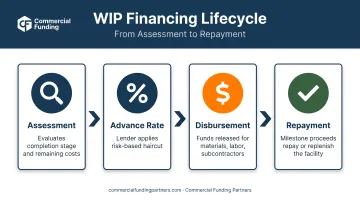
- Assessment — The lender evaluates project completion stage, remaining costs to finish, and expected final contract or production value.
- Advance rate — The lender applies a discount, often called a "haircut," to verified WIP value based on risk.
- Disbursement — The lender releases funds for raw materials, labor, subcontractor payments, and overhead as work continues.
- Repayment — When the product ships or a project milestone is invoiced and paid, proceeds repay the facility or replenish the credit line for the next draw.
Advance rates vary by collateral quality. According to SFNet's asset-based lending primer, lenders commonly advance 70-90% against eligible receivables and roughly 20-75% of net orderly liquidation value for inventory. WIP tends to sit toward the lower end of that inventory range because unfinished goods usually aren't saleable as-is, and recoverable value depends on how much work remains.
Documentation lenders typically want to see:
- Signed contracts or purchase orders
- A detailed WIP schedule (updated monthly is standard practice)
- Aged receivables and payables reports
- Historical project completion data
That last item matters more than most borrowers expect. A lender underwriting WIP is betting on your track record of finishing what you started, on budget and on time.
Benefits and Industries That Rely on WIP Financing
When structured well, WIP financing solves a specific, painful problem: getting paid for work you haven't billed yet.
Core benefits:
- Smoother cash flow through long production cycles
- Ability to bid on and accept larger orders without overextending working capital
- Less pressure to raise dilutive equity just to fund growth
Industries leaning on it most:
- Manufacturing
- Construction
- Aerospace and defense
- Energy and infrastructure
- Custom and made-to-order producers
These sectors share long contract cycles and heavy upfront costs—the conditions WIP financing is designed to address.
In those same cycles, WIP financing usually works with invoice factoring or accounts receivable financing, not in place of them. WIP funds the pre-invoice production phase. After you bill the customer, factoring or AR financing can bridge the collection gap.
Used together, they cover the full cash-flow timeline from first dollar spent to final dollar collected.
Risks, Costs, and Choosing the Right Financing Partner
WIP financing isn't without downsides. Know them before you sign anything.
Main risks:
- Valuation complexity: Percentage-complete calculations require judgment, and disputes over progress can complicate a draw
- Non-completion risk: If a project stalls or falls apart, the lender holds collateral that's hard to sell as-is
- Cost: WIP facilities generally carry higher rates or fees than a conventional term loan because the collateral is harder to value and liquidate
Collateral considerations: WIP financing is usually secured by the in-process work itself, and sometimes by additional business assets. Lenders monitor milestones closely throughout the life of the facility, not just at origination.
What to look for in a financing partner:
- Industry-specific underwriting experience (a lender who's seen your type of project before asks better questions)
- Transparent advance rates, with no surprises buried in the fine print
- Responsiveness when a milestone hits and you need funds released quickly
- Repayment terms flexible enough to match your actual project cash flow
Standard WIP financing works well for ongoing production and receivables-based lending. But it starts to strain at the seams for large capital equipment purchases or infrastructure projects with extended installation and build timelines of six to eighteen months or longer.
That's a different problem, and it needs a different structure: progress payments, milestone funding, or construction-draw financing rather than a standard AR-based WIP line.
This is where Commercial Funding Partners fits alongside, rather than in competition with, a company's existing bank relationship or WIP facility. CFP structures progress-payment and milestone-based financing for equipment and capital projects from $250,000 to $300 million.
Coverage can include deposits, engineering, procurement, fabrication, factory acceptance testing, shipment, installation, and commissioning. Interest-only-during-installation options keep payments manageable while equipment is built and installed, then convert to standard financing or leasing once it's accepted and running.
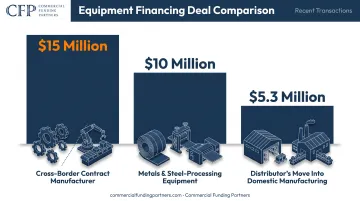
CFP has structured this kind of funding for complex, real-world scenarios:
- $15 million cross-border program for a contract manufacturer deploying equipment across the U.S. and Mexico
- $10 million facility for metals and steel-processing equipment
- $5.3 million progress-funded build supporting a distributor's move into domestic manufacturing
Because CFP doesn't compete for deposits, treasury management, or the banking relationship itself, it can layer in as project-specific capital without disrupting a company's existing lender or bank facility.
Frequently Asked Questions
How do you record work-in-progress (WIP) in accounting?
Costs for materials, labor, and overhead are posted to a WIP inventory account as production happens. Those costs later shift to finished goods, then to cost of goods sold once the item sells.
Is work-in-progress (WIP) an asset or an expense?
WIP is classified as a current asset (inventory) on the balance sheet. It becomes an expense only once the related goods or services are sold.
What does work-in-progress (WIP) mean in finance?
In a financing context, WIP is the unbilled value of in-progress work on a contract or production run. That earned but uninvoiced amount can still be used to secure short-term capital.
What is the formula to calculate work-in-progress (WIP)?
A common formula is: Total Contract Value × Percentage Complete − Amount Invoiced to Date. This produces the unbilled, earned value that lenders and finance teams typically reference.
Can startups qualify for WIP financing?
Generally, no. WIP financing is aimed at established businesses with a track record of completed projects and existing receivables, rather than early-stage startups with limited history.
How is WIP financing different from invoice factoring?
WIP financing advances funds before an invoice exists, based on in-progress work. Invoice factoring requires a completed, billed invoice as the underlying security.