Introduction
US businesses financed $1.34 trillion in equipment and software in 2023. That number is still climbing. According to ELFA's 2024 Horizon Report, 82% of end users relied on at least one form of financing, a clear sign that leasing and lending have become standard operating practice across American industry.
But picking the wrong leasing partner can cost you more than a bad rate. It can limit your deal size, lock you into a structure that doesn't fit your balance sheet, or leave you without a lender when your next growth phase requires a $5M transaction instead of a $500K one.
This guide covers the best equipment leasing companies for 2026. For each one, you'll find what they do well, who they serve best, and how to evaluate fit based on your deal size, industry, and credit profile.
Key Takeaways
- Equipment leasing preserves working capital by spreading asset costs over time rather than depleting cash reserves upfront.
- The best leasing company depends on your transaction size — a lender capped at $150K cannot serve a $5M deal.
- Capital leases, operating leases, and sale-leasebacks serve different financial goals — structural flexibility in a lender is non-negotiable for middle-market businesses.
- Approval speed matters less than lender fit; a fast "yes" from the wrong lender is still the wrong lender.
- Commercial Funding Partners (CFP) specializes in relationship-driven equipment financing for middle-market companies, handling deals from $250K to $100M+.
Overview of Equipment Leasing in 2026
Equipment leasing is a financing arrangement where a business uses equipment for a defined period in exchange for regular payments — with options to purchase, renew, or return the asset at term end. The lessee gets operational access to the equipment without tying up capital in ownership.
ELFA projects 6.2% equipment and software investment growth in 2026, driven largely by AI-related spending and infrastructure activity. Construction and agricultural machinery show improving momentum. Industrial, medical, and transportation equipment face headwinds from tariffs and tighter monetary policy.
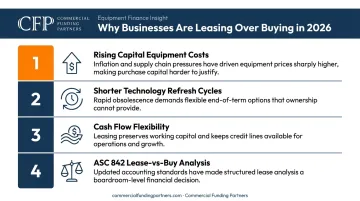
Key reasons businesses are leasing rather than buying in 2026:
- Capital equipment costs in manufacturing, healthcare, and construction have risen substantially
- Automation and technology refresh cycles are shortening equipment useful life
- Businesses prioritizing cash flow flexibility prefer matched monthly payments over lump-sum purchases
- ASC 842 accounting changes have shifted the lease-vs.-buy decision toward a more nuanced financial analysis
That market context shapes how leasing companies should be evaluated. Leasing companies range from online lenders capped at $150K to institutional firms handling $100M+ transactions — so the criteria below focus on deal size range, lease structure flexibility, industry coverage, and execution track record.
Best Equipment Leasing Companies for 2026
These companies were selected based on financing range, lease structure options, industry coverage, approval speed, and quality of client relationship. Each serves a distinct segment of the market — size and fit matter more than rankings.
Commercial Funding Partners (CFP)
Best for: Middle-market businesses with transactions from $250K to $100M+
Founded in 2012, CFP has invested billions into US companies across capital-intensive industries. COO Dave Johnson alone has funded over $1 billion in equipment and project financing since 2002 — a track record that signals the firm's capacity for large, complex deals.
CFP's defining characteristic is its relationship-first model. Three numbers stand out:
- 1-business-day response from a dedicated structuring specialist
- 40% client return rate for additional funding
- Leadership with prior backgrounds at Goldman Sachs, Axos Bank, and major commercial finance institutions — depth most independent lenders can't match
| Factor | Details |
|---|---|
| Financing Range | $250,000 to $100M+ |
| Lease Types | Capital leases, operating leases, sale-leasebacks, vendor financing, structured capital solutions, milestone/progress payment structures |
| Industries Served | Manufacturing, healthcare, construction, transportation, energy, agriculture, technology, food & beverage, metals, EV/charging infrastructure, and more |
| Response Time | Structuring specialist responds within one business day |
CFP is the right partner when deal complexity, transaction size, or structural requirements exceed what a standard online lender can execute. One example: a $36 million sale-leaseback and 60-month non-tax lease for a Midwest manufacturer — a facility-level recapitalization that didn't fit standard bank criteria — funded in under three weeks.

National Funding
Best for: Startups and businesses with fair credit seeking fast, accessible equipment financing
National Funding has provided over $4.5 billion to more than 75,000 US businesses and holds an A+ BBB rating. For newer businesses, the appeal is simple: a $150,000 financing cap, minimal documentation, and funding possible within 24 hours.
| Factor | Details |
|---|---|
| Financing Range | Up to $150,000 |
| Lease Types | Equipment loans and leases (new and used) |
| Best For | Businesses with at least six months of operating history needing fast, low-barrier financing |
| Approval Speed | Decision and funding in as little as 24 hours |
National Funding suits businesses in their early stages that need equipment quickly and can't meet a traditional bank's documentation requirements. Above $150K, or when deal structure matters, look at Crest Capital or JR Capital instead.
Crest Capital
Best for: Established SMBs with strong credit seeking fixed-rate leasing
Crest Capital is a direct lender focused on businesses with at least two years of operating history and solid credit. It finances new and used commercial equipment across healthcare, construction, IT, and transportation — known for fast decisions and transparent fixed-rate structures.
| Factor | Details |
|---|---|
| Financing Range | $10,000 to $500,000 |
| Lease Types | Fair market value leases, $1 buyout leases, equipment finance agreements |
| Best For | Profitable, established SMBs wanting predictable payments |
| Approval Speed | Same-day decisions; funding within 24–48 hours |
The streamlined, low-documentation process works best when you already know what lease structure you want. Not the right fit for startups or businesses with challenged credit — National Funding is the better option in those cases.
JR Capital
Best for: Businesses needing no-down-payment leasing with higher transaction amounts
JR Capital occupies a practical middle ground — higher capacity than most SMB lenders, with a $10M maximum and a minimum of $15,000. It offers long repayment terms (up to 84 months), no down payment for most equipment types, and approval in as little as two hours.
| Factor | Details |
|---|---|
| Financing Range | $15,000 to $10,000,000 |
| Lease Types | Equipment leases and loans, flexible payment and deferment structures |
| Best For | Businesses outgrowing $500K lenders but not yet requiring middle-market institutional capacity |
| Approval Speed | Approvals in as fast as 2 hours; same-day or 48-hour funding depending on asset type |
Construction, manufacturing, agriculture, and transportation businesses that have outgrown $500K lenders will find JR Capital a natural next step. When transactions push past $10M, CFP handles that tier.
Ameris Bank Equipment Finance (formerly Balboa Capital)
Best for: Businesses prioritizing fast approvals and minimal paperwork
Ameris Bank acquired Balboa Capital in 2021, and the operation now runs as Ameris Bank Equipment Finance — a bank-owned lender with one of the fastest decision timelines in the market. Decisions arrive within one hour during business hours, with same-day funding possible for qualifying deals.
| Factor | Details |
|---|---|
| Financing Range | Up to $500,000 (application-only) |
| Lease Types | Equipment leases, loans, end-of-term purchase options |
| Best For | Businesses with stable revenue that need equipment fast and want minimal paperwork |
| Approval Speed | One-hour decisions; same-day funding available |
Ameris suits businesses with straightforward equipment needs and stable revenue — the bank-owned structure adds institutional credibility, and the one-hour decision window is genuinely one of the fastest available. The $500K application-only cap is the key constraint to weigh.
How We Chose the Best Equipment Leasing Companies
Selecting an equipment leasing partner based on brand recognition or approval speed alone is a costly mistake. A lender that funds your $100K deal in 24 hours may be completely unable to handle your $3M transaction two years later.
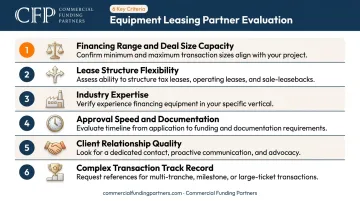
The core evaluation criteria used in this ranking:
- Financing range and deal size capacity: does the lender's maximum actually match your transaction?
- Covers the full range of lease structures — capital leases, operating leases, and sale-leasebacks — not just one
- Industry expertise: does the lender understand the equipment, the sector, and the collateral dynamics?
- Approval speed and documentation requirements — relevant, but secondary to fit
- Client relationship quality: does a real specialist handle your deal, or is it routed through automation?
- Demonstrated ability to close complex transactions at scale, not just straightforward approvals
For middle-market businesses with high-value equipment needs, the relationship dimension matters as much as rate. Monitor's research puts middle-market deal cycles at roughly 96–108 days — which means choosing a lender without the capacity or expertise to see a complex deal through creates real execution risk.
Each company ranked below was evaluated against these criteria — not just whether they can approve a deal, but whether they can execute it from term sheet to funding without losing momentum.
Conclusion
The best equipment leasing company for your business is the one aligned with your actual transaction size, industry, and structural requirements — not the one with the slickest website or the fastest automated approval.
Before committing to a lender, assess scalability: a company that handles your current $200K deal well may not be equipped to execute a $10M transaction when your next growth phase arrives. When that moment arrives, a lender that can't scale with you forces you to start over — at exactly the wrong time.
That's the gap Commercial Funding Partners is built to fill. For middle-market businesses across manufacturing, healthcare, construction, energy, transportation, and other capital-intensive sectors, CFP handles transactions from $250,000 to over $100 million — with flexible lease structures and a structuring specialist who responds within one business day. Forty percent of clients return for additional funding, which reflects what the relationship actually looks like in practice.
Reach out to the CFP team at (801) 461-3337 or [email protected] to discuss your equipment financing needs.
Frequently Asked Questions
What are the 4 types of leases?
The four main lease types are: operating lease (use without ownership transfer), finance/capital lease (economically transfers ownership risks and benefits), fair market value lease (lessee may buy, return, or renew at market value at term end), and sale-leaseback (sell owned equipment to a financier and lease it back). Each affects your monthly payments, balance sheet treatment, and end-of-term options differently.
Who owns leased equipment?
During a lease, the leasing company (lessor) retains legal ownership while the lessee has the right to use the equipment. Ownership may transfer to the lessee at term end depending on the agreement — a $1 buyout lease effectively conveys ownership, while a fair market value lease leaves the lessee with the option to buy, renew, or return.
What credit score do you need to lease equipment?
Credit score requirements vary by lender and deal size. Some online lenders accept fair-to-moderate credit profiles, while banks typically set higher thresholds. For middle-market transactions, lenders also evaluate business cash flow, collateral, time in business, financial statements, and industry profile — contact lenders directly for their current thresholds.
Is it better to lease or buy equipment for your business?
Leasing suits businesses that want to preserve cash flow, upgrade regularly, or use equipment for a defined term. Buying makes more sense for long-lived assets where residual value matters. Either way, factor in ASC 842 balance sheet treatment and Section 179 tax implications — a tax advisor can clarify which structure benefits your situation.
What is a sale-leaseback and when does it make sense?
A sale-leaseback involves selling equipment you already own to a leasing company and leasing it back — freeing up capital without disrupting operations. It's particularly useful for asset-intensive businesses that need liquidity but can't access standard bank financing. CFP completed a $36 million sale-leaseback for a Midwest manufacturer outside standard bank criteria, funded in under three weeks.
How long does equipment lease approval typically take?
Approval timelines range from one hour to several weeks depending on deal size and complexity. Online lenders can fund straightforward deals in 24–48 hours; larger middle-market transactions requiring financial statements or custom structures take longer. CFP responds to structuring inquiries within one business day and has closed multi-million-dollar transactions in under 30 days.