Introduction
Many businesses in capital-intensive industries own equipment worth hundreds of thousands — or millions — of dollars, yet can't access that value. The capital isn't gone. It's locked in physical assets, sitting idle on the balance sheet while growth opportunities wait.
Equipment sale leaseback financing resolves this directly. A business sells owned equipment to a financing company at fair market value, receives a lump sum cash payment, and immediately leases that same equipment back. Operations continue without interruption. The fixed asset becomes liquid capital.
According to ELFA, $1.34 trillion — or 57.7% of the $2.3 trillion invested in U.S. equipment and software in 2023 — was financed. Among businesses that acquired equipment or software that year, 82% used some form of financing.
For companies that already own their equipment outright, a sale leaseback offers a path to that same liquidity without acquiring new assets.
This article covers how the process works step by step, what equipment qualifies, tax and accounting implications under IRS and FASB rules, and how sale leaseback compares to traditional loans and equipment refinancing.
Key Takeaways
- A sale leaseback converts owned equipment into immediate working capital while preserving full operational use.
- Lease payments under a qualifying operating lease are generally tax-deductible under IRS Section 162.
- ASC 842 governs accounting treatment — structuring determines whether the deal qualifies as a true sale or a financing arrangement.
- Equipment must have demonstrable market value, remaining useful life, and secondary market demand to qualify.
- Sale leaseback is especially effective when traditional bank credit is constrained or unavailable.
What Is Equipment Sale Leaseback Financing?
Equipment sale leaseback financing is a transaction where a business sells equipment it already owns to a financing company at fair market value, receives a lump sum cash payment, and simultaneously enters a lease agreement to continue using that same equipment.
The role reversal is the defining feature: the original owner becomes the lessee; the financing company becomes the lessor. Ownership transfers legally, but operational control stays with the business. The equipment never needs to leave the facility.
How it differs from other financing structures:
- Creates lease obligations rather than loan debt — the asset moves off the balance sheet entirely
- Unlike equipment refinancing, the business no longer holds the asset as collateral
- Ongoing use of the equipment is guaranteed through the lease — it's not a liquidation event
- Applies to machinery, vehicles, medical devices, and other tangible business assets, not real property (which follows a structurally similar but legally distinct process)
Sale leasebacks are most common in capital-intensive industries where high-value equipment is essential to operations and represents a significant portion of the company's asset base.
How Does an Equipment Sale Leaseback Work?
The transaction follows a predictable sequence, though each deal is underwritten individually based on the specific assets and business involved.
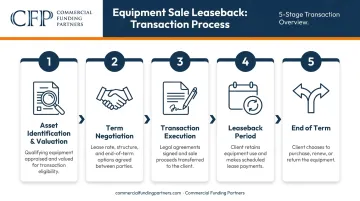
Step 1: Asset Identification and Valuation
The business identifies owned equipment and has it appraised to establish fair market value. Lenders typically base financing on liquidation value or orderly liquidation value — not the original purchase price or current book value. These figures can differ significantly, so businesses should get a realistic appraisal before projecting proceeds.
Step 2: Term Negotiation
The business and financing company negotiate:
- Sale price (based on appraised value)
- Lease term (typically 2–7 years)
- Monthly payment structure
- End-of-term options: repurchase, renewal, or return
- Any rent escalation clauses or buyback pricing
End-of-term provisions matter as much as the initial rate. If the equipment will remain central to operations, a pre-agreed repurchase option at a defined price is worth negotiating upfront.
Step 3: Transaction Execution
Ownership transfers to the financing company, and the business receives its lump sum cash payment. Both parties execute the lease agreement simultaneously — with no gap in equipment access or operational continuity.
Step 4: Leaseback Period
The business makes regular lease payments over the agreed term and continues using the equipment as before. Lease structures may be operating or finance leases depending on deal terms and the desired accounting treatment — a distinction covered in the tax and accounting section below.
Step 5: End of Term
Depending on what was negotiated upfront, options typically include:
- Purchasing the equipment back at fair market value or a pre-agreed price
- Renewing the lease for an additional term
- Returning the equipment to the lessor
The end-of-term structure should align with the equipment's long-term role in the business. Equipment central to production warrants a buyback option; equipment approaching obsolescence may not.
That end-of-term clarity is built into every transaction CFP structures. Commercial Funding Partners handles sale leaseback deals from $250,000 to over $100 million across manufacturing, healthcare, construction, transportation, and energy. In one documented transaction, CFP funded a $6 million sale leaseback for a masonry contractor — structured as a 48-month operating lease across two schedules, with first funding completed in under 30 days. A structuring specialist responds within one business day of inquiry.
Key Benefits of Equipment Sale Leaseback Financing
Immediate Liquidity Without Operational Disruption
The most direct advantage is unlocking capital that's already in the business — just tied up in equipment. The lump sum payment arrives without selling off the asset operationally. Production lines keep running, fleets keep moving, and service delivery continues without interruption.
This matters most when timing is critical: a growth opportunity or a maturing debt obligation doesn't wait for a bank's underwriting timeline.
Flexible Use of Proceeds
Unlike a designated equipment loan — where funds are restricted to acquiring a specific asset — sale leaseback proceeds can be deployed for any business purpose:
- Paying down high-interest debt
- Funding facility expansion or technology investment
- Covering payroll or operating costs during seasonal downturns
- Financing an acquisition
- Building a cash reserve for strategic flexibility
That breadth of deployment options is why the structure is in demand. ELFA data shows that among businesses using equipment financing broadly, 62% cited cash flow optimization as a leading motivation — reflecting exactly the operational liquidity that sale leaseback directly addresses.
Balance Sheet and Cash Flow Improvement
When structured properly as an operating lease under ASC 842, a qualifying sale leaseback removes the equipment from the balance sheet (as a fixed asset) and replaces it with a right-of-use (ROU) asset and lease liability.
Depending on how a company's lenders define leverage in their covenants, this can improve key financial ratios — including current ratio and debt-to-equity — and may enhance creditworthiness with existing lenders.
The specific impact depends on whether the leaseback qualifies as an operating or finance lease. Finance lease liabilities are treated as debt equivalents by many lenders; operating lease liabilities are generally classified as operating obligations. Businesses should work with an accountant to assess the covenant and ratio implications before structuring.
Strategic Flexibility When Bank Credit Tightens
Federal Reserve Senior Loan Officer survey data from Q1 2026 shows a net 8.1% of domestic banks tightened C&I lending standards for large and middle-market firms — with simultaneous tightening on loan premiums, covenants, and collateral requirements.
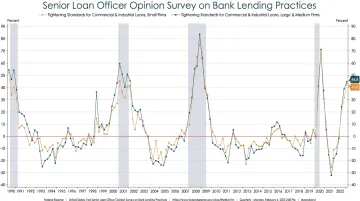
For businesses that can't qualify for new bank debt or face constrained credit lines, sale leaseback provides an alternative path to capital anchored in the value of owned assets — not credit scores or debt capacity ratios.
What Types of Equipment Qualify for a Sale Leaseback?
Eligible Equipment Categories
Most commercially valuable, productive equipment with an active secondary market qualifies. CFP has financed sale leaseback transactions across:
- Manufacturing machinery and production lines (including robotic welding systems)
- CNC machines and industrial processing equipment
- Construction equipment and heavy machinery
- Medical and diagnostic equipment
- Fleet vehicles and transportation assets
- Energy generation equipment and oil rigs
- Agricultural equipment
- Technology hardware
In one documented CFP transaction, $1.5 million in oil rigs were financed through a sale leaseback, delivering immediate liquidity to an energy company while allowing uninterrupted field operations.
What Lenders Evaluate
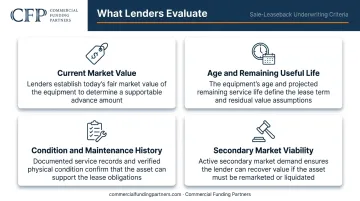
Financing companies assess several factors when underwriting a sale leaseback:
- Current market value — specifically liquidation or orderly liquidation value, not book value
- Age and remaining useful life — the equipment must remain functional for the full lease term
- Condition and maintenance history — well-maintained equipment with documentation commands better terms
- Secondary market viability — can the lessor re-lease or resell this asset if needed?
Highly specialized, single-purpose equipment with no meaningful secondary market is harder to finance. A production line custom-built to proprietary specifications carries more residual risk for the lessor than a standard CNC machine or a Class 8 semi-truck.
What Can Disqualify Equipment
When those secondary market and condition thresholds aren't met, lenders typically decline. Common disqualifiers include:
- Equipment that is too old with minimal remaining market value
- Heavily depreciated assets where liquidation value falls below a financeable threshold
- Damaged or poorly maintained equipment without service records
- Assets that are functionally obsolete with no active resale market
The sale price in a leaseback is based on what the market would pay for the equipment today — not what it cost new or what it's carried for on the books.
Tax and Accounting Considerations
IRS Tax Treatment
Capital Gains and Depreciation Recapture
When the business sells the equipment, the IRS treats it as a business asset disposition. If the sale price exceeds the equipment's adjusted tax basis — original cost minus accumulated depreciation — the business may owe tax on the gain.
For Section 1245 property (most tangible business equipment used in production), gain up to the amount of depreciation previously taken is recaptured as ordinary income. Gain above that amount may qualify for long-term capital gains treatment under Section 1231, subject to the five-year lookback rule.
A plain-English example: equipment purchased for $100,000, depreciated to an adjusted basis of $40,000, and sold for $80,000 generates a $40,000 gain — fully subject to Section 1245 recapture as ordinary income.
Lease Payment Deductibility
IRS guidance states that lease payments are deductible as ordinary business expenses — but only when the arrangement qualifies as a true lease rather than a conditional sale.
If the IRS determines the transaction is effectively a financing arrangement (due to a nominal buyback option, payments building equity, or other conditional-sale indicators under Rev. Rul. 55-540), the deduction is disallowed and the business must capitalize and depreciate the asset instead. A misclassified transaction can cost far more in taxes than the deal was worth.
Proper documentation and deal structuring are what protect that deduction. Work with a tax professional before executing.
FASB / ASC 842 Accounting Treatment
Tax treatment determines what you owe the IRS — accounting treatment determines how the transaction appears on your balance sheet and affects your financial ratios. Both frameworks need to align with your business objectives before the deal closes.
Does the Sale Qualify?
Under ASC 842, the transaction only qualifies as a true sale if control of the equipment transfers to the buyer-lessor — evaluated under the criteria of ASC 606. If repurchase options or other terms suggest the seller retains economic control, the transaction is treated as a secured financing arrangement. The equipment stays on the balance sheet, and the cash received is recorded as a liability.
Operating vs. Finance Lease
| Structure | Balance Sheet Treatment | Expense Presentation |
|---|---|---|
| Qualifying sale + operating leaseback | Equipment derecognized; ROU asset + lease liability recorded | Single lease expense (straight-line) |
| Qualifying sale + finance leaseback | ROU asset + finance lease liability recorded | Interest expense + ROU amortization (separate) |
| Failed sale test | Equipment remains on balance sheet; proceeds = financial liability | Depreciation + interest (financing treatment) |
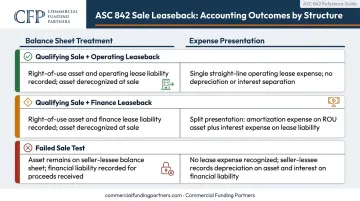
Finance lease liabilities are treated as debt equivalents by lenders, while operating lease liabilities are classified as operating obligations — a distinction that directly affects covenant compliance and key financial ratios.
The accounting outcome matters as much as the cash received. Businesses should confirm which structure aligns with their reporting objectives with their accountant before signing.
Equipment Sale Leaseback vs. Other Financing Options
| Feature | Sale Leaseback | Traditional Bank Loan | Equipment Refinancing | Outright Sale |
|---|---|---|---|---|
| Operational access to equipment | Retained | Retained (as collateral) | Retained (as collateral) | Lost permanently |
| New debt added | No (lease liability) | Yes | Yes | No |
| Equipment on balance sheet | Removed (if sale qualifies) | Remains | Remains | Removed |
| Credit profile requirements | Asset-focused | Credit-dependent | Credit-dependent | N/A |
| Use of proceeds | Unrestricted | Often restricted | Often restricted | Unrestricted |
vs. Traditional Bank Loan
A bank loan adds new secured debt, requires strong credit metrics, and goes through a full underwriting process. Sale leaseback converts an existing asset to cash without requiring additional borrowing capacity, and tends to be more accessible when credit is constrained or already committed elsewhere.
vs. Equipment Refinancing
Refinancing keeps the equipment on the balance sheet as collateral and adds a secured liability. It works well when a business wants to preserve ownership and has the credit profile to support the loan. Sale leaseback is the stronger choice when the goal is to fully convert the asset value to cash and improve balance sheet classification — specifically when the lease qualifies as an operating lease under ASC 842.
vs. Outright Sale
An outright sale generates a one-time cash payment but permanently ends access to the equipment, forcing the business to find and finance a replacement. Sale leaseback delivers the same capital without the operational disruption, making it the practical option when the equipment is actively generating revenue.
Frequently Asked Questions
How does an equipment sale leaseback work?
A business sells owned equipment to a financing company at fair market value, receives a lump sum cash payment, and immediately leases the equipment back under a formal lease agreement. Ownership transfers to the financing company, but the business retains full operational use throughout the lease term.
Who typically uses equipment sale leasebacks?
Middle-market businesses in capital-intensive industries — manufacturing, healthcare, construction, transportation, energy, and agriculture — most commonly use sale leasebacks when they need liquidity but can't afford to lose access to their equipment. Sale leasebacks are also common when traditional bank credit is constrained.
What types of equipment qualify for a sale leaseback?
Most commercially valuable equipment with an active secondary market qualifies — including manufacturing machinery, medical equipment, fleet vehicles, construction equipment, and energy assets — provided it has sufficient remaining useful life relative to the proposed lease term and verifiable market value.
What are the tax implications of an equipment sale leaseback?
The sale may trigger capital gains tax and Section 1245 depreciation recapture (taxed as ordinary income), while qualifying lease payments are generally deductible under IRS Section 162. If the IRS reclassifies the lease as a conditional sale, that deductibility is lost — making proper structuring and professional tax guidance essential.
How is an equipment sale leaseback different from a traditional equipment loan?
A loan adds new debt secured by the equipment and requires credit approval. A sale leaseback converts the equipment into immediate cash without adding to borrowing capacity requirements — and may offer different balance sheet and tax treatment depending on how the lease is classified under ASC 842.
What happens at the end of an equipment sale leaseback term?
End-of-term options typically include purchasing the equipment back at fair market value or a pre-negotiated price, renewing the lease, or returning the equipment to the lessor — all determined by what was structured upfront.