Commercial solar financing refers to the full range of funding structures businesses use to install and operate solar energy systems without bearing the entire upfront cost. Some options transfer ownership to a third party entirely. Others let a business own the system outright while spreading payments over time. Each approach carries a different combination of upfront cost, long-term savings, and tax benefits.
According to SEIA's 2025 Year in Review, the U.S. commercial segment installed 2,345 MWdc in 2025 — a 6% year-over-year increase — reflecting steady growth in business adoption of solar energy.
This guide covers the main financing structures available (PPA, lease, loan/equipment financing, cash purchase, and C-PACE), the tax incentives that affect which option makes sense, and the factors decision-makers should weigh when choosing.
Key Takeaways
- Commercial solar financing spans five main structures, each with distinct ownership, tax treatment, and cost tradeoffs
- Only system owners can claim the Federal Investment Tax Credit (ITC) and accelerated depreciation
- PPAs and leases offer immediate savings with no upfront cost but lower lifetime returns
- Equipment financing lets businesses own the system, claim tax incentives, and spread payments over time
- Tax-exempt organizations access separate pathways, including the IRS elective pay provision
What Is Commercial Solar Financing?
Commercial solar financing is the umbrella term for any structure a business uses to fund the acquisition, installation, and operation of a commercial-scale solar energy system. The three broad categories are third-party ownership (a developer owns the panels), debt-based ownership (the business owns the system but borrows to fund it), and direct cash purchase.
How Commercial Solar Differs from Residential
At commercial scale, the dollar figures, tax structures, and ownership considerations shift the decision into different territory entirely.
- System size: Commercial installations typically range from tens of kilowatts to several megawatts
- Cost range: Berkeley Lab's Tracking the Sun report puts the installed price for large non-residential systems above 100 kW at $1.70–$3.10 per watt DC — meaning even a 500 kW system can run $850,000 to $1.55 million
- Tax complexity: Commercial transactions involve federal tax credits, depreciation schedules, and ownership structures that simply don't come up in residential solar decisions
The Three Variables That Drive the Decision
Every financing choice ultimately comes down to three questions:
- Does the business want to own the system? Ownership unlocks tax benefits but adds capital or debt obligations.
- Does the business have federal tax liability to use? The ITC and depreciation are only valuable if the company has taxable income to offset.
- How much capital can be deployed upfront? This determines whether ownership structures are practical at all.
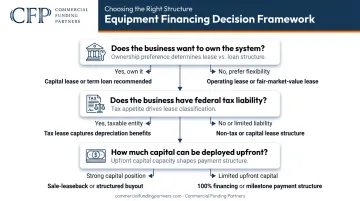
A manufacturer with strong taxable income and available capital faces a completely different calculus than a business preserving cash for operations — which is why the right structure varies so widely across companies of similar size.
The Main Commercial Solar Financing Options
Businesses have more structured options than ever — ranging from zero-upfront agreements to full ownership. Each transfers a different combination of cost, risk, and reward between the business and a financing or development partner.
Power Purchase Agreement (PPA)
A PPA is a contract between a business and a third-party developer. The developer owns, installs, and maintains the solar system on the business's property. The business purchases the electricity the system generates at a contracted per-kilowatt-hour rate, usually priced below the local utility rate.
Key characteristics:
- No upfront investment required from the business
- The developer owns the system and claims all tax benefits
- SEIA's C&I PPA model uses a standard 20-year initial term, with contract lengths generally ranging from 10–25 years
- The business cannot claim the ITC or depreciation
- Long-term contracts can complicate property sales or relocations
PPAs work well for businesses that want immediate energy savings without capital deployment or ownership responsibility.
Solar Lease
A solar lease resembles a PPA structurally — a third party owns and maintains the system — but the payment model differs. Instead of paying per kilowatt-hour produced, the business pays a fixed monthly fee regardless of how much electricity the system generates.
This creates more payment predictability, but it also makes the cost-per-energy comparison with a utility bill less transparent. If the system underperforms, the business still pays the same amount. Tax benefits stay with the third-party owner under a lease, just as they do with a PPA — which is one reason businesses that qualify for the ITC often look at ownership structures instead.
Solar Loan and Equipment Financing
Solar loans and equipment financing let a business own the system outright while spreading the cost over time. Ownership changes the financial picture considerably. The business can claim:
- The Federal Investment Tax Credit (ITC)
- MACRS accelerated depreciation (see the tax section below)
- Full retention of energy savings over the system's life
Lenders include banks, credit unions, and independent equipment finance firms. Commercial Funding Partners (CFP) structures commercial solar installations as equipment financing transactions, particularly useful for mid-market businesses with systems ranging from $250,000 to over $100 million. Unlike a traditional bank loan with a fixed underwriting template, CFP evaluates the structure that best fits the deal's actual operating requirements. That includes milestone-based funding for staged solar deployments, vendor deposits, and multi-site installations.

Cash Purchase
Paying outright eliminates monthly financing costs and delivers the highest long-term return. The business immediately owns the system, claims all available tax credits and depreciation benefits, and keeps every dollar of energy savings.
The tradeoff: significant capital leaves the business on day one. Payback periods for ownership models generally range from 4–8 years, depending on system size, energy costs, local utility rates, and available incentives. After payback, the system generates essentially free electricity for its remaining useful life.
C-PACE Financing
C-PACE (Commercial Property Assessed Clean Energy) is a financing structure that funds solar projects through a property tax assessment rather than a conventional loan.
Key features:
- Repayment runs through the property's tax bill over time
- DOE guidance reports terms of up to 20–30 years with financing of up to 100% of eligible costs
- The obligation can transfer to a future property owner upon sale — it stays with the property, not the business
- PACENation reports active C-PACE programs in 36 states plus Washington, D.C.
- Requires property ownership (and typically existing mortgage-holder consent)
- Credit eligibility is less restrictive than conventional lending since the assessment is secured against the property
C-PACE is worth evaluating for businesses that own their property, want long repayment terms, and may not qualify for traditional financing.
Tax Incentives and Financial Benefits of Commercial Solar
The tax picture for commercial solar has shifted materially since 2024 — and the changes affect both project timing and financing structure decisions.
The Federal Investment Tax Credit (ITC)
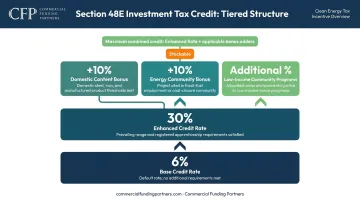
The current credit for commercial solar is governed by Section 48E of the tax code. The structure:
- 6% base rate — available to any qualifying commercial installation
- 30% enhanced rate — available when prevailing-wage and apprenticeship requirements are met or an applicable exception applies
- Additional bonus credits available for domestic content (+10 percentage points at the enhanced rate), energy community locations (+10 percentage points at the enhanced rate), and low-income community programs
Critical update: Under Public Law 119-21, for applicable solar facilities where construction begins after July 4, 2026, the credit terminates for facilities placed in service after December 31, 2027. This represents a significant change from earlier phase-down schedules. Verify current eligibility rules with a tax advisor at time of project planning.
The ITC is available only to the system owner. Businesses using a PPA or lease cannot claim it — the third-party developer does.
MACRS Depreciation
Businesses that own solar systems can depreciate the equipment under the Modified Accelerated Cost Recovery System (MACRS). A DOE example shows how the combined benefit works:
- Project cost: $1,000,000
- 30% ITC credit: $300,000
- Depreciable basis: reduced to $850,000
Front-loading those depreciation deductions into the first few years of ownership can meaningfully offset taxable income — particularly valuable for capital-intensive businesses with strong earnings.
Note: IRS Publication 946 now states that the special 5-year MACRS treatment does not apply to wind or solar property whose construction begins after December 31, 2024. Businesses planning new installations should confirm applicable depreciation treatment with a qualified tax professional.
Bonus Depreciation and Other Incentives
Public Law 119-21 permanently reinstated 100% first-year bonus depreciation for eligible property acquired after January 19, 2025 — replacing the prior phase-down for qualifying property. Whether a solar installation qualifies depends on its tax classification.
Additional incentives worth researching:
- State-level solar tax credits (vary significantly by state)
- Utility rebate programs
- Net metering policies, which allow businesses to sell excess generation back to the grid
- Check DSIRE for state-by-state program availability
For Tax-Exempt Organizations
The incentives above assume a tax-paying owner. Nonprofits, municipalities, and schools face a different set of options — two structures are specifically designed for these entities:
- PPAs — where a tax-paying developer captures the credits and passes savings to the organization through favorable pricing
- Section 6417 Elective Pay — allows certain tax-exempt entities to treat eligible clean energy credits as a direct tax payment from the IRS, effectively monetizing credits they couldn't otherwise use. Eligible entities include tax-exempt organizations, state and local governments, rural electric cooperatives, and others. Verify current eligibility requirements with a tax advisor.
Key Factors to Consider When Choosing a Financing Model
| Factor | Ownership (Loan/Cash) | Third-Party (PPA/Lease) | C-PACE |
|---|---|---|---|
| Upfront capital needed | High (cash) or moderate (loan) | None | None |
| ITC & depreciation | Business claims both | Developer claims both | Business claims both |
| Payment type | Debt service or none | Per-kWh or fixed monthly | Property tax assessment |
| Long-term savings | Highest | Lower (developer captures upside) | High |
| Contract flexibility | High — business owns asset | Low — 10–25 year contracts | Obligation transfers with property |
| Credit requirements | Business creditworthiness | Property/energy profile | Property ownership + lender consent |
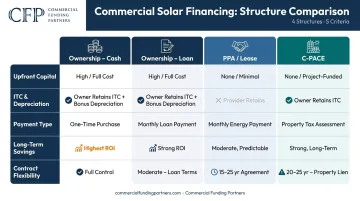
Tax position is the most decisive factor. Businesses with significant federal tax liability extract the most value from ownership structures — they can actually deploy the ITC and accelerated depreciation. Those without meaningful tax exposure typically fare better with third-party models.
Contract length deserves equal scrutiny. PPA and lease agreements running 15–25 years can complicate property sales, tenant transitions, and facility relocations in ways ownership structures don't. An owned system transfers clean value to the property; a C-PACE assessment transfers automatically with it.
PPAs and leases do deliver savings from day one with no capital at risk. The trade-off is total lifetime return — the developer retains the tax benefits and production upside, so ownership models consistently come out ahead over the full system life.
How to Qualify for Commercial Solar Financing
Qualification requirements vary significantly depending on the financing structure you pursue. Understanding which criteria apply to your situation helps narrow down the best fit before you approach a lender or provider.
For solar loans and equipment financing:
- Lenders evaluate business credit profile, time in operation, annual revenue, and cash flow
- Underwriting criteria vary by lender — there are no standardized industry-wide thresholds
- CFP evaluates each transaction individually, structuring deals around what fits the business — not a rigid checklist — which makes it a strong option for transactions outside standard bank parameters
For PPAs and leases:
- Providers focus less on traditional credit metrics
- Evaluation centers on the property's energy consumption profile, roof condition or land suitability, and the projected financial value of the system
- Businesses that struggle to qualify for conventional loans may find third-party models more accessible
For C-PACE:
- Secured against the property itself, making eligibility less restrictive than conventional lending
- Requires commercial property ownership (or ownership with mortgage-holder consent)
- Availability depends on whether an active program exists in the property's jurisdiction — check PACENation's program map
Frequently Asked Questions
Is commercial solar tax credit still available?
Yes. The Federal Investment Tax Credit (ITC) under Section 48E remains available for commercial installations. The enhanced 30% rate applies when prevailing-wage and apprenticeship requirements are met. However, legislation passed in 2025 changed the original phase-down schedule — verify current construction-start deadlines and credit terms with a tax advisor before committing to a project timeline.
Is it hard to qualify for solar financing?
It depends on the financing model. Ownership-based loans and equipment financing require a credit and cash flow review. PPAs and leases have lower barriers, focusing on the property and energy profile rather than the business's financials. C-PACE qualification is tied to property ownership rather than creditworthiness.
What is the difference between a solar lease and a PPA?
A PPA charges based on actual electricity produced (per kWh), so payment varies with system output. A solar lease charges a fixed monthly fee regardless of how much power the system generates. Both involve third-party ownership, but the PPA ties costs directly to energy production while the lease offers more payment predictability.
Can I use equipment financing to fund a commercial solar installation?
Yes. Solar systems qualify as commercial equipment and can be financed through equipment finance lenders. This approach lets businesses own the system and access the ITC and depreciation benefits while spreading costs over time. Commercial Funding Partners structures this type of transaction for middle-market companies, handling solar and energy projects ranging from $250,000 to over $100 million.
What is the typical payback period for a commercial solar system?
For ownership models, payback periods generally fall in the 4–8 year range, depending on system size, local energy costs, available incentives, and utility rates. Third-party models like PPAs deliver immediate savings but carry no payback period — the business never owns the asset and therefore never recoups a capital investment.