This breakdown is written for renewable energy developers, sponsors, and project finance teams weighing capital-raising options under today's tax credit rules and elevated interest rate environment. Sale-leaseback gets mentioned constantly alongside "tax equity," but it's frequently confused with partnership flips and inverted leases. Those are different structures with different tradeoffs.
Below, we cover how sale-leaseback actually works, why sponsors use it, and when it isn't the right fit.
Key Takeaways
- Sale-leasebacks let sponsors monetize ITC and Domestic Content Bonus value without owning tax capacity
- Tax equity supply hasn't kept pace with IRA-driven demand, pushing sponsors toward alternative structures
- Sponsors get upfront capital, off-balance-sheet treatment, and continued operational control
- Suitability depends on project size, asset type, and lease term structure
What Is a Sale-Leaseback and Why It's Used in Renewable Energy Projects
In a renewable energy sale-leaseback, the sponsor sells the project at fair market value to an investor or lessor, then leases it back under a long-term agreement. The sponsor keeps operating the asset and collecting project revenue throughout the lease term. What changes is ownership on paper, not who's running the plant day to day.
The goal is straightforward: turn an illiquid, tax-benefit-rich asset into immediate cash while preserving the sponsor's operational use of it.
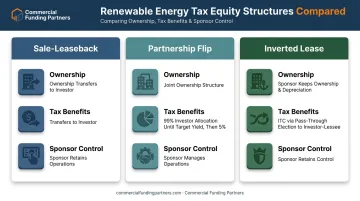
How it differs from other tax equity structures:
- Sale-leaseback — transfers ownership and nearly all tax benefits to the investor at closing
- Partnership flip — sponsor and investor jointly own the project, with the investor typically allocated 99% of income, loss, and credits until a target yield is hit, then dropping to a 5% share
- Inverted lease — sponsor keeps ownership and depreciation, while the investor-lessee claims the ITC through a pass-through election
Why This Structure Is Gaining Ground
The Section 48E Clean Electricity Investment Credit starts at a statutory base of just 6%, but climbs to 30% when a project meets prevailing wage and apprenticeship requirements (or qualifies for an exception).
Stack a Domestic Content Bonus on top, worth 2 percentage points at the base rate or 10 points at the elevated rate, and qualifying projects can reach roughly 40% combined credit value before factoring in separate energy-community or low-income adders.
That's a lot of tax value sitting on a project's balance sheet. The problem: most developers don't have enough tax liability to use it themselves.
This is where the market gap matters. From 2021 to 2023, the U.S. renewable tax-equity market averaged $18-20 billion annually. ACORE projected the market would need to exceed $50 billion annually by 2025 to absorb IRA-driven deployment.
Actual supply hasn't grown fast enough to close that gap, so sponsors without their own tax capacity increasingly look to sale-leaseback and direct credit transfers instead.
Core reasons sponsors choose sale-leaseback:
- Immediate capital injection at or near fair market value
- Off-balance-sheet treatment for the leased asset
- Retained operational control and revenue rights
- Transfer of depreciation risk and equipment obsolescence risk to the investor
How the Sale-Leaseback Process Works
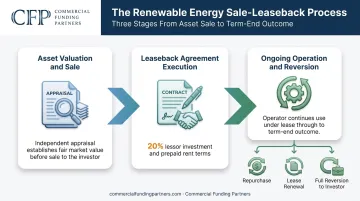
At a high level, the process runs from valuation to sale, then leaseback agreement, then ongoing lease payments, and eventually reversion or repurchase. It requires three things to work: a completed (or substantially built) renewable asset, an independent fair market valuation, and an investor with enough tax appetite to use the credits.
During the core transaction, legal title transfers to the investor. The sponsor signs a lease granting a long-term right to operate the asset. IRS leveraged-lease guidelines typically bound the lease terms, the investor collects prepaid rent upfront, and payment obligations usually follow a hell-or-high-water structure, meaning rent is due regardless of equipment disputes.
The net effect: the sponsor gains liquidity now and shifts future tax benefit realization to the investor. The investor gets a depreciable asset plus steady lease income for years. Commercial Funding Partners structures these transactions for renewable energy sponsors, matching lease terms and prepaid rent structures to each investor's tax appetite.
Step 1: Asset Valuation and Sale
An independent appraiser values the renewable asset at fair market value. The sponsor then sells it to the investor. Because this sale can close up to three months after the project is placed in service, and often at a value exceeding the original build cost, it frequently triggers a taxable gain for the sponsor.
Step 2: Leaseback Agreement Execution
The sponsor signs a long-term lease structured to stay within IRS leveraged-lease term limits. Rev. Proc. 2001-28 sets three useful benchmarks:
- Lessor investment: at least 20% of property cost at risk throughout the lease
- End-of-term value: at least 20% of original cost
- Remaining useful life: at least 20% of the original estimate
Practitioners often summarize this as capping the leaseback at roughly 80% of the asset's expected life and value.
At closing, the sponsor typically returns 15% to 20% of the sale proceeds as prepaid rent. This is a market convention, not a legal requirement, but it shows up consistently across both solar and storage deals. That means net upfront cash is meaningfully less than the headline sale price.
Step 3: Ongoing Operation, Lease Payments, and Reversion
The sponsor keeps operating the project and collecting revenue, making scheduled lease payments to the investor along the way. At the end of the lease term, three things can happen depending on contract terms:
- The sponsor repurchases the asset at a predetermined or fair-market price
- The lease renews for an additional term
- Ownership reverts fully to the investor
Where Sale-Leasebacks Are Applied and What Affects Them
Sale-leasebacks show up most often in utility-scale and commercial/industrial solar, and increasingly in battery storage financing. Norton Rose Fulbright has documented storage sale-leasebacks structured directly with bank leasing companies, and utility-scale solar remains one of the most consistent applications of the structure.
One important timing note: sale-leasebacks are typically executed once a project reaches mechanical completion or is newly placed in service, not during early development. Investors need a real, operating asset to value and finance, not a set of permits and interconnection agreements.
Meeting that operating-asset requirement calls for financing structured around a project's real performance, not projections on paper. CFP structures flexible sale-leaseback and other leasing arrangements, including capital leases, FMV leases, and master lease programs, tailored to a project's actual cash flow. That includes financing up to 100% of eligible project costs, covering soft costs like engineering, installation, and controls integration alongside the hardware itself.
CFP's team has directly funded renewable deals in this range, including a $6 million solar farm financing transaction handled through its private credit group.
Factors that shape deal outcomes:
- Asset type and remaining useful life, since DOE estimates 25-35 years for solar panels and roughly 30 years for wind turbines
- Battery storage lifespan assumptions, which NREL's 2025 cost modeling pegs at just 15 years given ongoing life-cycle uncertainty
- Investor tax appetite, which shifts with broader market and policy conditions
- Project size and complexity, since large builds may need milestone or progress-payment structures rather than a single closing
- IRS compliance requirements tied to leveraged-lease term limits and domestic content qualification
Common Issues, Misconceptions, and When Sale-Leaseback May Not Be the Right Fit
Misconception #1: Sale-leaseback and tax equity partnership flips are interchangeable. They're not. A sale-leaseback transfers nearly all tax benefits to the investor at inception. A partnership flip shares tax benefits between sponsor and investor over time, with the investor's ownership stake typically stepping down once a target return is met.
Misconception #2: Sale-leaseback proceeds equal the full appraised fair market value.
In reality, sponsors usually return 15-20% of that amount as prepaid rent at closing, which reduces net upfront cash below what the sale price suggests.
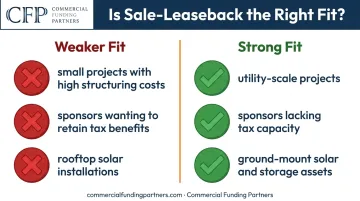
Sale-leaseback tends to be a weaker fit when:
- Small projects where transaction and structuring costs outweigh the benefit
- Sponsors who want to retain and use tax benefits directly rather than monetize them through a sale
- Rooftop solar installations, where residual value terms are often unfavorable; rooftop developers more commonly use inverted leases instead
Here's a warning sign for sponsors: teams that default straight to sale-leaseback without comparing it against partnership flips, inverted leases, or direct equipment financing risk leaving better-priced capital on the table. Running the comparison matters more than picking the most familiar structure.
Conclusion
A sale-leaseback lets renewable sponsors convert project assets into immediate capital while transferring the tax benefits to an investor with the appetite to use them. That's a real advantage for sponsors with limited tax capacity in today's tight tax-equity market.
But the mechanics matter. Valuation methodology, prepaid rent requirements, lease term limits, and reversion rights all shape whether this structure beats a partnership flip or another alternative for a specific project.
Getting that evaluation right often means working with a financing partner who structures both approaches. CFP works with renewable energy sponsors, EPC firms, and equipment vendors to structure sale-leaseback and other equipment financing solutions from $250,000 to $300 million. Projects declined or poorly priced elsewhere can also go through CFP's free Second Opinion Review before ruling out a structure entirely.
Frequently Asked Questions
What is a sale-leaseback in renewable energy?
It's a financing structure where a sponsor sells a completed renewable asset to an investor and leases it back. The sponsor gets upfront capital and keeps operating the project under a long-term lease agreement.
How does a sale-leaseback differ from tax equity partnership flips?
A sale-leaseback transfers nearly all tax benefits to the investor immediately at closing. A partnership flip shares tax benefits between sponsor and investor over time, until the investor hits a target return and its ownership share steps down.
What are the tax benefits of a sale-leaseback for solar or wind projects?
The investor claims the Investment Tax Credit, depreciation, and Domestic Content Bonus where the project qualifies. The sponsor doesn't get direct tax savings, but gains upfront liquidity instead.
Who are typical sale-leaseback investors for renewable projects?
Investors are usually banks, insurance companies, and other institutional capital sources with sufficient tax appetite and a long-term investment horizon. Banks alone have historically supplied roughly 80% of the annual clean-energy tax-equity market.
Is a sale-leaseback right for every renewable energy project?
No. It works best for larger, completed utility-scale or commercial projects. It's a weaker fit for small rooftop systems or sponsors who'd rather keep and use the tax benefits themselves.
How does the Inflation Reduction Act affect sale-leaseback financing?
The IRA's enhanced ITC and Domestic Content Bonus raised tax credit values, making sale-leaseback more attractive as tax equity supply tightens. New legislation (P.L. 119-21) sets a December 31, 2027 placed-in-service deadline for wind and solar projects starting construction after July 2026; storage projects are exempt.