Many business owners know financing exists but don't understand the mechanics behind approval, structuring, or repayment. That gap leads to mismatched terms, missed payments, or working with the wrong lender entirely. This guide breaks down exactly how construction equipment financing works, from application to payoff, including options for large or complex equipment projects.
TL;DR
- Acquire machinery with a loan, lease, or structured capital deal instead of a full cash outlay
- Use the equipment as collateral to qualify more easily than with unsecured credit
- Expect terms based on credit, time in business, cash flow, and current debt load
- Scale from mid-market equipment loans to structured deals exceeding $100 million
- Match payments to project cash flow with seasonal, deferred, or milestone schedules
What Is Construction Equipment Financing?
Construction equipment financing is a loan, lease, or structured capital arrangement used to acquire heavy machinery, vehicles, or specialized gear for job-site operations. The equipment itself secures the deal, so you avoid tying up cash that should stay available for payroll, materials, or an unexpected project delay.
Unlike a working capital loan or real estate financing, the credit is collateralized by the asset you are buying.
Why contractors rely on it:
- Preserves liquidity for operations and emergencies
- Matches payments to the equipment's useful life
- May offer tax advantages depending on structure
The main categories include:
- Equipment loans — ownership-focused, borrower holds title
- Leases — capital, operating, tax, FMV, or sale-leaseback structures
- Structured capital — for larger or more complex projects, combining direct lending with institutional capital partners
Commercial Funding Partners, for example, structures construction equipment financing from $250,000 to $300 million per project.
That coverage spans excavators, skid steers, backhoes, graders, dump trucks, cranes, and machines from manufacturers such as Caterpillar, Komatsu, Deere, Hitachi, Liebherr, and Bobcat.

How Does Construction Equipment Financing Work?
The process follows a defined sequence regardless of transaction size: identify the need, apply, get underwritten, structure payments, then fund.
Identifying Needs and Applying
It starts with picking the equipment and getting a vendor quote. From there, you submit an application along with financial documents: typically two to three years of business financials, a current interim statement, a debt schedule, and three to six months of bank statements.
For standard equipment purchases, this process is largely automated online. Larger or more complex transactions (multi-million-dollar automation, specialized machinery, extended-build projects) require direct conversations with a structuring specialist instead.
Common bottleneck: Incomplete financial documentation or a vague equipment quote slows approval significantly. Having your paperwork organized before applying speeds everything up.
Underwriting and Structuring
Lenders evaluate three things simultaneously:
- The equipment's value and resale market
- The borrower's credit profile and cash flow
- How the equipment will generate revenue to support repayment
During underwriting, lenders may fund the vendor directly or reimburse a business that already paid cash or drew on a credit line. This stage also locks in structuring decisions: term length, down payment (generally 0-20%), and whether the deal is a loan or a lease.
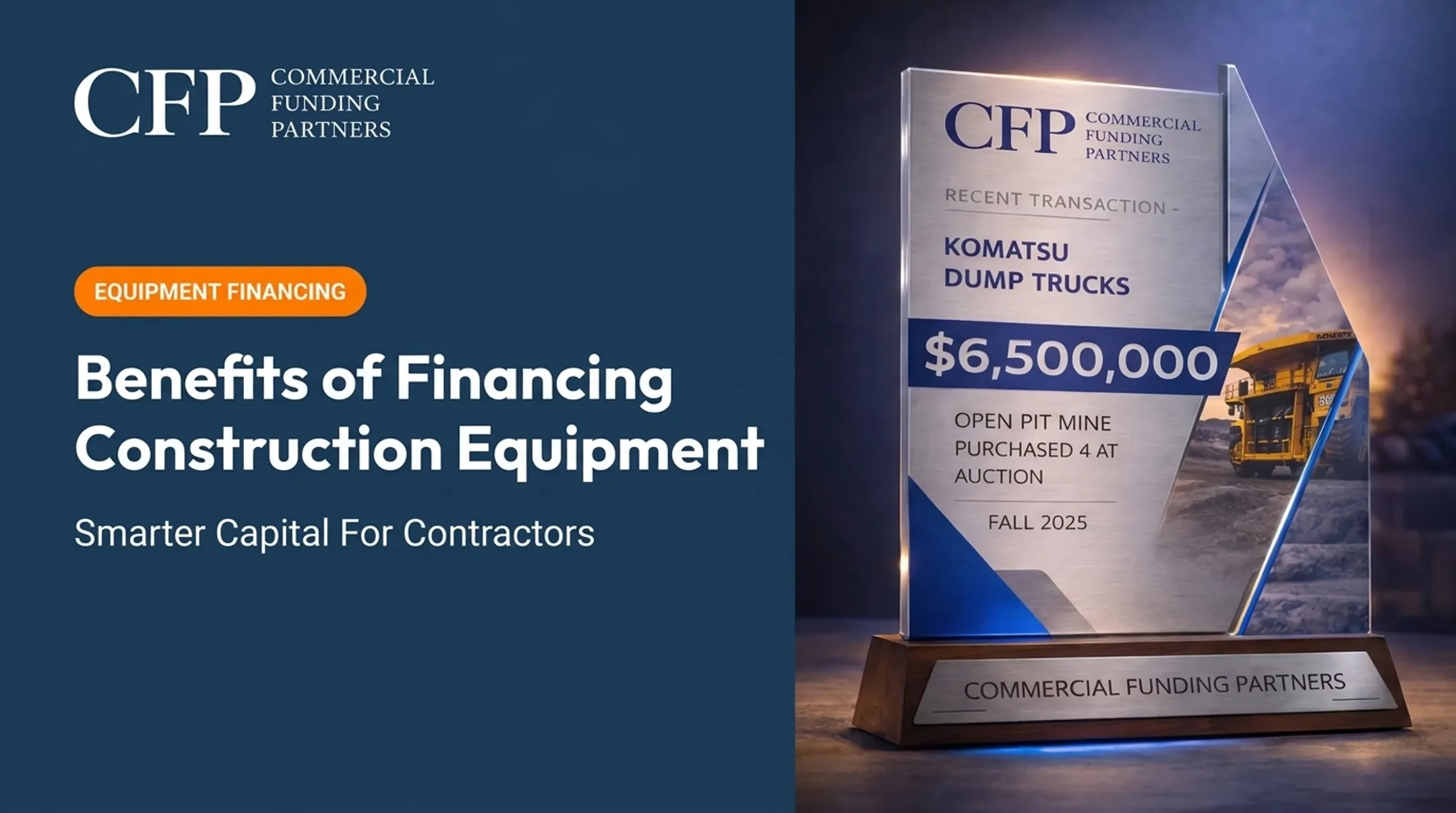
CFP deal examples span that range. One construction client closed a $1.75 million, 60-month capital lease. Another refinanced $6.5 million across four used Komatsu 100-ton dump trucks bought at auction in Ohio, a nonstandard acquisition many traditional lenders would not touch.

Matching Payments to Cash Flow
Construction revenue is seasonal and project-based, so lenders build in flexibility rather than forcing a rigid monthly payment on every borrower.
Common structures include:
- Seasonal payments (higher in peak season, lower in the off-season)
- Step-up structures that increase as revenue grows
- Deferred-principal periods
- Milestone or progress-payment funding for equipment tied to extended-build projects
Mismatched payment schedules against actual project cash flow are a leading reason equipment gets repossessed. For very large transactions, structuring can also include interest-only periods during installation or commissioning of automated equipment.
Funding and Ownership Outcome
The lender disburses funds, often directly to the vendor. You deploy the equipment, and scheduled repayments begin.
The end result differs by structure:
| Structure | Outcome |
|---|---|
| Loan | Builds toward full ownership, ends with lien release |
| Finance lease ($1 buyout) | Economically similar to a loan; ownership at end |
| FMV/operating lease | Ends with purchase, return, or renewal options |

Properly structured financing lets contractors bid on larger projects, maintain fleet capacity, and avoid cash strain during slow seasons.
Financing Options: Loans, Leases, and Structured Capital
Equipment loans transfer title to you immediately, require a down payment in most cases, and work best for equipment that holds value long-term: think cranes or dozers that still have resale value a decade out.
Leases typically mean lower monthly payments and no down payment, with flexibility at the end of the term. They suit equipment that becomes technologically outdated or heavily worn faster, since you're not stuck owning a depreciating asset.
For large-scale or complex projects, structured capital is often the better fit. A financing partner combines direct lending with a network of banks, institutional investors, and specialty finance sources to cover costs traditional bank financing often won't touch:
- Engineering and design
- Software and controls
- Freight and transportation
- Installation and commissioning
- Automation integration
CFP, for instance, can finance up to 100% of eligible project costs and structure progress-payment or milestone funding for equipment built or delivered in stages. One documented $10 million case used that structure for deposits and production-cycle milestones.
Which structure you choose also shapes the tax outcome. Section 179 and depreciation can apply to owned equipment; the IRS lists a $2.5 million maximum deduction with a $4 million phaseout threshold for 2025. A true tax lease shifts depreciation benefits to the lender in exchange for lower payments. Involve your tax advisor on this call, not just your lender.
Qualification Requirements Lenders Look At
Credit score matters, but it's one factor among several. Because the equipment secures the loan, construction financing is usually more accessible than unsecured business credit.
Lenders typically weigh:
- Credit profile — strong scores help; collateral and overall strength can offset weaker credit
- Financials and cash flow — evidence you can service the debt from operations, not just win the bid
- Time in business — Commerce Bank notes two years of operating history as a benchmark for the best rates and terms; leadership performance through slow periods also counts
- Down payment — generally 0–20%, based on credit strength, equipment type, and resale value for specialized gear

Lenders working across a wide range of credit profiles will also look at business fundamentals and project viability rather than relying on a single score cutoff.
Where Large-Scale Construction Financing Fits Best
Large-scale construction financing typically covers:
- Excavators and cranes
- Automation and material handling systems
- Fleet vehicles
- Specialized machinery for infrastructure or industrial builds
Standard bank financing works fine for routine purchases. Larger or more complex work—automation integration, cross-border equipment, multi-phase builds—often needs a lender that can move quickly, fund soft costs, and structure milestone-based draws most banks will not offer.
When a deal falls outside a bank's credit box, businesses often turn to an independent equipment finance partner. CFP's Bank Overflow Desk handles cases where the bank relationship is strong but the project still sits outside policy—extended installation periods, vendor progress payments, or leverage above lending authority.
A free Second Opinion Review is also available for projects declined or poorly priced elsewhere. CFP has completed construction transactions from $250,000 to $300 million, including the Ohio dump truck refinancing mentioned earlier.
Frequently Asked Questions
How does financing construction equipment work?
The equipment serves as collateral. Lenders typically disburse funds to the vendor, and you repay the loan or lease with interest over a set term. Underwriting weighs credit, cash flow, and the equipment's revenue potential.
How long can you finance construction and heavy equipment?
Terms generally run from 12 months to 7+ years, with repayment structured so it doesn't outlast the equipment's useful life.
What credit score do you need for construction equipment financing?
There's no universal minimum. Lenders weigh credit alongside cash flow and collateral, so strong cash flow can offset a lower score in many cases.
Is it better to lease or finance construction equipment?
Financing suits equipment that retains long-term value—like cranes—when you want ownership. Leasing fits assets that depreciate or age out quickly and keeps payment flexibility higher.
What down payment is required for construction equipment financing?
Down payments typically range from 0-20% depending on credit, equipment type, and lender, with some programs financing up to 100% of eligible project costs for qualified borrowers.
Can I get financing for large or specialized construction equipment projects?
Yes. Large or specialized projects often need a structured capital partner that can cover soft costs, progress or milestone payments, and other needs a standard bank loan won't fund.