The decision of how to acquire that equipment matters as much as which equipment to buy. Financing structures affect cash flow, tax positioning, balance sheet presentation, and your ability to upgrade as technology evolves. Getting this wrong can lock capital in depreciating assets or create unexpected accounting complications.
This guide breaks down the core differences between equipment financing and leasing, the specific lease structures available to manufacturers, key tax and accounting considerations, and how to choose the right approach for your business.
Key Takeaways
- Equipment financing transfers ownership; leasing provides use without it — each affects taxes, balance sheets, and end-of-term options differently
- 82% of U.S. businesses used at least one financing method for equipment acquisition in 2023
- Four primary lease structures serve manufacturers: operating, capital/finance, FMV, and $1 buyout leases — plus sale-leaseback for converting owned assets into capital
- Under ASC 842, most leases now appear on the balance sheet regardless of type
- Section 179 deductions reach $2.5 million in 2025; 100% bonus depreciation is permanently restored for qualifying property placed in service after January 19, 2025
Manufacturing Equipment Financing vs. Leasing: What's the Difference?
These two terms get used interchangeably, but the structures — and what they mean for your balance sheet, taxes, and end-of-term options — are meaningfully different.
Equipment Financing (EFA)
An Equipment Finance Agreement works similarly to a secured loan. The manufacturer borrows funds to purchase the equipment, makes fixed monthly payments over the term, and owns the asset outright (either immediately or upon final payment). From day one, the borrower is treated as the owner, meaning:
- Maintenance, insurance, and liability fall to the borrower
- The asset appears on the borrower's balance sheet
- Depreciation deductions (including Section 179) are available to the owner
Equipment Leasing
Under a lease, the lessor retains ownership of the equipment. The manufacturer pays for the right to use it over a fixed term, with options at the end to purchase, renew, or return the equipment. Responsibilities vary by agreement — some lease structures shift maintenance obligations to the lessor, others keep them with the lessee.
The Practical Distinction
The core difference is ownership and what comes with it: liability exposure, maintenance costs, depreciation rights, and what happens when the term ends.
| Factor | Equipment Financing (EFA) | Equipment Leasing |
|---|---|---|
| Ownership | Borrower (immediately or at end) | Lessor retains |
| Maintenance | Borrower's responsibility | Varies by structure |
| Balance sheet | Asset and debt recorded | ROU asset + liability (ASC 842) |
| End-of-term | Borrower keeps the asset | Purchase, renew, or return |
| Tax treatment | Depreciation deductions available | Lease payments may be deductible |
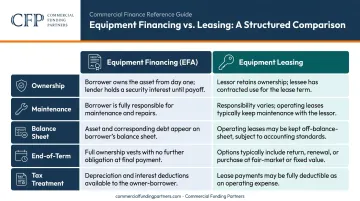
Neither option requires full capital outlay upfront — both preserve cash relative to an outright purchase. The structure you choose affects how that cash preservation interacts with your accounting and tax position.
Choose financing for core, long-lived production assets you intend to keep indefinitely: heavy industrial presses, foundry equipment, structural fabrication systems.
Choose leasing for technology-intensive equipment that may need upgrading, situations where balance sheet management is a priority, or when preserving cash flow flexibility matters more than ownership.
Types of Manufacturing Equipment Leases
Not all leases are structured the same way. Manufacturers typically encounter four primary structures, each suited to different operational and financial goals.
Operating Lease
The lessee uses the equipment without taking ownership. Payments are treated as operating expenses, and the lessor retains the asset on their books. The right fit: equipment with a shorter useful life relative to the lease term, or when the priority is flexibility to upgrade or return at term end.
Capital (Finance) Lease
This structure functions more like a purchase. The lessee assumes most ownership risks and benefits — the asset and a corresponding liability appear on the lessee's balance sheet, recording separate amortization and interest expense. It works best when the manufacturer plans to own the equipment long-term but wants to preserve cash during acquisition.
Fair Market Value (FMV) Lease
FMV leases offer lower monthly payments with three options at term end: purchase the equipment at its then-current fair market value, renew the lease, or return the equipment. Lower cash outlays today plus the option to walk away — useful when the equipment's long-term role in operations isn't yet clear.
$1 Buyout Lease
Monthly payments run higher than an FMV lease, but the lessee acquires the equipment for $1 at term end — ownership is effectively guaranteed from day one. Choose this structure when keeping the equipment is already decided and a lump-sum buyout at the end isn't appealing.
Sale-Leaseback
A sale-leaseback allows a manufacturer who already owns equipment to sell it to a financing company and immediately lease it back — receiving immediate cash while retaining full use of the asset. The equipment never leaves the facility, production continues uninterrupted, and the freed capital can fund expansion, new equipment acquisition, or working capital shortfalls. For manufacturers sitting on significant owned equipment, it's one of the fastest ways to unlock balance sheet liquidity without taking on new debt.
Commercial Funding Partners structures sale-leaseback transactions for manufacturers across multiple industries — including a $40 million automation equipment deal in Idaho. CFP's COO Dave Johnson has overseen more than $1 billion in equipment and project financing transactions, with sale-leaseback a frequent tool for manufacturers navigating capital constraints or funding growth.
Key Benefits of Leasing Manufacturing Equipment
According to the Equipment Leasing and Finance Association, 57.7% of all U.S. equipment and software investment — roughly $1.34 trillion — was financed through loans, leases, or lines of credit in 2023. Among manufacturers specifically, the adoption rate is even higher. The reasons aren't hard to identify.
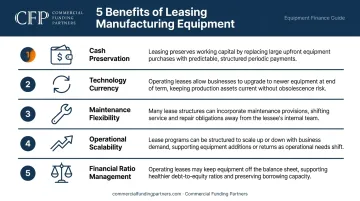
Five advantages drive most of the adoption:
- Cash preservation — Leasing converts a large capital expenditure into manageable monthly payments with minimal upfront capital. Rather than deploying $2 million into a single asset, manufacturers can spread that cost over a 36- to 60-month term and redeploy working capital into inventory, labor, or new market opportunities.
- Technology currency — Automation systems, CNC equipment, and robotics evolve quickly. An operating or FMV lease lets manufacturers upgrade to newer equipment at term end rather than carrying outdated assets on the books.
- Maintenance flexibility — Certain lease structures shift upkeep responsibility to the lessor, reducing the cost and disruption of unexpected repairs. Lessees still carry scheduled maintenance obligations under most agreements, but the exposure is narrower.
- Operational scalability — Leasing makes it easier to add equipment mid-term or return assets when production demands shift, rather than being locked into depreciating owned assets through a slow period.
- Financial ratio management — Depending on lease structure, payments may be classified as operating expenses rather than debt service — which matters when securing additional financing or managing bank covenants.
Tax and Accounting Considerations for Manufacturers
Section 179 and Bonus Depreciation
Manufacturers who purchase or finance equipment can take advantage of significant first-year deductions. For 2025:
- Section 179 deduction limit: $2.5 million, with a dollar-for-dollar phaseout beginning at $4 million in total qualifying purchases (up from $1.22 million and $3.05 million in 2024)
- Bonus depreciation: 100% for qualifying property acquired and placed in service after January 19, 2025 — permanently restored under Public Law 119-21, enacted July 4, 2025
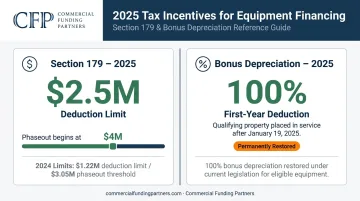
These provisions can eliminate most or all of the first-year tax cost on financed equipment. A manufacturer financing a $1.5 million CNC line could potentially deduct the full cost in year one — improving the after-tax economics of ownership versus leasing.
Lease Payment Deductibility
For true operating leases, monthly payments are generally deductible as a business operating expense under IRS guidance. This creates a consistent annual tax benefit rather than a concentrated first-year deduction.
The critical caveat: the IRS distinguishes between true leases and conditional sales contracts based on the substance of the agreement, not its label. If the agreement effectively transfers ownership — nominal purchase option, payments that build equity, or terms approximating acquisition cost — the IRS may reclassify it as a conditional sale, making payments non-deductible as rent. Manufacturers should work with a CPA to confirm tax classification before assuming deductibility.
ASC 842 Accounting Impact
Under current U.S. GAAP, ASC 842 requires most leases longer than 12 months to appear on the balance sheet. Each lease generates a right-of-use (ROU) asset and a corresponding lease liability. This applies to both operating and finance leases, though income statement presentation differs:
- Operating leases: Single lease cost, recognized on a straight-line basis
- Finance leases: Separate interest expense and ROU asset amortization
The practical implication: leasing no longer keeps assets off the balance sheet for most manufacturers. Added lease liabilities can affect reported leverage ratios, bank debt covenants, and how lenders evaluate creditworthiness. Before signing a multi-year lease, finance teams should model the covenant impact — particularly if existing credit agreements include leverage or coverage ratio tests.
How to Apply for Manufacturing Equipment Financing
What Lenders Evaluate
When a manufacturer approaches a financing source, underwriters typically assess:
- Business and personal credit profiles
- Time in business and revenue stability
- Financial statements (typically 2-3 years)
- Equipment type, age, and collateral value
- Ability to service the debt relative to projected cash flow
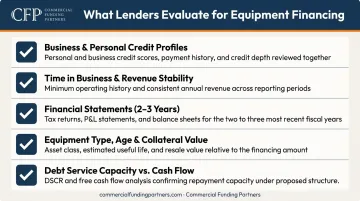
Preparing these materials in advance — and being ready to explain how the equipment will directly benefit revenue or reduce operating costs — accelerates the approval process considerably. ### Why Specialized Lenders Matter
Many manufacturing transactions get declined at traditional banks not because the business lacks creditworthiness, but because the transaction size, deal complexity, or equipment type falls outside the bank's appetite. A $5 million automation line financed over 60 months with a sale-leaseback component isn't a standard commercial loan application — it requires a lender that understands how to structure and underwrite it.
That gap is exactly where specialized intermediaries add value. Commercial Funding Partners focuses on large-scale equipment financing from $250,000 to $100 million-plus, serving manufacturing, construction, healthcare, energy, and other capital-intensive industries. The team has a track record of stepping in where traditional banks have passed — on specialized equipment, complex deal structures, and industries that conventional lenders typically avoid.
CFP's structuring specialists respond within one business day. Available structures include:
- Operating leases
- Capital leases
- FMV leases
- $1 buyout leases
- Sale-leasebacks
- Vendor finance programs
Frequently Asked Questions
What are the types of manufacturing equipment leases?
Four primary structures cover most manufacturing scenarios:
- Operating leases — use without ownership; payments treated as operating expenses
- Capital/finance leases — ownership-like treatment; asset appears on the lessee's balance sheet
- FMV leases — lower payments with a fair-market-value purchase option at term end
- Sale-leasebacks — sell owned equipment to a financing company, then lease it back for immediate cash
How do you record a manufacturing equipment lease in accounting?
Under ASC 842, leases over 12 months are recorded as a right-of-use asset with a corresponding lease liability. Operating leases use straight-line lease cost; finance leases separate amortization and interest expense. Work with a CPA to confirm proper classification.
What is the difference between equipment financing and equipment leasing?
Financing (EFA) transfers ownership to the borrower immediately or at final payment; leasing provides use of the equipment without ownership. The two structures differ in how maintenance responsibility, liability, end-of-term options, balance sheet treatment, and tax deductions are handled.
Can a manufacturer use a sale-leaseback to free up capital?
Yes. A sale-leaseback lets a manufacturer sell owned equipment to a financing company and lease it back immediately, receiving cash while retaining full use of the asset. The freed capital can fund expansion, cover working capital needs, or accelerate new equipment acquisition.
What credit or financial requirements are needed to qualify?
Lenders typically review business and personal credit, time in business, financial statements, and the equipment's type and collateral value. Specialized independent lenders like Commercial Funding Partners can often structure solutions for manufacturers that traditional banks may decline due to deal complexity or transaction size.
Is it better to lease or buy CNC machines and automation equipment?
Leasing tends to work better for CNC and automation equipment, where technology cycles fast. An FMV or operating lease allows upgrades at term end instead of carrying aging assets. For long-lived, heavy-duty equipment, buying via EFA may make more sense — Section 179 or 100% bonus depreciation can substantially offset year-one costs.