The stakes are real. Choose wrong and you strain working capital, trigger an unfavorable tax outcome, or get stuck with equipment that's obsolete before it's paid off. In 2023, U.S. businesses financed $1.34 trillion in equipment and software, roughly 57.7% of the $2.3 trillion spent nationwide, according to the Equipment Leasing & Finance Foundation. Most companies aren't paying cash outright.
This guide breaks down the financial, tax, and operational tradeoffs of leasing versus buying, with a practical framework and a real example to help you decide with confidence.
Key Takeaways
- Leasing preserves capital and adds flexibility, but rarely builds equity in the asset
- Buying builds ownership and long-term equity, but demands a bigger upfront cash commitment
- ASC 842 and IFRS 16 now put most leases on the balance sheet, changing how lenders read your ratios
- Skip the guesswork. Run an NPV comparison of after-tax cash flows before committing either way
Lease vs Buy: Quick Comparison
Here's how leasing and buying compare on the factors that matter most:
| Factor | Leasing | Buying |
|---|---|---|
| Upfront cash outlay | Little to no down payment; some structures finance 100% of project costs | Full purchase price (cash) or a down payment plus loan principal |
| Balance sheet & ownership | Lessor holds title; under ASC 842/IFRS 16, most leases still appear on-balance sheet as a right-of-use asset and liability | Buyer holds title immediately; asset and any related debt appear on the balance sheet |
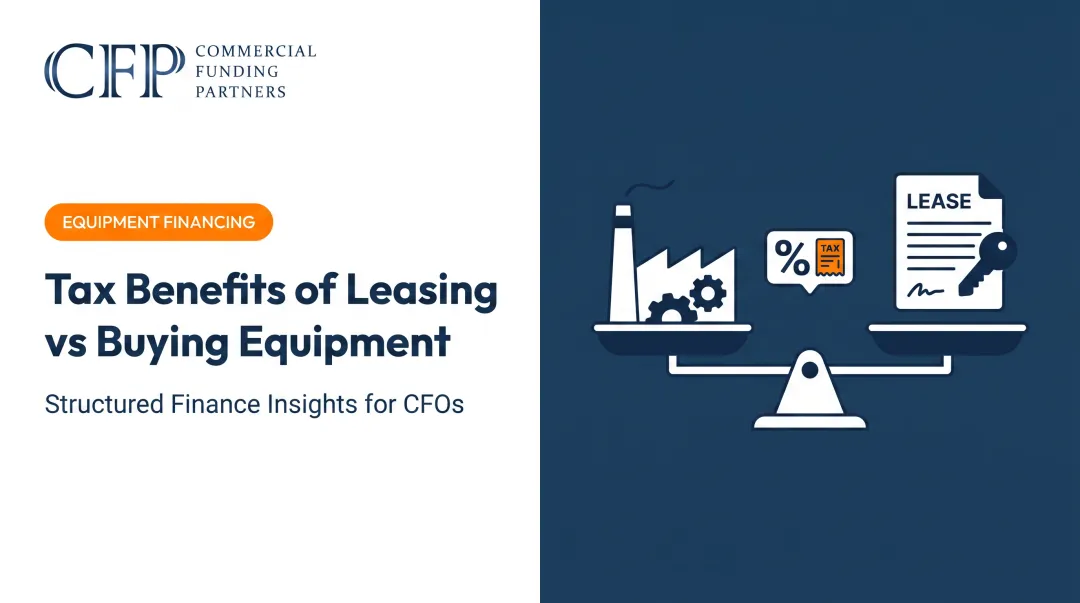
| Tax treatment | Lease payments are often deductible as an operating expense | Section 179 and bonus depreciation may allow rapid write-offs of the purchase price |
| Flexibility & obsolescence risk | Easier to upgrade or return equipment at term end; lessor absorbs resale risk | Business bears resale and obsolescence risk, but keeps full control of the asset |
| Maintenance & long-term responsibility | Can be structured as full-service or net lease, depending on the agreement | Owner is responsible for all maintenance, repairs, and eventual disposal |
CFP's leasing programs can finance up to 100% of eligible project costs, including installation, software, and freight. That structure helps cash-constrained projects keep working capital free for operations.
What Is Leasing for Business Equipment?
Leasing is a contractual arrangement where a business (the lessee) pays to use an asset owned by a lessor for a defined term. There is no purchase and no title transfer: only the right to use the equipment. For capital-intensive industries, that frees up cash that would otherwise sit locked in machinery.
Core benefits include:
- Lower upfront cost, often with no down payment required
- Predictable monthly payments that simplify budgeting
- Payment schedules matched to project cash flow, preserving liquidity for payroll or expansion
Lease Structures Businesses Actually Use
Not all leases work the same way. Businesses typically choose among:
- Operating leases: shorter-term structures favored for cash-flow management and end-of-term flexibility
- Finance/capital leases: full-payout structures, often with a nominal buyout, for businesses that want a path to ownership
- FMV leases: lower payments with a fair-market-value purchase option at term end
- Master lease programs: used for large, multi-vendor, or revolving equipment programs
- Sale-leasebacks: convert owned equipment into working capital without interrupting its use
Commercial Funding Partners uses these same structures to match a company's cash flow and tax goals. CFP has structured everything from a 60-month operating lease for equipment rental fleets to a $100 million sale-leaseback with a 12-month interest-only ramp.
One caveat: writing off lease payments as an operating expense can still offer a tax advantage, but ASC 842 and IFRS 16 now require most leases — operating and finance alike — to appear on the balance sheet as a right-of-use asset and liability.
Use Cases of Leasing
Leasing fits best where obsolescence risk runs high: IT infrastructure, medical imaging systems, or manufacturing automation that may be outdated within five years. Industries with heavy equipment financing and leasing adoption include:
- Healthcare: roughly 70% of equipment acquisitions involve financing or leasing
- Construction: around 85% of equipment acquisitions involve financing or leasing
- Manufacturing: industrial equipment financing and leasing rates near 78%

For certain fleets, leasing can even beat ownership on pure cost. A 2024 KPMG analysis of Class 8 truck fleets found leasing could save up to 19% compared to ownership under certain pricing assumptions.
What Is Buying for Business Equipment?
Buying means acquiring full ownership of an asset, either with cash or a loan. For businesses that need long-term control, want customization rights, or plan to use an asset well past any lease term, ownership usually wins.
Core benefits include:
- Building equity instead of paying for use only
- No end-of-lease negotiations, returns, or buyout surprises
- Tax advantages through Section 179 deductions and depreciation
On the tax side, the numbers matter. For 2025, the IRS raised the Section 179 deduction ceiling to $2.5 million and restored 100% bonus depreciation for qualifying property acquired and placed in service after January 19, 2025, according to IRS Form 4562 instructions.
That is a meaningful shift from the 2024 rules, which capped Section 179 at $1.22 million with 60% bonus depreciation.
Buying takes two forms. An outright cash purchase keeps the balance sheet debt-free. A debt-financed purchase adds a loan liability but still books the asset and its full depreciation benefit.
Ownership also means unrestricted modification rights, a real advantage for specialized manufacturing equipment that needs custom retrofits later.
When Buying Makes Sense
Buying makes the most sense for durable, slow-to-obsolete assets that a business will use for many years:
- Heavy construction and agricultural machinery
- Company-owned vehicles and long-haul trucking fleets
- Manufacturing lines and permanent production systems
A Wolters Kluwer case study modeled a $50,000 piece of equipment used over eight years, including a 25% down payment and a 6% after-tax discount rate. Present-value cost: $32,204 to buy versus $34,838 to lease. For that long-lived asset profile, ownership won. The math tilts toward buying when the asset holds its usefulness and value for the long haul.
Lease vs Buy: How to Decide
There's no universal winner here. The right call depends on five factors:
- Expected duration of use — will you need this asset for 3 years or 15?
- Pace of technological change — does your industry's equipment become outdated quickly?
- Available capital and credit access — can you absorb a large upfront outlay without straining operations?
- Tax strategy — does your business benefit more from expense deductions or depreciation?
- Impact on financial ratios and debt covenants — will a lease liability or loan affect your borrowing capacity elsewhere?

As a starting point:
- Lease if preserving cash, avoiding obsolescence risk, or securing 100% project financing is the priority
- Buy if the asset has a long useful life, holds resale value, and you want the full depreciation benefit
But don't stop at gut instinct. Run a net present value (NPV) comparison of after-tax cash flows for both options. Factor in interest, depreciation, maintenance, and residual value rather than comparing payment size alone. Then bring in a structuring specialist or accountant before finalizing anything.
CFP's structuring specialists typically respond to a project inquiry within one business day. They walk through both purchase and lease paths—including equipment loans, capital leases, operating leases, tax leases, and FMV leases—so you can see the full picture before signing anything.
Real-World Example: Financing a Major Equipment Upgrade
In January 2026, an Idaho-based manufacturer of cell phone casings needed $40 million in new automation equipment to keep production moving. Vendors had to be paid within a strict three-week window, and the company's auditor had mandated a specific lease rate factor that traditional banks couldn't structure fast enough to meet.
An outright cash purchase wasn't realistic on that timeline, and a conventional bank loan couldn't satisfy the auditor's requirements on time either. Deadline pressure plus that accounting constraint pushed the company toward a structured lease instead of ownership.
Commercial Funding Partners structured a $40 million, 36-month equipment lease and funded it ahead of schedule. Results:
- Vendor payments cleared inside the three-week window
- Production stayed online with no missed deadlines
- $40 million in cash stayed available for other operations
- Lease terms met the auditor’s required rate factor

The deal worked because the structure could flex on both speed and accounting treatment—not because lease is always better than buy. When banks decline or misprice a project, CFP’s free Second Opinion Review re-underwrites the transaction from scratch to test whether a different lease or loan fit works better.
If your business is weighing a major equipment purchase, talk to a CFP structuring specialist about running a lease-vs-buy analysis for your specific project before you commit either way.
Frequently Asked Questions
What is the 1.25% rule of leasing?
The 1.25% rule says a reasonable monthly lease payment is roughly 1.25% of the equipment's total cost. Treat it as a quick screening tool, not a substitute for a full NPV analysis.
Is it better to lease or buy equipment for a small business?
It depends on your cash reserves, how long you'll use the equipment, and how fast it becomes obsolete in your industry. There's no single right answer; run the numbers for your specific situation.
Can you switch from leasing to owning an asset later?
Yes, many leases include lease-to-own or end-of-term purchase options. Terms vary significantly by lessor, so review the buyout structure carefully before signing.
Is leased equipment tax deductible?
Lease payments are often deductible as an operating expense, provided the arrangement is a true lease rather than a conditional sale. Purchased equipment, by contrast, may qualify for Section 179 or bonus depreciation instead.
How do you calculate whether leasing or buying saves more money?
Compare the after-tax cash outflows of each option (interest, depreciation, maintenance, and residual value) discounted to present value over the asset's useful life. This NPV approach beats comparing payment size alone.
Does leasing equipment affect my business's ability to get other financing?
It can. Under ASC 842 and IFRS 16, most leases now appear on the balance sheet, which can affect debt-to-equity ratios and covenant calculations that lenders review closely.