Introduction
When a business decides to go solar, the financing structure is often the last thing on the agenda — and the decision that matters most. The U.S. solar market added 43 GWdc of new capacity in 2025, bringing cumulative installed capacity to 279 GWdc according to SEIA's 2025 Year in Review, with forecasts projecting 769 GWdc by 2036. More commercial operators are going solar than ever before — and the gap between a well-structured deal and the wrong one can span hundreds of thousands of dollars over a 20-year horizon.
This isn't just a monthly payment question. The choice between a lease and a loan directly affects:
- Who owns the system and captures the tax incentives
- How the asset appears on your balance sheet
- What happens when you sell or refinance the property
- How much you actually save over a 20–25 year horizon
For commercial operators, the stakes are even higher. A manufacturing facility or agricultural operation financing a $500,000+ solar installation needs a structure that matches its capital situation, tax position, and long-term operational goals — not a one-size-fits-all consumer product.
This guide breaks down how each option works, how they compare across key dimensions, and how to choose the right structure based on your financial goals.
Key Takeaways
- A solar lease gives you use of a system for a fixed monthly fee — no ownership, no maintenance burden, but no tax incentives either
- A solar loan means you own the panels from day one, making you eligible for federal and state tax credits and depreciation benefits
- Loans typically produce higher lifetime savings; leases offer lower upfront commitment and operational simplicity
- Businesses owning systems through a loan or capital lease can access 5-year MACRS depreciation, which leases don't provide
- The right choice depends on your capital availability, tax position, hold horizon, and appetite for ownership
Solar Lease vs. Solar Loan: A Quick Comparison
| Dimension | Solar Lease | Solar Loan |
|---|---|---|
| Upfront Cost | None | None to low |
| Ownership | Third-party provider | You (borrower) |
| Monthly Payments | Fixed fee (or per-kWh for PPA) | Principal + interest |
| Federal Tax Credits | Goes to leasing company | You claim directly (if eligible) |
| MACRS Depreciation | Not available to lessee | Available to commercial owners |
| Maintenance | Provider handles it | Your responsibility |
| Property Value Impact | Minimal or complicating | Typically increases value |
| End-of-Term Options | Buy, renew, or remove | You own it outright |
| Commercial Applicability | Limited tax benefit | Strong capital asset treatment |
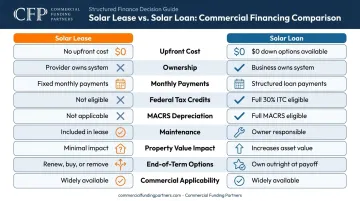
Both options make solar accessible without a full cash outlay upfront. The real difference comes down to ownership — and ownership determines who captures the tax credits, the depreciation, and the asset value.
For commercial properties, the decision gets more nuanced. Operating leases, capital leases, and equipment sale-leasebacks each carry distinct accounting and tax implications — and the right structure depends on how the asset fits your balance sheet, your depreciation strategy, and your long-term capital plan.
What Is a Solar Lease?
A solar lease is a third-party ownership arrangement. A solar company installs panels on your property, retains ownership, and charges you a fixed monthly fee for use of the system. A Power Purchase Agreement (PPA) works similarly but bills you per kilowatt-hour actually produced rather than a flat equipment fee — making the two distinct products even though they're often grouped together.
The core appeal: no upfront cost and no maintenance burden. The leasing company handles installation, monitoring, and repairs. For businesses prioritizing immediate utility cost reduction without tying up capital, that tradeoff is worth examining — but the contract terms carry real risks.
The Escalator Clause Risk
Most residential leases include annual rate increases of 1%–3%, with some PPAs carrying escalators up to 5% according to CFPB's solar financing research. That compounding can erode your savings if utility rates don't rise at the same pace.
A simple example: a $150/month lease payment with a 3% annual escalator becomes roughly $215/month by year 15. Whether that still represents a saving over your utility bill depends entirely on how rates move — something no contract can guarantee.
End-of-Term Options
At the end of a typical 20–25 year residential lease, you generally choose between:
- Buying the system at fair market value (often priced above remaining payment totals)
- Renewing the lease for another term
- Having panels removed by the leasing company
Consumer Reports documented a case where homeowners offered $16,000 to buy out a leased system when selling their property — but the leasing company enforced the contract's $21,000 buyout price. That gap is not unusual, and it matters enormously if you're trying to sell.
Use Cases for a Solar Lease
A lease makes practical sense when:
- Capital is limited and immediate utility savings are the priority
- Your tax liability is too low to benefit from ownership incentives
- You want zero maintenance responsibility and maximum operational simplicity
- You're in a short- to medium-term hold situation with no plans to sell soon
One important geographic note: third-party solar PPAs are currently authorized in at least 29 states plus Washington, D.C., and Puerto Rico, with state-specific rules and limitations. Not all markets permit residential or commercial solar leases — verify availability before proceeding.
What Is a Solar Loan?
A solar loan finances your outright purchase of the solar system. You own it from the day it's installed and pay it off in monthly installments over a contracted term — typically 8 to 25 years for residential solar-specific products, with actual payoff often occurring in 7 to 9 years due to prepayments.
Secured loans (backed by home equity or PACE programs) generally carry lower rates than unsecured options, with creditworthiness driving the specific terms you'll receive. CFPB's market research found stated APRs of 1%–7% for residential solar loans — but dealer fees embedded in the financed amount can add materially to the real cost, sometimes reaching 10%–30% of the cash price.
The Ownership Advantage
Ownership is what unlocks the financial upside. As the system owner, you're eligible for:
- Federal tax credits — the commercial Section 48E Clean Electricity Investment Credit starts at a 6% base rate and can reach 30% when applicable multiplier requirements are met
- 5-year MACRS depreciation for qualified clean energy property placed in service after 2024
- Net metering credits where available
- State-level incentives that vary by jurisdiction
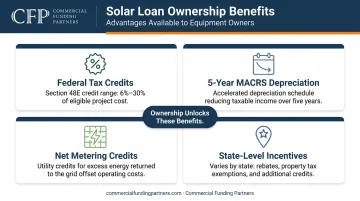
None of these benefits are available to lessees — the leasing company claims any applicable commercial credits.
The residential picture differs. The Section 25D credit (historically 30%) applied to qualifying installations completed through December 31, 2025. For residential expenditures after that date, it is no longer available. Commercial buyers should consult a tax advisor for current Section 48E eligibility and timing requirements.
Property Value Impact
Berkeley Lab's analysis of over 22,000 home sales found an average solar ownership premium of approximately $4 per watt — roughly $15,000 for an average-sized residential system. For commercial properties, owned solar systems can be treated as capital assets on the balance sheet, adding book value that a lease cannot.
Long-Term Economics
Once the loan is paid off, typically within 5 to 15 years, the system produces electricity at near-zero marginal cost for the remaining 10–20 years of its useful life. That's where the real savings stack up. EnergySage estimates the average residential solar buyer breaks even around year 10, with projected savings of approximately $61,093 over 25 years.
For commercial solar installations above $250,000, Commercial Funding Partners (CFP) structures equipment loans, capital leases, and sale-leaseback arrangements tailored to each client's cash flow profile. With over $1 billion funded across energy, manufacturing, and infrastructure transactions, CFP's team can evaluate whether a loan, capital lease, or operating lease best fits a given balance sheet and tax position.
Use Cases for a Solar Loan
A loan makes the most financial sense when:
- You plan to hold the property long-term and want to build equity
- Your business has taxable income that benefits from depreciation deductions
- The system is large enough that ownership economics justify the financing effort
- You want to maximize total lifetime savings and asset value
For businesses in manufacturing, construction, agriculture, and energy storage, the financial return on a commercial solar loan over a system's life can reach hundreds of thousands of dollars in reduced operating costs.
Solar Lease vs. Solar Loan: Which Option Works Best?
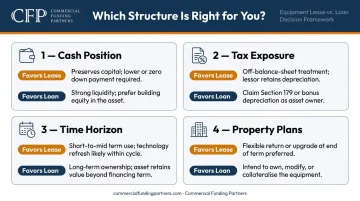
The right structure comes down to four variables that interact differently for every business. Get these right, and the answer becomes clear.
Four Key Decision Factors
Cash position: Leases eliminate upfront financing complexity. If preserving capital matters more than building equity, that shapes the decision immediately.
Tax exposure: Depreciation and commercial tax credits (Section 48E, MACRS) only flow to the system owner. If your taxable income is too low to absorb those deductions, those deductions go unused — and ownership loses a key advantage.
Time horizon: Exit within 5–7 years and the cumulative savings from ownership may not materialize before you're out. Long-term holders are the ones who capture the full backend returns.
Property plans: Leased systems complicate sales. A buyer must qualify to assume the lease under the leasing company's credit approval — or you buy it out, typically at a premium above remaining payments. Owned systems transfer as a value-add or settle cleanly at closing.
Situational Recommendations
Choose a lease if:
- Capital preservation is the priority and immediate utility savings matter now
- Your tax liability is too low to benefit from credits or depreciation
- Shifting maintenance responsibility to the lessor fits your operational model
- You're not planning to sell the property in the near term
Choose a loan if:
- You want full ownership and long-term asset value
- Your tax position allows you to benefit from Section 48E and MACRS depreciation
- The property is a long-term hold where backend savings compound
- The installation is commercial-scale and large enough to justify treating it as a capital asset
Commercial solar installations at scale — where system costs run into seven figures — warrant a more detailed structure analysis. CFP's structured finance team can evaluate equipment loans, capital leases, operating leases, and sale-leaseback arrangements to find the structure that preserves cash flow and maximizes ROI for your specific situation. Reach them directly at (801) 461-3337 or [email protected].
Conclusion
A solar lease and a solar loan each serve legitimate purposes — the question is which purpose matches your situation. Leases offer accessibility and simplicity with no upfront capital required. Loans deliver ownership, tax benefits, depreciation access, and significantly higher lifetime savings for those who qualify.
For businesses and commercial property owners making large-scale solar investments, the financing structure matters more than the monthly payment. A $500,000 commercial installation structured as a capital lease versus an equipment loan versus a sale-leaseback produces materially different outcomes on your balance sheet, tax return, and long-run cash position.
The right structure depends on three core variables:
- Ownership goals — whether you want to own the asset outright or prefer a hands-off arrangement
- Tax position — whether your business can capture depreciation and the ITC, or has limited tax liability to offset
- Cash flow priorities — whether preserving capital now matters more than maximizing lifetime savings
Talk to a structured finance specialist who can model the full picture — lifetime cash position, tax treatment, and balance sheet impact — before you commit. Commercial Funding Partners works with middle-market businesses on large-scale solar and energy equipment financing, structuring deals from $250,000 to $100M+ across capital leases, equipment loans, and sale-leasebacks. Reach out to discuss which structure fits your situation.
Frequently Asked Questions
Is it worth it to buy out a solar lease?
A buyout makes sense when you're planning to sell the property, want ownership benefits, or can negotiate a price below the remaining payment total. Many contracts, however, price buyouts above remaining balances — Consumer Reports documented one case where the contractual buyout was $21,000 against a homeowner's $16,000 offer. Review the contract terms carefully before committing.
Is it harder to sell a house with a solar lease?
Yes — a leased system adds real friction to a home sale. The buyer must qualify to assume the lease under the leasing company's terms, or you absorb the buyout cost, often at a premium. Owned systems, by contrast, typically transfer as a straightforward value-add or can be paid off at closing.
What happens at the end of a solar lease?
At the end of a typical 20–25 year solar lease, you generally have three options: purchase the system at fair market value, renew for another term, or have the panels removed by the leasing company. Buyout pricing and renewal terms are fixed in the original contract — read those provisions carefully before signing.
Can businesses finance commercial solar installations with a loan?
Yes. Businesses can finance commercial solar systems through equipment loans, capital leases, or structured arrangements tailored to their cash flow and tax position. For larger installations, lenders like Commercial Funding Partners can align repayment schedules with projected energy savings and balance sheet requirements.
Do solar loans affect your credit score?
Solar loans require a credit check and appear as a liability on your credit profile. On-time payments may improve your score over time, while missed payments will hurt it — and your creditworthiness at application heavily influences the rate you qualify for.
Who gets the federal solar tax credit — the lessee or the loan holder?
The credit goes to the system owner. Loan holders can claim it directly, subject to current eligibility rules. Lessees don't qualify — the leasing company claims any applicable commercial credit and may or may not pass savings through as lower rates.