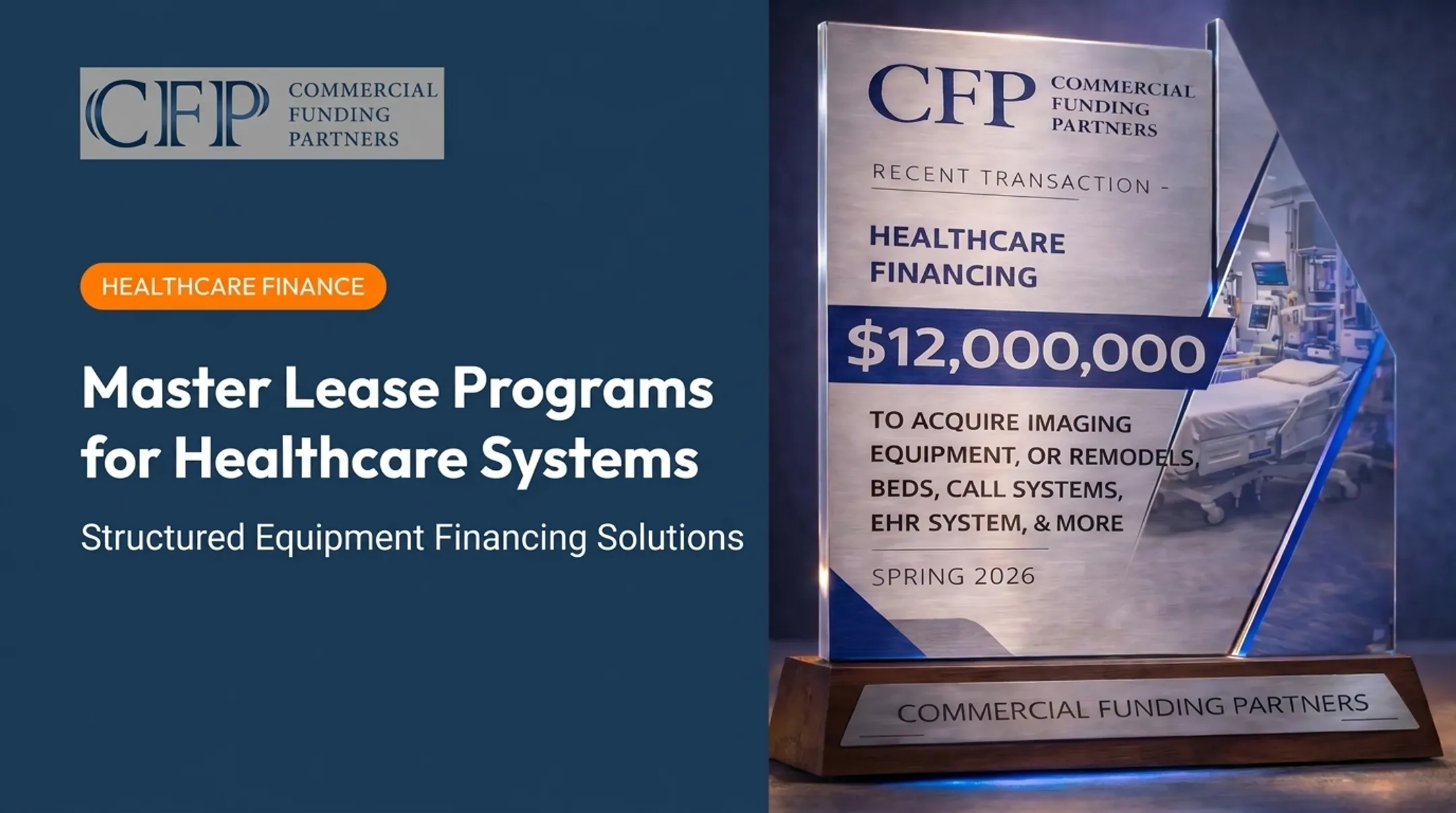
That cycle doesn't match how modern manufacturing actually runs. A Master Lease Program solves it by putting one pre-approved financing structure in place, then letting manufacturers draw against it repeatedly without renegotiating terms every time.
This guide breaks down how master leases work, what they cost, how they stack up against other financing options, and how Commercial Funding Partners (CFP) structures these programs for manufacturers from $250,000 to $300 million.
Key Takeaways
- One master agreement covers unlimited future equipment schedules under pre-negotiated terms
- Add new machines without repeating underwriting each time
- Finance up to 100% of project costs, including installation, engineering, and automation integration
- Get a CFP structuring response within one business day—same-day preliminary reviews available
What Is a Master Lease Program for Manufacturers?
A master lease agreement is an umbrella contract. It locks in standard terms, pricing frameworks, and documentation before you finance the next machine.
According to the ELFA-backed Equipment Finance Advantage guide, a master lease covers multiple equipment deliveries, with each delivery documented on its own schedule.
Here's how that plays out in practice:
- Master agreement — negotiated once for credit terms, general conditions, and documentation standards
- Individual schedules (or addenda) — added each time you finance new equipment under the master terms
- No full re-application — not required for each asset, as long as it fits the program parameters
Master Lease vs. Single-Transaction Lease
A standard equipment lease finances one asset, one time. It's a closed transaction.
A master lease is built for scale. That can mean adding a production line at one plant, financing robotics across three facilities, or running a multi-year capital plan without a new contract each time.
Manufacturers can combine multiple lease types under a single master program: capital leases, operating leases, FMV leases, and tax leases. That flexibility matters because different equipment purchases suit different accounting treatments, and a rigid one-size-fits-all lease structure rarely fits every acquisition.
Real-world scale: CFP structured $8.5 million across seven tax-lease schedules for one client, spanning a 10-entity borrower structure with terms from 36 to 48 months — one framework, multiple schedules, one relationship.

How Master Lease Programs Work for Manufacturers
The process breaks into two phases, and understanding the split is what makes this structure valuable.
Phase one is the heavy lift: credit approval and execution of the master agreement itself. Underwriting happens here, terms get negotiated, and the manufacturer's overall credit profile gets established.
Phase two is the fast part. Every time new equipment comes up, an equipment-specific schedule gets added and funded against the pre-approved terms. No new credit committee review. No renegotiating rates from zero.

This structure fits multi-site manufacturers particularly well, especially those adding production lines annually or rolling out automation across multiple plants on a rolling basis.
Payment Structures Built Around Your Operations
Master leases aren't locked into a single payment format. Structures can include:
- Seasonal payments for manufacturers with cyclical demand
- Step-up schedules that start low and increase as new equipment ramps to full production
- Deferred-principal periods during installation and commissioning
- Milestone or progress payments tied directly to installation timelines
Financing Soft Costs, Not Just Hardware
Master leases can finance the soft costs that come with automation or CNC projects—line items banks typically won't book:
- Software and controls
- Freight
- Commissioning
- Integration labor
A traditional bank loan usually finances the machine. It rarely covers the six-figure integration project around it.

Getting Started with CFP's Master Lease Programs
CFP's senior structuring specialists respond within one business day. Same-day preliminary reviews are available for vendor and manufacturer partners setting up a master lease facility.
If a manufacturer's master lease request was declined elsewhere or priced poorly, CFP's Second Opinion Review™ offers a no-cost re-underwriting look at the deal before you write it off.
Key Benefits of Master Lease Programs for Manufacturers
Master lease programs give manufacturers a repeatable way to fund equipment without restarting credit for every purchase:
- Predictable multi-year budgeting. Fixed rates negotiated once apply across schedules, so CAPEX planning stays consistent across divisions.
- Speed to funding. Once the master agreement is in place, new schedules can execute in days. CFP funded a $320,000 manufacturing equipment transaction just seven days after formal credit submission.
- Working capital stays put. Financing up to 100% of eligible project costs keeps cash free for labor, materials, and day-to-day operations.
- Potential tax advantages. Lease payments can often be deducted as operating expenses, but treatment depends on structure and lease type. IRS Publication 946 notes lessees generally cannot depreciate leased property; confirm with a tax advisor.
- Continuous modernization without CAPEX strain. Deloitte's 2025 Smart Manufacturing and Operations Survey of 600 U.S. manufacturing executives reported 10-20% higher output and 7-20% higher productivity after implementation. Master leases don't create those gains alone; they remove the budgeting friction that delays upgrades.
For one CFP client, that same $320,000 transaction was projected to lift the bottom line by 20%, a concrete case for what timely equipment access can deliver.
Master Lease vs. Other Equipment Financing Options
The right facility depends on how often you buy, which costs need coverage, and whether capital is already tied up in owned equipment.
| Financing Type | Best For | Key Limitation |
|---|---|---|
| Single-transaction equipment loan | One-time, standalone purchases | Full re-underwriting for every new purchase |
| Traditional bank loan | Straightforward hardware-only purchases | Often excludes soft costs and non-admitted assets |
| Master lease program | Recurring, multi-year equipment needs | Requires upfront program setup |
| Sale-leaseback | Unlocking capital from owned equipment | Limited to existing assets—not future purchases |
Traditional bank loans tend to exclude the costs that make automation projects work: software licenses, integration engineering, installation labor, freight, commissioning, and training. A master lease program can absorb all of that under one facility.

When a master lease isn't the right fit
If you're making a single, large equipment purchase with no recurring need on the horizon, a standalone lease or sale-leaseback may be simpler. Master leases earn their value through repeat use; one-off deals don't need the umbrella structure.
Is a Master Lease Program Right for Your Manufacturing Business?
Ideal candidates share a common trait: ongoing equipment needs, not a single purchase. That includes manufacturers with:
- Multiple facilities requiring coordinated equipment rollouts
- Multi-year automation or robotics implementation plans
- Annual or semi-annual capital equipment cycles
- Growth plans that require repeated, fast equipment access
CFP structures master lease programs from $250,000 to $300 million. Mid-sized manufacturers planning three or four equipment additions over the next few years benefit just as much as multinationals running automation across a dozen plants.
Before committing, map out your 3-5 year equipment roadmap. If it shows recurring needs, a master lease will likely deliver more value than negotiating each purchase separately.
Frequently Asked Questions
What is equipment leasing and how does it work?
Equipment leasing lets you use equipment in exchange for regular payments to a lessor. At the end of the term, you typically can purchase, return, or upgrade the equipment.
How is a master lease different from a standard equipment lease?
A master lease establishes one overarching agreement covering multiple future equipment financings. A standard lease covers a single transaction and requires new documentation each time.
Can a master lease program finance installation and software costs, not just equipment?
Yes. Master leases often include soft costs like installation, engineering, freight, and software integration that traditional banks typically exclude from financing.
What size manufacturing companies benefit most from master lease programs?
Middle-market and large manufacturers with recurring or multi-year equipment needs benefit most. One framework scales cleaner when you add lines, cells, or facilities over time.
Are there tax benefits to using a master lease for equipment financing?
Lease payments can often be written off as a business expense, potentially lowering the net cost of financing. Consult a tax professional for guidance specific to your situation.
How quickly can new equipment be added under an existing master lease agreement?
Once the master lease is in place, new equipment schedules usually fund much faster than a first-time application. The credit framework is already approved, so each add-on is mainly a new schedule.