Introduction
Aircraft financing is the process of using loans, leases, or structured capital to acquire an airplane or helicopter instead of paying cash outright. For businesses, that distinction matters more than it sounds.
This guide is written for operators, not personal jet buyers. Think charter companies, corporate flight departments, ag and cargo operations, and flight schools acquiring aircraft as revenue-generating equipment.
Most articles on this topic blend personal wealth-management financing with commercial underwriting, leaving business buyers without a clear playbook. That gap gets more expensive heading into 2026, as tax rules shift and aircraft backlogs stretch delivery timelines.
Here's how aircraft financing actually works at the operational level, what drives approval and terms, and when it makes sense for your business.
Key Takeaways
- Loan terms often run shorter than amortization schedules, leaving a balloon payment due at term-end
- Down payments typically run 15-20%, though some lenders finance up to 100% of eligible costs
- Aircraft age, Part 91 vs. Part 135 use, and cash flow strength shape your rate and structure
- Independent finance firms increasingly step in where banks decline or mis-price complex aviation deals
What Is Aircraft Financing & Why It Matters for Business in 2026
Aircraft financing means using a secured loan, an operating or capital lease, or another structured capital arrangement to fund an aircraft purchase, with the plane itself typically serving as collateral. The goal isn't just to get a plane in the hangar.
It's to preserve working capital while spreading the cost of an expensive, long-life asset over the years it actually generates revenue for your business.
That's a different calculation than personal aircraft financing, which leans on wealth-based underwriting and treats the plane as a luxury asset. Business aircraft financing is equipment-finance underwriting — tied to cash flow, utilization, and the aircraft's role in your operation, whether that's flying cargo, training pilots, or running charter routes.
A 2026 Tax Shift Worth Knowing
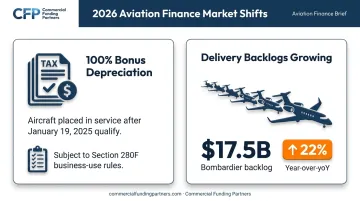
Under IRS guidance issued for 2026, qualified aircraft acquired and placed in service after January 19, 2025 generally qualify for permanent 100% additional first-year depreciation, replacing the prior phase-down schedule. That's a meaningful incentive for businesses weighing whether to buy now or wait.
Eligibility still depends on meeting Section 280F's business-use tests, so timing matters. Before assuming the deduction applies, confirm:
- The aircraft is placed in service after January 19, 2025
- Business use clears the threshold required under Section 280F
- Your acquisition date and placed-in-service date are documented correctly
Delivery Backlogs Are Reshaping Buyer Behavior
Supply is tightening the other side of the equation. Bombardier closed out 2025 with a $17.5 billion order backlog, up 22% year over year.
When new-aircraft wait times stretch, more buyers turn to the used market or lock in financing early to secure a delivery slot. Pre-qualification before you've even chosen an aircraft is becoming standard practice, not an extra step.
Where do businesses go when a deal is too large, too complex, or already turned down by a bank? Firms like Commercial Funding Partners (CFP) treat aviation as a core lending vertical, financing business aircraft transactions from $250,000 to $300 million with structures traditional banks often can't match.
How Aircraft Financing Works: Loans vs. Leases
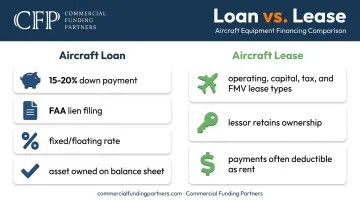
The two primary paths, debt and lease, differ in who owns the aircraft, how depreciation gets claimed, and how the deal shows up on your balance sheet. A loan puts the plane on your books as an owned asset. A lease shifts ownership (and often the depreciation benefit) to the lessor, in exchange for payments that may be deductible as a business expense.
Aircraft Loans
A secured aircraft loan works much like commercial real estate debt. You put down a deposit, the lender files a lien against the aircraft, and you pay down principal and interest over time.
- Down payment: Typically 15-20% of the aircraft's value
- Lien filing: Recorded with the FAA Civil Aviation Registry; for larger or cross-border aircraft, also registered on the International Registry under the Cape Town Convention to establish priority
- Rate structure: Fixed or floating, depending on lender and borrower profile
Here's the quirk that catches first-time aircraft buyers off guard: loan terms are often shorter than the amortization schedule. A lender might amortize your loan over 20 years but only extend a 5- or 10-year term.
AOPA describes a common 5-year term on 20-year amortization as one standard loan structure. That gap means you'll owe a balloon payment, need to refinance, or plan to sell the aircraft when the term ends. Budget for that from day one.
Aircraft Leases
Leasing shifts the ownership and tax-benefit calculus, and there are several structures worth understanding:
- Operating lease — Lessor retains ownership and residual-value risk; lessee typically covers maintenance, insurance, and operating costs
- Capital/finance lease — Functions closer to ownership for accounting purposes, with the lessee assuming more end-of-term responsibility
- Tax lease — Payments are deductible as rent, provided the arrangement's substance (not just its label) supports lease classification under IRS rules
- FMV lease — At term-end, the lessee returns the aircraft, buys it at fair market value, or renews at fair market rent
A sale-leaseback lets a business that already owns an aircraft sell it to a lessor and lease it right back, unlocking the capital tied up in that asset without giving up use of the plane. Lease payments can often be written off as a business expense, adding a tax advantage on top of the freed-up capital.
CFP structures the full range of options (capital, operating, FMV, master lease programs, and sale-leasebacks) so the deal fits the business, not the other way around.
The Aircraft Financing Process: From Pre-Qualification to Closing
Aircraft deals fall apart more often from bad sequencing than bad credit. Moving through these steps in order prevents delays, lost deposits, and deals that unravel days before closing.
Step 1: Pre-Qualification
Before you shop for an aircraft, a lender runs a soft credit check and financial review to establish a realistic budget. This step tells you what you can actually afford, which matters more than ever with 2026 delivery backlogs pushing buyers toward faster decisions on available inventory.
Aviation-focused lenders like CFP typically respond to pre-qualification requests within one business day, giving you that budget clarity before you start touring aircraft.
Step 2: Application & Documentation
Once you've identified a target aircraft, expect to submit:
- Two to three years of business financials and tax returns
- Entity formation documents and ownership structure
- Personal financial statements or guarantees, if requested
- Aircraft-specific records (logbooks, maintenance history) as due diligence progresses
Step 3: Appraisal, Title Search & Lien Filing
The lender orders an independent appraisal to confirm the aircraft's fair market value. It then runs a title search against FAA Registry records, and the International Registry for qualifying aircraft, to confirm no existing liens exist before filing its own security interest.
Step 4: Purchase Agreement & Pre-Purchase Inspection
Most lenders require a neutral third-party pre-purchase inspection (PPI) before finalizing terms. The purchase agreement formalizes price and conditions, and typically allocates airworthiness issues to the seller while cosmetic items remain the buyer's responsibility.
Step 5: Insurance, Escrow & Closing
You'll need proof of insurance in place before closing. An escrow agent manages fund transfer and confirms clear title, then disburses funds once every condition is satisfied. Only then does ownership (and the lien) officially record.
Key Factors That Affect Approval and Terms (Plus Mistakes to Avoid)
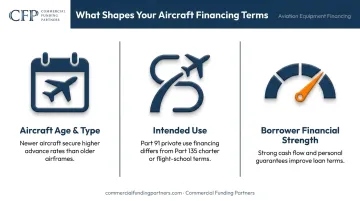
Not every aircraft deal gets the same rate or structure. Three variables do most of the heavy lifting.
Aircraft age and type. Newer aircraft generally secure higher advance rates and more favorable loan-to-value ratios. Older aircraft, particularly piston aircraft manufactured before roughly 1960 or airframes with unusually high hours, often face shorter terms, larger down payments, or more conservative structures.
Intended use. Part 91 private and business flying carries different risk than Part 135 commercial or charter operations. Charter and flight-school aircraft see higher utilization, which accelerates depreciation and wear, so lenders adjust amortization and available lender pools accordingly.
Borrower financial strength. Credit history, liquidity, business cash flow, and willingness to provide a personal guarantee all factor into rate and structure. Lenders want visibility into how debt service gets paid, not just what the collateral is worth.
Two mistakes come up again and again:
- Treating a letter of interest as a done deal. A lender's proposal isn't a binding approval. Confirm final underwriting before you take delivery or release a deposit: terms can shift once full documentation is reviewed.
- Underestimating ongoing operating costs. Insurance, maintenance reserves, hangar fees, and engine programs add up fast, and a loan payment sized without them can strain cash flow within the first year.
If a bank declines or mis-prices your deal, that's not the end of the road. CFP's Second Opinion Review™ offers a free re-underwriting for aviation transactions that didn't get a fair look the first time — a resource worth using before assuming financing isn't available at all.
Conclusion
Aircraft financing blends elements of equipment finance with real-estate-style collateral rules, and the terms you land on depend on aircraft age, intended use, and how strong your business's financial profile looks on paper.
Preparation drives outcomes more than lender choice does. Businesses that walk in with clean documentation, a realistic operating-cost budget, and a clear read on loan-versus-lease trade-offs close faster and on better terms.
For complex, high-value, or bank-declined aviation deals, working with an experienced equipment finance partner that treats aviation as a core vertical, not an occasional exception, beats defaulting to a single bank relationship. Firms like Commercial Funding Partners built dedicated bank-referral desks and second-opinion underwriting exactly for that gap.
Frequently Asked Questions
How much does it cost to finance a plane?
Cost depends on your down payment (typically 15-20%), interest rate, term and amortization structure, and closing fees. Factor in insurance and maintenance reserves too: total cost of ownership goes well beyond the loan payment.
Can you finance a plane?
Yes. Options include aircraft loans, several lease structures, or specialty equipment finance firms, depending on the aircraft type, how it will be used, and your qualifications as a borrower.
Is it hard to finance a plane?
Difficulty depends on aircraft age and type, intended use, and your business's financial strength. Specialized aviation and equipment lenders can often structure deals traditional banks turn down.
How old of a plane can you finance?
Most lenders will finance aircraft up to a certain age, adjusting loan-to-value and rates as aircraft get older. Very old airframes may require a cash purchase or an alternative financing structure.
What credit score do I need to finance an aircraft?
There's no universal minimum; expectations vary by lender and deal size. For business aircraft transactions, strong company cash flow and financials can offset personal credit concerns.
What is a typical down payment for aircraft financing?
Industry norms run 15-20% of the aircraft's value. Some specialty lenders will finance up to 100% of eligible project costs for well-qualified borrowers.