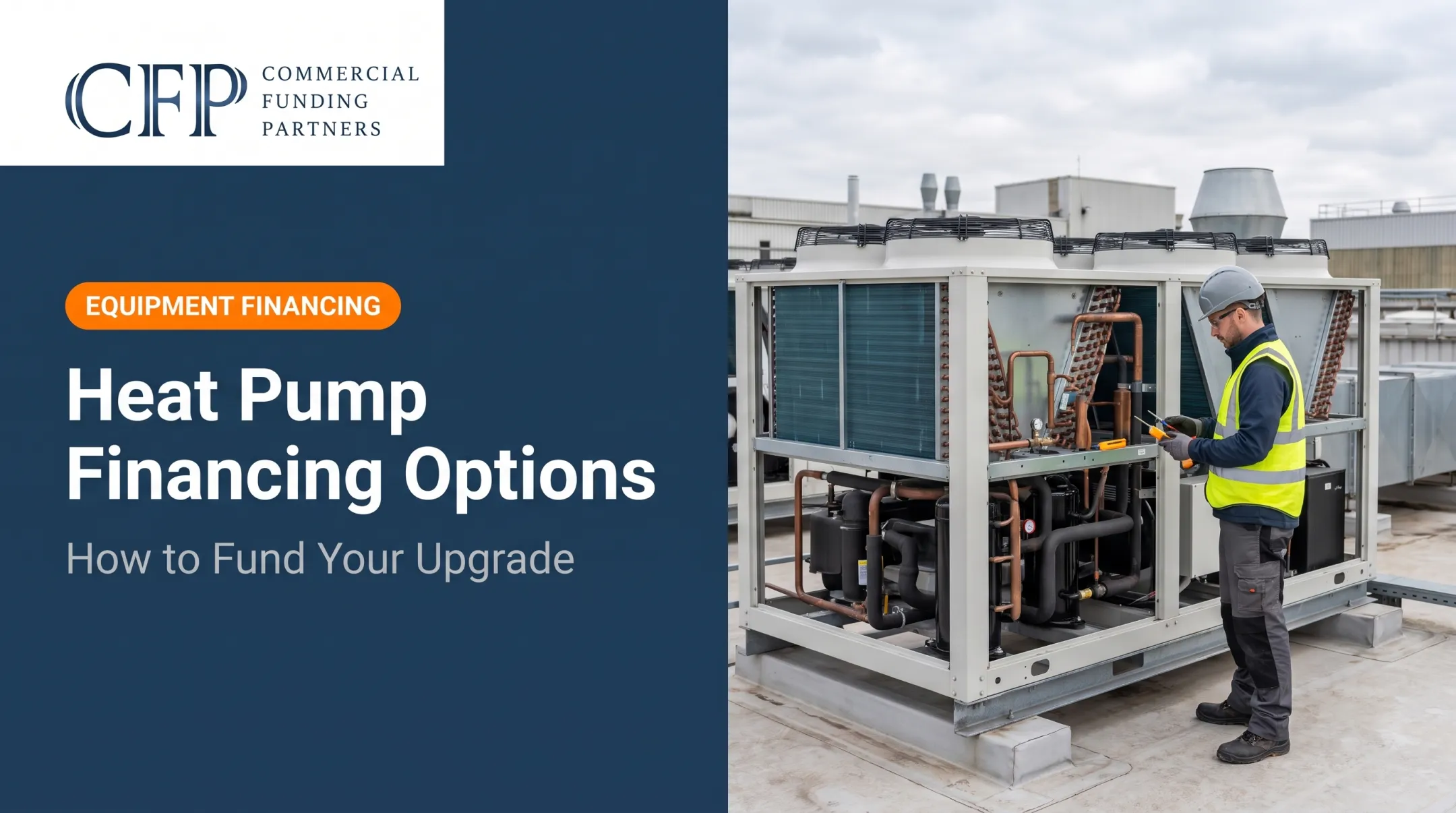
This guide breaks down personal loans, 0% APR credit cards, contractor financing, HELOCs, and tax credits so you can pick the option that actually costs you less. We'll also touch on something most consumer guides skip: businesses and property owners facing large-scale commercial HVAC replacements have entirely different financing needs than a homeowner replacing a furnace.
Key Takeaways
- Personal loans and 0% APR credit cards fund most home HVAC jobs fastest, with the fewest restrictions
- "0% APR" contractor deals often hide deferred interest or dealer fees baked into the price
- Credit score cutoffs differ by lender type — check yours before you apply
- Federal tax credits can lower your net HVAC cost after install
- Large commercial or multi-unit HVAC projects need equipment financing, not consumer loans
How Much Does a New HVAC System Cost?
Costs swing widely based on system type, home size, and efficiency rating. Here's a 2026 breakdown:
| System Type | Installed Cost Range |
|---|---|
| Central AC | $3,000-$15,000 |
| Furnace | $3,800-$12,000 |
| Heat pump | $6,000-$25,000 |
| Ductless mini-split | $2,000-$14,500 |
| Full system replacement | $5,000-$28,000 |
Home size drives tonnage requirements, which drives price. A 2,000 sq ft home typically needs less cooling capacity than a 3,000 sq ft home.
Exact tonnage still depends on insulation, climate zone, and ductwork condition, not square footage alone. Skip the guesswork and get a Manual J load calculation from your contractor before assuming a number.
Don't forget the extras. Labor, ductwork modifications, and permits can add another $1,000-$5,000 on top of equipment costs. Duct replacement alone averages around $3,500 for a full job.

Comparing HVAC Financing Options
Four common paths cover most HVAC purchases: personal loans, 0% intro cards, contractor “same-as-cash” plans, and home equity. Use the snapshot below, then dig into the details that matter for your timeline and credit.
| Option | Typical APR | Funding speed | Best for |
|---|---|---|---|
| Personal loan | ~7%–36% | Same day–next day | Predictable payments, full project cost |
| 0% APR card | 0% intro, then ~17%–30% | Instant at purchase | Payoff inside the promo window |
| Contractor / same-as-cash | Often deferred interest | At install | Only if you can clear the balance on time |
| HELOC / home equity loan | ~7.4%–8.1% avg. | 2–6 weeks | Planned replacements, lower rate |

Personal Loans
Personal loans give you a fixed rate, fixed term, and a lump sum you can use for equipment or labor.
- APR range: Roughly 7%–36%, depending on credit
- Credit needed: Some lenders start near 300; stronger rates usually need 660+, and the best offers sit in the 700s
- Funding speed: Often same-day to next-day after approval
Pros:
- No collateral required
- Funds cover equipment or labor
- Predictable fixed payments
Cons:
- Origination fees on some loans
- Rates rise quickly with weaker credit
0% APR Credit Cards
Many issuers offer introductory 0% periods lasting 12–21 months. If you can pay off the full HVAC cost inside that window, financing is effectively free.
The catch: when the promo ends, leftover balances usually jump to 17%–30% APR.
Buy-now-pay-later tools such as Affirm may also fund home services at 0%–36% APR or a “Pay in 4” split—but only when the contractor offers them at checkout.
Contractor / Same-As-Cash Financing
"Same-as-cash" or dealer 0% offers are often deferred interest plans, not true 0% APR.
If you miss paying the full balance by the deadline, interest is charged retroactively on the original balance from day one, per the Consumer Financial Protection Bureau. One late month can dump months of accrued interest onto the bill at once.
Smart move: Get pre-approved for a personal loan before you talk to a contractor. Walking in as a cash buyer often unlocks better pricing and skips dealer financing fees.
HELOCs and Home Equity Loans
These loans use your home as collateral, so rates run lower:
- HELOC: recent averages around 7.44%
- Home equity loan: recent averages around 8.10%
Speed is the tradeoff. Closing usually takes 2–6 weeks, so HELOCs are a poor fit when the AC fails in August. They work better for planned replacements.
If the system counts as a substantial home improvement, interest may be tax-deductible under IRS rules—confirm with a tax professional before you count on that.
Qualifying for HVAC Financing
Credit requirements shift depending on which financing path you choose:
- Personal loans: Minimums range from roughly 300 (some fintech lenders) to 680+, though favorable rates usually need 700+
- Contractor financing: Common lender minimums sit around 600-660
- Credit cards: No universal minimum; issuers evaluate income, existing debt, and credit history together
What's the "$5,000 rule"? A common repair-vs-replace shortcut: multiply your system's age by the repair cost. Under $5,000, repair is usually smarter. Over $5,000, replacement tends to win—and that's when loan or promotional financing (and meeting the credit bars above) matters most.
If your credit history is thin or troubled, a co-signer or a secured loan can improve approval odds on those larger replacement amounts.

Rebates, Tax Credits, and Ways to Save
For 2026 installs, plan without the federal Section 25C Energy Efficient Home Improvement Credit. That credit previously offered up to $2,000 for heat pumps and $600 for central AC, but it applied only to systems placed in service through December 31, 2025.
Based on current IRS guidance, it is not available for systems installed in 2026. Confirm the latest status on IRS.gov before you assume eligibility.
That doesn't mean savings have disappeared. Stack these instead:
- Utility rebates — ask your electric or gas provider about current high-efficiency HVAC incentives
- Manufacturer rebates — confirm active promotions with the equipment brand before you buy
- Multiple quotes — the same job can differ by thousands across contractors
Other ways to cut costs:
- Buy in shoulder seasons (spring/fall), when contractors often have more availability and sharper pricing
- Right-size the system — oversized units cost more upfront and usually run less efficiently
- Secure your own financing first — a pre-approved loan reduces pressure to take dealer financing on the spot
When HVAC Financing Needs Go Beyond Residential Scale
Everything above works for a homeowner. It falls apart for a property management company replacing rooftop units across a 200-unit apartment complex, or a manufacturing plant upgrading climate control across a production floor.
Those projects can run into the hundreds of thousands or millions of dollars, well beyond what a personal loan or credit card can cover.
At that scale, equipment financing replaces consumer lending. Commercial Funding Partners structures financing for HVAC and mechanical equipment projects from $250,000 up to $300 million, using flexible lease structures rather than standard consumer loans.
CFP financed $928,150 for a Florida air-conditioning contractor through a 60-month operating lease, covering two portable A/C units the contractor had been renting at a steep ongoing cost. Owning the equipment instead of renting improved cash flow and profitability on future jobs.

Commercial equipment financing suits:
- Commercial property managers modernizing multi-building HVAC systems
- HVAC contractors financing their own fleet or equipment
- Manufacturers and facilities upgrading mechanical infrastructure
CFP's structuring specialists typically respond to inquiries within one business day. The firm operates as a direct lender backed by a network of banks and institutional investors, separate from the retail lending options covered above.
Frequently Asked Questions
What is the $5,000 rule for HVAC?
It's a repair-versus-replace guideline: multiply your system's age by the estimated repair cost. If the result exceeds $5,000, replacement is usually the smarter financial move.
What credit score do you need for HVAC financing?
It depends on the lender. Personal loan minimums often fall between about 580 and 680+, some specialty lenders go lower, contractor plans commonly want 600–660, and cards weigh more than score alone.
Can I buy an HVAC system now and pay later?
Yes, through same-as-cash contractor financing or BNPL services like Affirm. Confirm whether the offer is real 0% APR or deferred interest that can back-bill finance charges if you miss the payoff window.
Does Affirm finance HVAC systems?
Affirm can finance home services, including HVAC, but only if the contractor offers Affirm at checkout. It's not automatically available everywhere.
Is there a tax credit for HVAC in 2026?
Based on current IRS guidance, the federal Section 25C credit applied only through December 31, 2025. Check IRS.gov directly for the latest status before assuming eligibility for 2026 installations.
How can I save money on an HVAC replacement?
Get multiple quotes, buy during shoulder seasons, right-size your system rather than oversizing it, and secure your own loan pre-approval before talking to contractors.