This guide covers residential financing options (loans, leases, PACE, SELF), Florida-specific incentives, and the equipment financing structures businesses use for larger commercial solar installations. Homeowner financing and business financing work very differently, and we'll walk through both.
Key Takeaways
- No Florida state cash rebate — plan on sales and property tax exemptions plus the 30% federal tax credit
- Full retail net metering credits exports at retail rates, strengthening grid-tied solar payback in Florida
- Dealer fees baked into "low APR" loans can add tens of thousands of dollars to total system cost
- Large commercial solar projects can use equipment financing structures beyond consumer solar loans
Solar Financing Options for Florida Homeowners
Cash Purchase vs. Solar Loans
Paying cash captures the maximum long-term return since there's no interest and no fees eating into savings. The catch: most homeowners don't have $30,000 sitting around.
Solar loans solve that problem while still preserving ownership, meaning you keep eligibility for the federal tax credit and Florida's tax exemptions. The trade-off is interest and, often, hidden fees.
According to the Consumer Financial Protection Bureau, stated solar loan APRs typically run just 1% to 7%. That sounds appealing, but low advertised rates rarely tell the whole story.
Watch Out for Dealer Fees in Low-APR Loans
Many "low APR" solar loans build a dealer fee directly into the loan principal before you ever make a payment. The CFPB's own example is stark: a $30,000 cash-price system turns into a $39,000 loan once a $9,000 dealer fee is added, before a single interest charge accrues.
The CFPB reports these hidden fees typically range from 10% to 30% of the cash price, and can exceed 50% in some cases. EnergySage's late-2024 loan data backs this up:
- Most-quoted product: 8.49% APR over 20 years
- Median quoted rate: 7.24%
- 60% of quotes carried rates of 6% or higher
- Average fee across quoted loans: 12%

The takeaway: a higher-rate loan with a smaller fee can genuinely cost less than a low-rate loan with a large embedded fee.
Always ask your installer for the cash price separately from the financed price, and request a full amortization schedule before signing anything.
If owning the system still isn’t realistic after you price cash and loans, third-party agreements are the other common path.
Solar Leases and PPAs
Leases and power purchase agreements (PPAs) let you go solar with no upfront cost. A third-party developer owns the system, and you either pay a flat lease fee or buy the electricity it produces, typically under a 10-25 year contract.
Per the Solar Energy Industries Association, the developer—not you—claims the federal tax credit and any other incentives. You get lower bills without ownership, but you give up the largest long-term savings lever available to Florida homeowners.
State-Specific Programs: PACE and SELF
Florida offers two financing paths built specifically for homeowners who don't want (or can't get) a traditional loan.
PACE (Property Assessed Clean Energy)
- Repaid through a non-ad valorem assessment (a special charge) on your property tax bill
- No minimum credit score required
- Terms up to 20 years for residential property, according to Ygrene
- Creates a recorded lien with first priority. You’ll likely need to pay it off before selling or refinancing
SELF (Solar and Energy Loan Fund)
- Nonprofit, CDFI-certified lender based in Florida
- Loans of $3,000-$25,000 (some listings show up to $50,000)
- Fixed rates typically 5%-12%, with SELF's Florida page citing an 8.5% average
- No minimum credit score or income requirement
- 2.5% origination fee, 3-7 year terms
PACE works best if you have home equity but a lower credit score. SELF suits smaller projects where you want to avoid a property lien entirely.

Florida Solar Incentives & Tax Benefits
Federal Solar Tax Credit
The Residential Clean Energy Credit covers 30% of your total system cost for qualifying installations placed in service through December 31, 2025, per the IRS. It applies whether you pay cash or finance with a loan.
Many borrowers apply the credit to loan principal once it arrives, which shrinks the balance and total interest paid.
Leases and PPAs don't pass this credit to homeowners; the third-party owner claims it instead.
Florida Sales and Property Tax Exemptions
Florida adds two exemptions that need no application beyond your installer's paperwork:
- 6% sales tax exemption on solar equipment and components, per Florida Statute 212.08
- 100% property tax exemption on the added value solar brings to your home, under Florida Statute 193.624 (nonresidential property gets an 80% exemption)
Your exact dollar savings depend on your local millage rate and system value, so there's no single statewide figure. The exemption still means your home's assessed value (and tax bill) won't jump just because you added solar.
Net Metering / Solar Buyback
Florida requires full retail net metering from major utilities like FPL and TECO. Here's how it works in practice:
- Excess solar production gets subtracted from your monthly usage
- Unused kWh credits roll forward to future bills
- FPL settles any remaining balance in December, crediting it at FPL's average annual generation cost, not the full retail rate
This annual "true-up" nuance matters: your banked credits function like a battery most of the year, but the year-end settlement isn't always full retail value. Ask your utility how their specific rollover and annual settlement rules work before assuming unlimited banking.

Local City/County Grants
A few Florida municipalities layer on small local incentives:
- Tallahassee Utilities: solar loans at 5% interest, up to $20,000
- Dunedin: solar energy grant of $0.25/watt, capped at $2,500
These programs have limited funding, so check the city's official page before counting on the incentive.
Financing Large-Scale Commercial Solar Installations in Florida
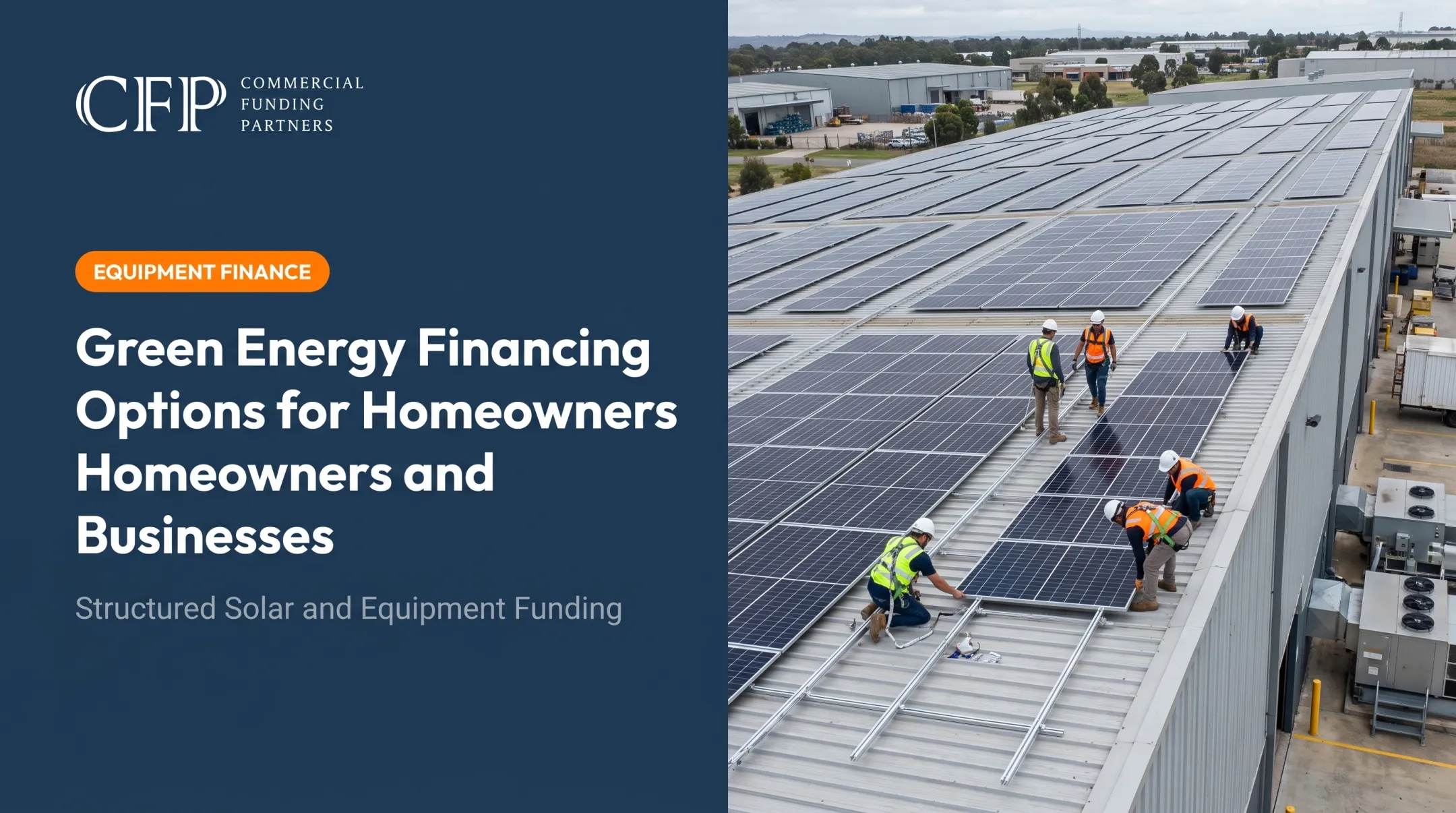
Homeowner solar loans and leases weren't built for a 500 kW rooftop array, a ground-mount system, or a solar carport covering an employee parking lot. Florida businesses pursuing projects in the multi-hundred-thousand to multi-million dollar range typically need equipment financing structures designed for that scale.
Structures commonly used include:
- Capital leases — build equity in the system over the lease term
- FMV (fair market value) leases — lower payments, option to purchase, return, or renew at lease-end
- Sale-leasebacks — free up capital tied to equipment you already own or purchased outright
What sets commercial equipment financing apart from consumer solar loans is coverage of soft costs — engineering, installation, controls, automation integration, and commissioning — expenses many banks simply won't book.
Financing that can cover up to 100% of eligible project costs means a business isn't left scrambling to fund the "invisible" parts of a solar build with cash.
Payments can also be structured around how the business actually generates revenue, rather than a fixed residential-style schedule:
- Seasonal payment schedules for businesses with cyclical cash flow
- Step-up structures that start low and increase as the system offsets more utility cost
- Deferred-principal or interest-only periods during installation and commissioning
Commercial Funding Partners works with businesses across manufacturing, energy, agriculture, and related sectors on renewable energy and solar infrastructure. Examples include:
- $6 million financing for a solar company developing farms and leasing energy to consumers and municipalities
- $2.3 million renewable-energy financing for transportation and warehouse-racking infrastructure supporting a renewables client
CFP structures financing from $250,000 up to $300 million. Its Second Opinion Review offers free re-underwriting for projects declined or priced poorly elsewhere.

Lease payments on commercial solar equipment can often be written off as an operating expense. Confirm the specific treatment with your CPA based on lease structure and entity type.
Choosing the Right Financing Path for Your Situation
Before signing anything, compare ownership-based paths against leases on the metrics that actually determine your savings.
| Factor | Cash / Loan / PACE / SELF | Lease / PPA |
|---|---|---|
| Federal tax credit | You claim it | Third party claims it |
| Property tax exemption | You keep it | Not applicable |
| Upfront cost | Higher (or $0 with PACE/SELF) | $0 |
| Long-term savings | Higher | Lower |
| Ownership at end of term | Yes | Only if buyout exercised |
Before committing to any financing structure:
- Request a side-by-side comparison showing total loan cost with and without dealer fees
- Ask how the tax credit gets applied: directly to principal, or not at all
- Calculate your break-even timeline based on current utility rates
- Project savings over 25-30 years, not just the first five
For businesses, that same discipline applies at a larger scale. Factor in soft costs, cash flow timing, and how a lease's tax treatment stacks up against ownership before locking in a structure.
Frequently Asked Questions
How much do solar panels cost for a 2,000 square foot house in Florida?
Florida averages about $2.17 per watt installed, so a typical ~14.73 kW system runs roughly $32,000 before incentives. Energy use, roof condition, and shading drive cost more than square footage alone.
Will the state of Florida pay for solar panels?
No, Florida doesn't offer a state cash rebate. It does provide a 6% sales tax exemption, a 100% property tax exemption on added value, full retail net metering, and financing programs like PACE and SELF.
Is installing solar panels a good investment in Florida?
For most homeowners, yes. The combination of the 30% federal tax credit, tax exemptions, and full retail net metering typically delivers strong long-term savings, especially as utility rates continue to rise.
What is the difference between a solar loan and a solar lease in Florida?
A solar loan lets you own the system, keeping you eligible for the tax credit and property tax exemption. A lease or PPA requires no upfront cost, but a third party owns the system and claims those incentives instead.
Can Florida businesses get financing for commercial solar installations?
Yes. Businesses can finance commercial solar with equipment loans and structured capital that cover hardware plus soft costs—engineering, installation, and commissioning—that many banks will not fund.