Introduction
Middle-market businesses in manufacturing, construction, healthcare, and transportation are sitting on significant capital locked inside owned equipment — and many don't realize it. At the same time, Federal Reserve Senior Loan Officer surveys reported major net tightening of commercial and industrial lending standards through 2023, with covenants, collateral requirements, and risk premiums all tightening across multiple consecutive quarters.
The result: borrowing is harder, more expensive, and more restrictive than it was just a few years ago.
That locked equipment equity is where sale-leasebacks come in. Most people associate leasebacks with real estate, but the same structure applies to manufacturing machinery, construction fleets, medical devices, and industrial equipment — any capital asset where a business has accumulated equity it can redeploy as working capital.
This article covers three concrete advantages sale-leasebacks hold over traditional debt financing: the specific outcomes CFOs and business owners track when comparing both options.
Key Takeaways
- A sale-leaseback converts owned equipment into immediate working capital while retaining full use of the equipment
- Unlike a bank loan, it does not add traditional debt to the balance sheet
- Lease payments under a true-tax-lease structure are fully deductible as operating expenses
- Sale-leasebacks carry no restrictive financial maintenance covenants that constrain business decisions
- Most valuable when credit is constrained, capital needs are urgent, or payment predictability matters
What Is an Equipment Sale-Leaseback?
A sale-leaseback is straightforward: a business sells an asset it already owns — manufacturing equipment, construction machinery, medical devices, fleet vehicles — to a finance company, then immediately signs a lease to continue using that same equipment through the lease term.
The business receives cash proceeds from the sale, the leasing company becomes the legal owner, and operations continue without interruption.
The structure sits outside traditional debt and equity categories. The business accesses capital without adding a term loan to the balance sheet and without giving up any ownership stake in the company.
Typical assets used in equipment sale-leasebacks include:
- Manufacturing and production machinery
- Construction and heavy equipment
- Medical devices and diagnostic systems
- Fleet and transportation vehicles
- Energy generation and processing equipment
- Food processing and packaging lines
To put that in concrete terms: Stonebriar Commercial Finance closed a $75 million sale-leaseback for a private equity-backed U.S. beverage manufacturer — a 60-month transaction on production and packaging equipment, with proceeds supporting facility investments and general corporate purposes. That scale and structure are not unusual for capital-intensive manufacturers with significant equipment equity.
Three Key Advantages of Sale-Leasebacks Over Traditional Debt
Advantage 1: More Capital Accessed, Without Adding to Your Debt Load
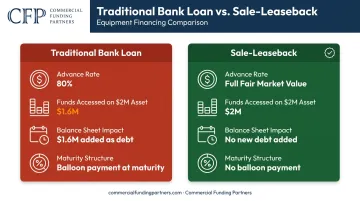
Traditional bank loans against equipment typically advance around 80% of the asset's appraised value — an OCC supervisory example cited in the 2023 Comptroller's Handbook references this figure — and the loan itself appears as a liability on the balance sheet, increasing your debt-to-equity ratio.
A sale-leaseback works differently. The asset is sold at fair market value, generating cash based on the full appraised value rather than an advance against the asset's value. There's no balloon payment at maturity, no principal repayment schedule compressing monthly cash flow.
Why this matters in practice:
- A business with $2M in owned equipment might access $1.6M through a traditional loan (80% advance) while adding $1.6M in debt
- The same equipment in a sale-leaseback generates proceeds based on full fair market value — with no new debt on the balance sheet
One important nuance: under ASC 842, operating leases longer than 12 months do create a right-of-use asset and lease liability on the balance sheet. Proper structuring — and a conversation with your accounting advisors — determines how the transaction is classified and what balance sheet impact results.
Rating agencies like S&P also treat lease obligations as debt-like in adjusted credit metrics. The balance sheet benefit depends on transaction structure, not just the label.
This advantage matters most when:
- Traditional credit lines are at or near capacity
- The business is preparing for a capital raise, acquisition, or lender review
- Demonstrating stronger financial ratios has strategic value
KPIs affected: Debt-to-equity ratio, balance sheet liquidity, borrowing headroom, return on assets
Advantage 2: No Restrictive Covenants, No Operational Constraints
Traditional commercial loans and credit facilities almost always include financial maintenance covenants. Moody's research on direct lending found that approximately 80% of direct-lending transactions include maintenance covenants, with a typical middle-market deal carrying two actively tested covenants.
Common covenant structures include:
- Minimum EBITDA thresholds
- Debt service coverage ratios
- Restrictions on additional borrowing
- Dividend limitations
- Periodic financial re-approval requirements
Any of these can constrain how management runs the business — limiting capital expenditures, blocking M&A activity, or forcing premature restructuring when a revenue quarter comes in soft.
A sale-leaseback agreement is structured around the lease itself: a fixed payment schedule with agreed-upon terms. No EBITDA maintenance tests. No coverage ratio triggers. No lender approval required before making a capital allocation decision.
Proceeds can go wherever the business needs them — debt payoff, new equipment acquisition, working capital, hiring — without a lender dictating use of funds or imposing ongoing compliance requirements.
For businesses in cyclical industries like manufacturing, construction, or energy, this matters at exactly the moments when it's hardest to maintain: when revenue dips, when a large project delays, or when a growth opportunity requires capital reallocation on short notice.
Best fit for:
- Companies in cyclical or seasonal industries
- Businesses in growth phases requiring flexible capital allocation
- Companies that have experienced covenant pressure from existing lenders
KPIs affected: Management flexibility, covenant compliance exposure, capital redeployment speed, operational autonomy
Advantage 3: Predictable Fixed Costs and Stronger Tax Treatment
The third advantage is less visible than the first two — but it compounds over the life of the deal. Under a traditional equipment loan, only the interest portion of each payment is tax-deductible. The principal repayment generates no tax benefit, and the equipment's cost is recovered through depreciation separately, subject to MACRS class life schedules and IRC Section 163(j) interest limitations.
In a qualifying true-tax-lease structure, IRS guidance permits deduction of reasonable lease payments as rent. The full lease payment — not just the interest component — is deductible as a business operating expense in the applicable tax year.
The practical difference:
On a $1M equipment loan, a business deducts only the interest portion each year. On a $1M sale-leaseback structured as a true tax lease, the business deducts the full lease payment. For a profitable company with meaningful taxable income, the after-tax cost difference across a 5-year term can be significant.
One critical clarification: the IRS distinguishes between a true lease (where real economic transfer occurs) and a conditional sale disguised as a lease. The tax treatment depends on the substance of the transaction, not just how it's labeled. GAAP operating lease classification under ASC 842 does not automatically mean the IRS treats it as a true lease. Work with your tax advisor to confirm classification before assuming full deductibility.
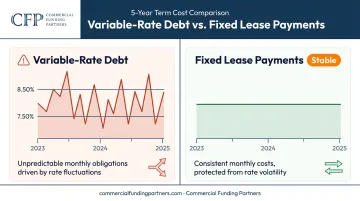
Tax treatment aside, fixed lease payment schedules offer cost certainty that variable-rate debt cannot match. With the bank prime rate moving from 7.50% in January 2023 to 8.50% by July 2023 before gradually declining through 2024–2025, businesses on floating-rate debt faced real cash flow variability. Fixed lease payments eliminate that exposure for the full duration of the term.
When to prioritize this advantage:
- Rates are elevated or uncertain (both currently apply)
- The business has strong taxable income and benefits most from operating expense deductions
- Long project or production cycles require stable, foreseeable cost structures
KPIs affected: Effective cost of capital, annual tax liability, cash flow predictability, budget variance, interest rate exposure
What Happens When Businesses Rely Only on Traditional Debt
The constraints compound quietly. As a business draws down its bank credit facility, its capacity to respond to new opportunities shrinks in step. Common pressure points include:
- Refinancing risk that builds each time a term loan matures
- Balloon payments that create acute cash flow stress at maturity
- Covenant violations that can trigger default events even in operationally healthy businesses
- Reduced headroom that limits the ability to act on time-sensitive opportunities
There's also a ceiling problem that many middle-market businesses hit without recognizing it: traditional lenders cap their exposure based on collateral values and credit ratios. A business that has grown its equipment base significantly may find it owns far more asset value than its lender will advance against — locking up recoverable capital in owned machinery.
Businesses entirely dependent on traditional debt often delay equipment upgrades, pass on growth investments, or carry underperforming capital structures for years. In many cases, an equipment sale-leaseback could restructure that capital stack more efficiently — and do so without displacing the existing bank relationship.
How to Get the Most Value From an Equipment Sale-Leaseback
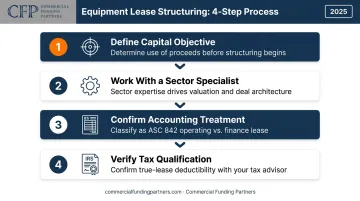
Getting the most from a sale-leaseback comes down to preparation, the right partners, and clean structuring on both the accounting and tax sides. Four practices separate transactions that deliver on their objectives from those that leave value on the table.
Define the capital objective first. Sale-leasebacks perform best when the business decides what the proceeds are for before structuring the deal — debt payoff, equipment reinvestment, working capital, or acquisition funding. That objective shapes lease term length, payment schedule, and overall deal architecture.
Work with a sector specialist. Equipment-focused finance firms bring valuation and structuring expertise that generalist lenders can't match. CFP structures sale-leaseback transactions from $250,000 to over $100 million across manufacturing, healthcare, construction, transportation, energy, and other capital-intensive industries — including sectors many traditional lenders avoid, such as oil and gas, mining, and coal energy.
Confirm the accounting treatment before closing. Under ASC 842, operating lease vs. finance lease classification determines how obligations appear on the balance sheet. A finance leaseback is recorded as a financing arrangement rather than a sale, which changes the balance sheet impact. Proper structuring upfront ensures you capture the intended treatment.
Verify tax qualification as a separate step. Accounting treatment and tax qualification are tested independently. A transaction can qualify as an operating lease under GAAP and still fail true-lease treatment under the IRS's substance-over-form analysis. Confirm deductibility with your tax advisor before assuming it.
Conclusion
Sale-leasebacks deliver a structural advantage across three dimensions: more capital accessed from existing assets, fewer operational constraints on how that capital gets used, and better cash flow economics through fixed costs and potentially stronger tax treatment.
That positions them as a deliberate capital strategy — not a fallback. For businesses that have built significant equipment equity, a sale-leaseback puts that equity to work without adding debt to the balance sheet, without surrendering operational control, and without the covenant and reporting requirements that come with traditional bank facilities.
Frequently Asked Questions
Why would a company do a sale and leaseback?
A company uses a sale-leaseback to convert equity locked in owned equipment or property into immediate working capital while retaining full use of that asset. Common motivations include funding growth, paying down debt, or avoiding additional bank borrowing when traditional credit capacity is limited.
What is a 20-year sale-leaseback?
A 20-year sale-leaseback refers to the lease term negotiated as part of the transaction — most common in real estate contexts — where the seller-turned-tenant secures occupancy rights and a fixed payment rate for the full term. This structure provides cost stability and eliminates refinancing risk for the duration.
How does a sale-leaseback affect a company's balance sheet?
A sale-leaseback increases cash, and the resulting lease obligation may be classified differently than traditional debt depending on structure. Under ASC 842, leases longer than 12 months appear as a right-of-use asset and lease liability — so the precise impact depends on lease classification and how lenders analyze your adjusted metrics.
What types of equipment qualify for a sale-leaseback?
Most income-producing, titled hard assets qualify — including manufacturing machinery, construction equipment, medical devices, fleet vehicles, and energy generation systems. Qualification turns on the asset's useful life, fair market value, marketability, and the business's demonstrated ability to fund lease payments.
Is a sale-leaseback better than a bank loan?
Neither is universally better. A sale-leaseback is often advantageous when a business needs to access full asset value, avoid covenants, or keep traditional debt off the balance sheet. A bank loan may be preferred when preserving asset ownership is a priority or when the company has ample low-cost credit capacity available.
Are lease payments in a sale-leaseback tax-deductible?
In a qualifying true-tax-lease structure, lease payments are generally fully deductible as operating expenses — unlike a traditional loan, where only the interest portion qualifies. Tax treatment depends on IRS substance-over-form analysis, not GAAP classification alone, so consult your tax advisor.