Equipment financing and business loans are the two paths most companies consider. Pick wrong, and you either overpay for flexibility you didn't need or lock up assets you can't afford to risk. 82% of businesses that acquired equipment or software in 2023 used some form of financing to do it, according to the Equipment Leasing and Finance Association's Horizon Report. This guide breaks down how equipment financing and business loans differ, so you can match the structure to the project.
Key Takeaways
- Equipment financing is asset-secured and can fund up to 100% of costs, including installation and engineering.
- Business loans allow broader use of funds but often require a blanket lien or personal guarantee.
- Approval speed, collateral exposure, and use-of-funds rules are the three biggest differentiators.
- Large, complex equipment purchases favor specialized financing over a general-purpose loan.
Equipment Financing vs Business Loans: Quick Comparison
Here's how the two structures stack up across the factors that matter most to a CFO or controller evaluating a purchase.
| Factor | Equipment Financing | Business Loan |
|---|---|---|
| Collateral & down payment | Secured by the equipment itself; specialized lenders can finance up to 100% of eligible project costs, minimizing or eliminating a down payment | Often requires a blanket lien on business assets, a personal guarantee, or a set down payment percentage |
| Approval speed | Specialized lenders can provide same-day preliminary reviews and full approvals within days for well-documented deals | Term loans and SBA loans can take weeks to months; Bank of America cites 3-4 weeks for a line of credit, and one SBA lender estimates 60-90 days for SBA products |
| Cost of capital | Rates tied to equipment type, useful life, and borrower credit; often competitive since the asset secures the loan | Rates vary widely by loan type and may include origination fees or draw fees |
| Flexibility of use | Funds are typically restricted to equipment and related soft costs (installation, freight, software, training) | Funds can cover equipment, payroll, inventory, expansion, or working capital |
| Ownership & balance sheet impact | Depending on lease vs. loan structure, the business may own the asset outright or keep flexible end-of-term options | The business owns whatever the proceeds purchase, but the loan sits as a general liability, not tied to one asset |
Equipment financing trades flexibility for speed and lower collateral exposure. Business loans trade some of that speed for the ability to fund almost anything.
What Is Equipment Financing?
Equipment financing is capital structured specifically to acquire machinery, vehicles, or technology. Instead of tapping a general credit line, the business borrows against the value of the asset it's purchasing, using loan or lease structures built around that transaction.
The biggest advantage is preserving working capital. A well-structured deal can cover up to 100% of eligible project costs: not just the equipment sticker price, but soft costs many banks won't book at all:
- Installation and labor
- Engineering and design services
- Software licensing and integration
- Freight and shipping
- Commissioning and training
Payments Built Around Your Revenue
Equipment financing also flexes on timing. Payments can be structured as seasonal schedules, step-up payments, deferred-principal periods, or milestone-based disbursements tied to a project's build phases.
For example, a manufacturer waiting on a multi-vendor automation build might need six to eighteen months before the line generates revenue. A milestone facility can fund deposits, engineering, and fabrication in stages, then convert to standard equipment financing once the equipment is installed and accepted.
Lease vs. Loan Structures
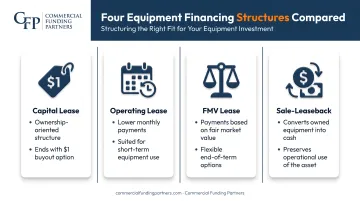
Not every equipment deal ends in ownership. Common structures include:
- Capital leases: ownership-oriented, often with a $1 buyout at the end of the term
- Operating leases: lower monthly costs, suited to equipment that becomes obsolete quickly
- FMV leases: payments based on projected fair market value at lease end
- Sale-leasebacks: a business sells equipment it already owns and leases it back, converting equity into working capital
Independent specialists like Commercial Funding Partners focus on structuring these solutions for transactions from $250,000 to $300 million. They act as a direct lender and connect borrowers to banks and institutional partners on complex, multi-vendor projects.
Use Cases of Equipment Financing
Equipment financing tends to show up at a specific point in a company's growth cycle: when it needs to acquire, replace, or upgrade a revenue-generating or operations-critical asset. Automating a production line or modernizing a fleet are typical triggers.
Adoption skews heavily by industry. According to ELFA's 2023 data, financing adoption reached 85% in construction, 70% in health care, and 70% among goods-sector firms, compared to 61% for services-sector firms overall (see the full Horizon Report breakdown). Sectors where it's especially dominant include:
- Heavy manufacturing and metals processing
- Construction and earthmoving
- Healthcare and diagnostic imaging
- Food processing and packaging
- Transportation and fleet operations
- Data centers and energy infrastructure
What Is a Business Loan?
A business loan is a broader financing category than equipment financing. Term loans, SBA loans, commercial and industrial (C&I) loans, and revolving lines of credit all fall under this umbrella. Unlike equipment financing, these products aren't tied to a single purchase.
The core benefit is flexibility. One financing relationship can cover equipment, payroll, inventory, or marketing spend at once, which helps when a company is juggling several priorities rather than funding a single asset.
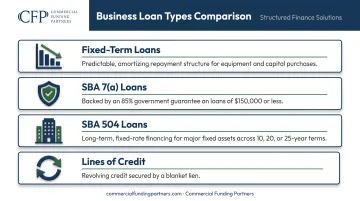
Common variations include:
- Fixed-term loans — amortizing loans typically repaid over a set schedule from business cash flow
- SBA 7(a) loans — government-guaranteed, general-purpose, with SBA guarantees of 85% on loans of $150,000 or less and 75% above that threshold
- SBA 504 loans — long-term, fixed-rate financing for major fixed assets, with 10-, 20-, and 25-year terms
- Lines of credit — revolving facilities usually secured by a blanket lien on business assets
Use Cases of Business Loans
Business loans fit best when a company is managing multiple capital needs at once, or when an equipment purchase is small enough to bundle with other expenses rather than justify its own financing structure.
Common scenarios include:
- Using an SBA loan to fund a facility renovation alongside new equipment
- Drawing on a line of credit to smooth seasonal cash-flow gaps between invoices
In these cases, the equipment is one line item in a larger capital plan, not the centerpiece.
Equipment Financing vs Business Loan: Which Is Better?
Neither structure wins by default. The right call depends on four questions:
- How large is the transaction? Larger, asset-specific purchases favor equipment financing.
- How urgent is the deadline? A vendor payment window measured in weeks changes the calculus fast.
- Is the goal owning one asset, or accessing flexible capital? Single-purpose vs. multi-purpose funding needs point in different directions.
- How much other collateral are you willing to put at risk? A blanket lien on business assets is a real trade-off.
Choose equipment financing if you're acquiring a specific, revenue-generating asset and preserving cash and collateral matters, especially when soft costs like installation and engineering need to be rolled into the deal.
Choose a business loan or line of credit if your funding need spans multiple purposes beyond one equipment purchase, or short-term liquidity is the priority.
Real-World Example: A $40 Million Automation Deal
Commercial Funding Partners recently structured a $40 million automation equipment financing deal for a cell phone casing manufacturer in Idaho. The deal had to clear a strict three-week vendor payment window and meet an auditor-mandated lease rate and structure.
A standard bank loan or line of credit couldn't accommodate both requirements simultaneously. The size, complexity, and soft-cost components (engineering, installation, integration) of the project made a specialized equipment lease more workable than general bank financing.
CFP structured a 36-month lease matching the auditor's requirements and moved through approval, documentation, and funding fast enough to pay vendors ahead of the deadline. The manufacturer kept its automation project on schedule without disrupting production or straining working capital elsewhere.
If you're evaluating a large equipment upgrade and aren't sure a standard loan structure will work, get a second set of eyes before you commit. CFP's team offers a free Second Opinion Review for projects that have been declined or priced unfavorably elsewhere.
Conclusion
Neither option wins in every case. Equipment financing fits large, asset-specific investments when preserving capital and matching payments to project cash flow matter most. Business loans fit broader, smaller, or multi-purpose needs when flexibility outweighs asset-matching.
Choose based on the job the capital has to do:
- Equipment financing when the purchase is asset-specific, you want to keep cash free, and payments should track project revenue
- Business loans when you need flexible, multi-purpose funds or the ticket size and use case don't justify asset-backed structure
Done well, the outcome is practical: cash left for other priorities, equipment online sooner, and less strain on existing credit lines. Commercial Funding Partners can walk you through those trade-offs before you sign—often the difference between a deal that fits and one that just closes.
Frequently Asked Questions
Can I use a business loan to buy equipment?
Yes. General business loans and lines of credit can fund equipment purchases, but they typically require broader collateral or personal guarantees than equipment-specific financing tied to the asset itself.
What is the 20% rule for SBA?
Owners with 20% or more equity in an SBA borrower must provide an unlimited personal guarantee. SBA 504 loans also generally require borrower equity of at least 10% of the total project cost.
How much is the monthly payment on a $250,000 business loan?
At about 8% over five years, payments land near $5,070 per month. Rate, term, credit, and fees all change that figure—use a loan calculator for a precise estimate on your deal.
Is it easier to qualify for equipment financing than a business loan?
Equipment financing can be easier to secure since the equipment itself serves as collateral, reducing lender risk compared to unsecured or broadly collateralized business loans.
Does equipment financing affect my business credit differently than a loan?
Both typically report to business credit bureaus, tracking payment behavior, balances, and any UCC filings. Equipment financing is often viewed as lower-risk secured debt tied to a specific, resalable asset.
Can I combine equipment financing with a business loan?
Yes. Many businesses use equipment financing for asset purchases while keeping a separate line of credit or loan for working capital, since the two serve complementary purposes.