The good news: most construction businesses don't pay cash for cranes. According to the Equipment Leasing and Finance Foundation's 2024 Horizon Report, 85% of construction firms use financing to acquire equipment — the highest rate of any industry. The U.S. equipment finance industry totaled an estimated $1.34 trillion in 2023, reflecting just how standard financing has become for capital equipment.
This guide covers everything a business owner needs to navigate commercial crane financing: the types of financing available, qualification requirements, typical terms and rates, and how to find the right lender for large-scale equipment needs.
Key Takeaways:
- Multiple financing structures exist — loans, capital leases, operating leases, and sale-leasebacks — each suited to different ownership goals and cash flow needs
- Qualification depends on business credit, time in business, cash flow, and the crane's collateral value
- Specialty equipment finance firms typically move faster and handle larger, more complex transactions than generalist banks
- "Crane Finance" (cranefinance.com) is a consumer tribal lender — entirely unrelated to commercial crane equipment financing
- Deal sizes range from $25,000 for small equipment loans to $100M+ for large tower or crawler crane transactions
What Is Crane Financing?
Crane financing is a specialized form of equipment financing that lets businesses acquire cranes — new or used — by spreading the cost over time through a loan, lease, or structured credit arrangement, rather than one lump-sum payment.
Why It's Different from General Business Lending
Crane financing differs from standard small business loans in several key ways:
- High asset values — commercial cranes routinely cost $250,000 to several million dollars, requiring lenders comfortable with large collateral positions
- Specialized collateral — cranes are heavy, mobile, and jurisdiction-specific assets that require lenders experienced in equipment valuation and remarketing
- Industry context — construction, manufacturing, energy, and infrastructure businesses have project-based revenue patterns that affect how deals are structured
Generalist banks often struggle with these factors. Specialty equipment finance firms are built specifically for this type of deal — firms like Commercial Funding Partners (CFP), which structures construction and heavy equipment transactions from $250,000 to $100M+.
A Note on "Crane Finance"
"Crane Finance" (cranefinance.com) is a consumer tribal lender, not a commercial equipment finance company. It offers short-term personal loans of $100–$1,500 for emergency expenses and is owned by a Native American tribe. It has no connection to commercial crane equipment financing. If you're a business looking to finance a crane, you're looking for commercial equipment finance — a completely different product.
Types of Crane Financing Options
Businesses have multiple structures to choose from depending on ownership goals, cash flow needs, and tax strategy. Here's how each works in practice.
Equipment Loans (Term Financing)
With an equipment loan, the lender provides capital to purchase the crane outright. The crane serves as collateral, and the borrower repays in fixed monthly installments over a set term — typically 24 to 84 months. At payoff, the business owns the crane free and clear.
Best for: Companies that want long-term ownership, plan to use the crane for many years, and want to build asset equity on their balance sheet.
Equipment Leasing: Capital and Operating Leases
Leasing comes in two main forms:
| Lease Type | How It Works | Best For |
|---|---|---|
| Capital Lease | Structured like financing; includes a $1 buyout or balloon payment at term end. Treated as an owned asset for accounting purposes. | Businesses planning to own the crane long-term with favorable tax treatment |
| Operating Lease | Lower monthly payments; equipment is returned or upgraded at term end. Off-balance-sheet treatment. | Businesses needing flexibility, shorter project cycles, or access to newer crane models |
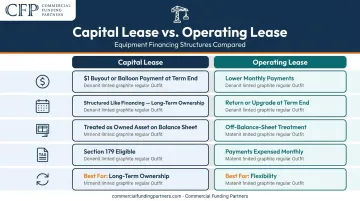
CFP structures both capital and operating leases tailored to specific project and cash flow needs. The determining factor is usually simple: will you need this crane in five years, or do you want the option to upgrade?
Sale-Leaseback
A sale-leaseback allows a business to sell a crane it already owns to a financing company, then immediately lease it back and continue using it. The contractor receives a lump sum of capital while retaining full operational use of the equipment.
Most contractors don't realize they can monetize equipment they already own without giving it up. CFP completed a $6 million sale-leaseback for a masonry contractor's fleet expansion, funded in under 30 days across two funding tranches. Contractors with significant equipment equity — cranes, heavy fleet, yard equipment — can access that capital without disrupting operations.
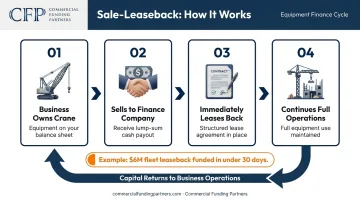
Common reasons contractors use sale-leasebacks:
- Working capital gaps during project ramp-up
- Vendor deposits or progress payments due before revenue arrives
- Fuel, materials, and labor cost pressure compressing margins
- Bank credit lines at capacity
SBA Loans and Working Capital Lines
SBA 7(a) and 504 loan programs are options for smaller construction businesses:
- SBA 7(a) generally caps at $5 million, with maturities up to 25 years for real property (shorter for equipment)
- SBA 504 is designed for fixed assets — primarily real estate, but applicable to large equipment purchases
- Both programs require strong credit history, detailed documentation, and a longer approval timeline
SBA programs can offer competitive rates and lower down payments, but the documentation burden and processing time make them less practical for time-sensitive crane acquisitions. Note that CFP does not offer SBA lending — those programs are best pursued through SBA-approved lenders.
Auction and Used Crane Financing
Buying at auction requires pre-arranged financing. Most specialty lenders offer pre-approval up to a set dollar amount before bidding begins, which converts to a standard equipment loan after purchase.
Two things to confirm before targeting a used crane:
- Lender age/condition policies — some lenders set maximum equipment age limits (often 10–15 years) for collateral acceptance
- Appraisal requirements — used cranes above certain values may require a formal appraisal before final approval
Each of these structures serves a different situation. The right fit depends on your timeline, balance sheet priorities, and whether you're buying new, buying used, or monetizing equipment you already own.
How to Qualify for Crane Financing
Qualification requirements vary by lender type, deal size, and financing structure — but most commercial crane financing programs evaluate a consistent set of factors.
Key Eligibility Factors
Standard underwriting criteria:
- Business credit profile: payment history, existing debt load, and credit utilization
- Personal credit score — most equipment lenders look for a minimum in the 650–680 range, though specialty lenders are often more flexible
- Time in business — typically 2+ years for conventional financing; newer businesses may qualify with stronger collateral and owner credit
- Revenue and cash flow — lenders want to see that debt service fits comfortably within operating cash flow
- Crane value as collateral — the equipment itself secures the loan, which carries real weight in the underwriting decision
For larger transactions in the $500,000 to $5M+ range, lenders also evaluate:
- Project pipeline depth and contract backlog
- Existing debt load relative to revenue
- Industry experience and operational track record
- Business structure complexity (multiple entities, locations, or schedules)
At this level, credit score alone doesn't drive the decision. A contractor with 15 years of documented project history and solid contracts in place is a fundamentally different credit profile than a newer business with the same number.
Documentation Lenders Typically Require
Standard documentation for most commercial crane financing applications:
- Business tax returns (2–3 years)
- Recent bank statements (3–6 months)
- Equipment quote or dealer invoice
- Business financial statements (profit & loss, balance sheet)
- Proof of insurance
For larger or more complex transactions, lenders may also request:
- Active contracts or project documentation
- Business plan or revenue projections
- Equipment appraisals (especially for used or high-value assets)
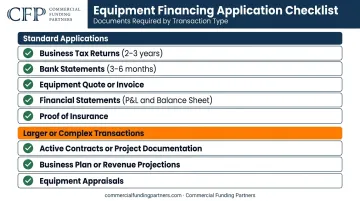
CFP offers an Equipment Financing Readiness Checklist that helps businesses prepare before the application process begins.
Financing with Imperfect Credit
Less-than-perfect credit doesn't automatically disqualify a business from crane financing. Because the crane serves as physical collateral, lenders can often offset weaker credit profiles through asset-backed underwriting — particularly when:
- The crane has strong market value and liquidity
- The business has solid cash flow even if its credit history is spotty
- There are compensating factors like long-term contracts or a strong down payment
Specialty equipment finance firms evaluate the full business profile — not just the credit score. When a deal doesn't fit standard bank lending criteria, the path forward is usually a collateral-driven structure: one that accounts for asset value, cash flow, and contract depth together. That's where firms like CFP focus their underwriting energy.
Crane Financing Terms, Rates, and Structures
Terms vary widely based on deal size, borrower profile, equipment type, and lender.
Loan Amounts and Repayment Terms
- Equipment loans: Typically 24–84 months; larger transactions may be structured longer
- Equipment leases: Generally 24–84 months depending on asset useful life and lender requirements
- Deal size range: Small contractor loans may start at $25,000–$50,000; large tower or crawler crane transactions handled by specialty firms like CFP can reach several million dollars or more per transaction
Interest Rates and Total Cost of Financing
Rate variation is driven by several factors:
- Business and personal credit scores (borrower creditworthiness)
- Time in business — established operations typically qualify for better rates
- Down payment size — more equity upfront lowers lender risk and often improves terms
- Collateral quality — newer, higher-value equipment typically earns favorable pricing
- Lender type — banks, credit unions, and specialty lenders each price differently
According to the Equipment Leasing and Finance Association, commercial equipment financing rates vary considerably based on market conditions and borrower profile. Always evaluate the total cost of financing — APR plus all fees — not just the stated rate. Two offers with the same rate but different fees can have substantially different total costs.
Down Payments and Ownership
- Equipment loans: Typically require 10–20% down, though some lenders offer up to 100% financing on strong deals
- Capital leases: Often structured with first/last month payment or a modest security deposit
- Operating leases: Lowest upfront cost; usually requires first month's payment and a security deposit
Ownership structure affects both your balance sheet and long-term flexibility:
- Equipment loans: business owns the crane outright at payoff
- Capital leases: ownership transfers at term end via $1 buyout or balloon payment
- Operating leases: lender retains ownership throughout; business returns or upgrades at term end
How you hold the asset on paper directly shapes how it's treated at tax time.
Tax Considerations
The financing structure determines how the crane is classified for tax purposes:
- Equipment loans and capital leases: May qualify for Section 179 deductions (2025 limit: $1,220,000) and bonus depreciation (40% for 2025)
- Operating leases: Monthly payments are typically deductible as a business expense
- Sale-leasebacks: Tax treatment depends on structure and classification
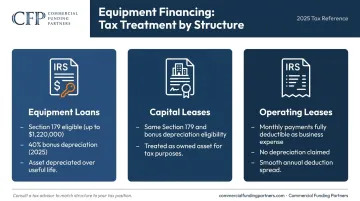
A capital lease might deliver a larger first-year deduction through Section 179, while an operating lease spreads deductions evenly across the term. Consult a tax advisor to match the structure to your tax position before committing.
How to Choose the Right Crane Financing Partner
Not all lenders are equally suited for crane financing — especially for large or complex transactions. Key differentiators to evaluate:
- Verified experience with construction and crane assets — not just general small business lending
- Deal size capacity that matches your needs (many online platforms cap out at $500,000–$1M)
- Multiple structure options: loans, capital leases, operating leases, and sale-leasebacks
- Fast turnaround — traditional banks can take several weeks; specialty firms like CFP respond within one business day
- Flexibility for complex profiles involving multiple entities, used equipment, or project-based revenue
Once you've identified candidates, press them with direct questions before committing:
- What is your maximum deal size?
- How do you handle multi-asset or multi-site transactions?
- What is your typical turnaround from application to funding?
- What lease structures do you offer?
- How do you evaluate collateral on used or specialty equipment?
The answers will quickly separate lenders with genuine construction finance depth from generalists who treat a $5M crane the same as a small business equipment loan.
Frequently Asked Questions
What are the benefits of using crane financing?
Crane financing preserves working capital, provides predictable monthly payments, and may offer tax advantages through Section 179 or bonus depreciation. It also allows businesses to acquire higher-value equipment than a cash purchase would permit, enabling faster capacity growth without depleting cash reserves.
Is Crane Finance a tribal lender?
Yes — "Crane Finance" (cranefinance.com) is a consumer lending company owned by a Native American tribe that offers short-term personal loans of $100–$1,500 for emergency expenses. It is entirely unrelated to commercial crane equipment financing, which is a specialized form of business lending for purchasing or leasing construction and industrial cranes.
Does Crane Finance report to credit bureaus?
Commercial equipment finance lenders handle credit reporting differently from consumer lenders, and practices vary by institution. Ask your specific lender about their reporting policies during the application process.
What types of cranes can be financed?
Most equipment finance lenders can finance a broad range of crane types — tower cranes, mobile cranes, crawler cranes, overhead cranes, rough terrain cranes, marine cranes, and more — both new and used, subject to the lender's collateral policies and equipment age requirements.
How much can I borrow for crane financing?
Commercial crane financing amounts vary widely. Smaller equipment loans may start at $25,000–$50,000, while large crane purchases handled by specialty equipment finance firms can reach several million dollars or more per transaction. CFP, for example, structures crane and construction equipment financing from $250,000 to over $100 million for middle-market businesses nationwide.
Can a startup or newer business qualify for crane financing?
Newer businesses face stricter requirements, but specialized equipment finance lenders — particularly those focused on asset-backed deals — can work with them by placing greater weight on the crane's collateral value, the owner's personal credit, and any existing contracts or revenue history. Coming prepared with documentation on all three significantly improves approval outcomes.