Without a well-built milestone framework, contractors front labor and materials with no guarantee of timely reimbursement, while owners worry about releasing capital for work that isn't actually done yet. The tension is real: a 2022 Levelset survey of 519 U.S. construction companies found that only about 1 in 10 contractors were always paid on time, and 95% reported real stress from slow payments.
This article breaks down what milestone payments are, how milestone billing actually works step by step, how the structure compares to progress payments and retainage, the legal pitfalls to avoid, and financing options for bridging the cash flow gaps milestones can create.
Key Takeaways
- Milestone payments tie money to completed project stages, not elapsed time or a re-measured percent-complete.
- Undefined completion terms in a contract, such as "sign-off," have triggered costly disputes in court.
- Retainage typically runs 5%-10% of each payment under standard industry contract guidance.
- Slow, unpredictable payment cycles strain contractor cash flow and raise project financing risk.
- Structure financing to the project's milestone timeline instead of a generic monthly loan schedule.
What Are Milestone Payments in Construction?
A milestone payment is a lump-sum or percentage-based payment tied to completing a specific, pre-agreed stage of work. It's earned when the deliverable is done, not when a certain number of days have passed.
This model differs from standard monthly progress billing, where a contractor and owner re-measure the percentage of overall work completed each billing cycle—usually against a schedule of values and standard pay application forms.
Milestone billing skips that recurring re-measurement in favor of discrete, contract-defined checkpoints.
Common construction milestones include:
- Contract execution or mobilization deposit
- Foundation and substructure completion
- Structural framing or major equipment delivery
- Rough-in of mechanical, electrical, and plumbing (MEP) systems
- Substantial completion
- Final completion and punch-list closeout
Not every item on that list is a formally standardized term. Substantial completion and final completion are recognized as distinct construction milestones in AIA guidance, but mobilization, foundation, and MEP rough-in triggers are project-specific—and only carry weight if the contract spells them out clearly.
What Does a Milestone Payment Mean for Owners and Contractors?
For a contractor, a milestone payment represents earned revenue. It offsets costs already sunk into labor, materials, or equipment tied to that specific stage. Without it, working capital stays tied up in completed work that hasn't been paid for.
For owners and lenders, a milestone is a checkpoint. It verifies quality and progress before more capital goes out the door, cutting the risk of overfunding work that isn't finished.
This "pay for verified progress" logic isn't unique to buildings. Large equipment manufacturing, government R&D contracts, and technology projects all use milestone structures for the same reason. The Department of Defense alone provided roughly $22 billion in milestone-based performance payments in FY2023 to support capital-intensive weapon systems with long production cycles.
How Does Milestone Billing Work?
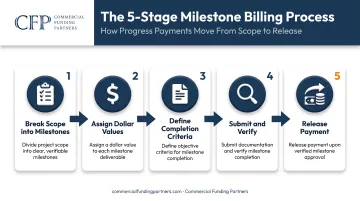
Milestone billing follows a consistent sequence across most commercial contracts.
- Break the scope into milestones. During negotiation, the project scope is divided into a logical sequence of stages tied to the schedule or critical path.
- Assign dollar values. Each milestone gets a dollar amount or percentage of contract value that reflects the cost and effort to reach it.
- Define completion criteria precisely. Every milestone needs a clear, objective, measurable definition of "done." This is where projects go wrong most often.
- Submit and verify. The contractor submits a milestone completion notice or invoice; the owner, architect, or engineer inspects the work against the agreed criteria.
- Release payment. Once verified, payment goes out within the contract's specified timeframe, and the next milestone period begins.
Step 3 deserves extra attention. In Bennett (Construction) Ltd v CIMC MBS Ltd, a UK Court of Appeal case involving 78 prefabricated modular hotel units, two payment milestones depended on "sign-off" with no definition of that term anywhere in the contract.
The dispute went all the way to appeal before the court ruled that "sign-off" meant an objective state of completion, not a literal signature. The lesson translates directly to U.S. contracts: ambiguous milestone language invites dispute, regardless of jurisdiction.
A typical milestone payment schedule might look like this:
| Milestone | % of Contract Value |
|---|---|
| Mobilization deposit | 10% |
| Foundation complete | 20% |
| Structural/equipment installation | 30% |
| Substantial completion | 30% |
| Final completion | 10% |
Milestone Payments vs. Progress Payments vs. Retainage
These three terms get used interchangeably, but they solve different problems.
| Mechanism | Trigger | Timing | Documentation |
|---|---|---|---|
| Milestone payment | A specific, discrete deliverable is completed | Event-driven, irregular | Milestone completion notice, acceptance evidence |
| Progress payment | A re-measured percentage of overall work is done | Usually monthly | Pay application plus updated schedule of values |
| Retainage | Withheld from every earned payment | Released at substantial or final completion | Retainage calculation and release documentation |
Retainage sits alongside both models rather than replacing them. It's a percentage withheld from each progress or milestone payment as a hedge against defects or non-performance.
According to ConsensusDocs, retainage in U.S. commercial construction contracts typically ranges from 5% to 10%, though many states allow the rate to be negotiated. New York, for example, caps private-contract retainage at 5% under GBL Section 756-c and requires 1% monthly interest on late release.
The exact terms vary enough by state that contract language shouldn't be copied from one jurisdiction to another without a legal review.
Benefits and Challenges of Using Milestone Payments
Milestone billing solves real problems, but it creates new ones too.
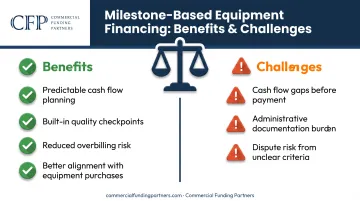
Benefits:
- More predictable cash flow planning for contractors tied to actual project stages
- Built-in quality checkpoints before owners release additional capital
- Reduced risk of overbilling relative to true progress
- Better alignment of payment timing with long-lead equipment or material purchases
Challenges:
- Cash flow gaps when contractors must pre-fund labor or specialized equipment before the next payment trigger
- Administrative burden of documenting and verifying each stage
- Dispute risk when completion criteria aren't airtight
Those gaps show up clearly in the data. That same Levelset survey found slow payments caused wasted resources for 45% of construction businesses, reduced profit for 41%, and left 18% unable to meet payroll.
Nearly 9 in 10 offered payment terms of 30 days or less, but fewer than 4 in 10 said they actually received payment within that window. That gap between contract terms and reality is exactly why so many contractors look for supplemental financing to bridge milestone-to-milestone cash flow.
Legal and Contract Considerations for Milestone Payment Structures
Getting the payment mechanics right on paper matters as much as getting the schedule right.
Prompt-payment compliance. U.S. construction contracts should comply with applicable state prompt-payment statutes. These laws generally require clear payment terms and timely disbursement once an obligation is triggered.
California's Civil Code Section 8800, for instance, requires owners to pay undisputed progress-payment demands within 30 days. Wrongful withholding carries a 2% monthly penalty plus attorney fees. Rules vary significantly by state, so don't assume one state's framework applies elsewhere.
Precise milestone definitions. As the Bennett case illustrated, vague terms like "sign-off," "substantially complete," or "ready for inspection" invite disagreement over exactly when payment becomes due. Every milestone needs an objective, measurable acceptance test spelled out in the contract itself.
Lien waivers. Conditional or unconditional lien waivers are commonly exchanged alongside each milestone payment on U.S. projects. AIA recognizes four types:
- Conditional progress
- Unconditional progress
- Conditional final
- Unconditional final
Conditional waivers typically take effect upon payment. Unconditional waivers should generally follow actual receipt of funds, not just a promise to pay.
Use established frameworks. Standard-form contract systems like AIA Contract Documents or ConsensusDocs give both sides a tested starting point. Add a milestone payment rider specific to the project, and have legal counsel review it before signing. Improvising milestone language from scratch is where most disputes originate.
Financing Milestone-Based Construction and Equipment Projects
Even with a well-drafted milestone schedule, the funding gap problem doesn't disappear. Contractors and project owners frequently have to pay for labor, materials, and especially large capital equipment before the next milestone payment clears. On extended-build projects, that strain on working capital adds up fast.
Milestone-aligned financing avoids locking a project into a rigid monthly repayment schedule. Structures can mirror the actual milestone timeline of the build instead.
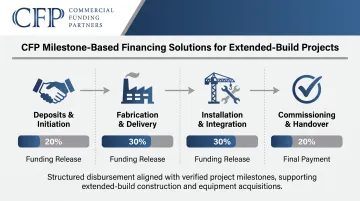
Commercial Funding Partners (CFP) structures progress payment, milestone funding, construction draw, and interest-only-during-installation financing for extended-build equipment and infrastructure projects. Manufacturing, delivery, and installation on these deals often stretch six to 18 months or longer.
Recent examples include:
- A $40 million, 36-month lease for an Idaho manufacturer, with disbursements tied to supplier deposits, progress payments, and equipment milestones—and a three-week vendor-payment deadline met
- A $15 million multi-vendor equipment program across the United States and Mexico, with milestone verification coordinated across vendors and asset locations
CFP can finance up to 100% of eligible project costs, and structures can include:
- Deferred-principal or interest-only periods during installation or commissioning
- Step-up schedules that increase payments as cash flow recovers
- Seasonal payment structures for cyclical industries
- Milestone-matched disbursements tied to deposits, fabrication, factory acceptance testing, shipment, installation, and commissioning
Businesses managing a complex, multi-stage equipment or construction project can request CFP's free Second Opinion Review—a no-obligation re-underwriting for projects a bank declined or structured too rigidly. A structuring specialist typically responds within one business day.
Frequently Asked Questions
How does milestone billing work?
Milestone billing ties each payment to completion of a specific, pre-defined project stage, verified by the owner, architect, or engineer before funds are released. Payment isn't triggered by the calendar or a re-measured percentage of overall work.
What does a milestone payment mean?
A milestone payment is a lump-sum or percentage amount due when a defined project stage is met—not on a fixed date or a running completion percentage. Once verified, it counts as earned, recognized revenue.
What are FAR milestone payments and how are they used?
In federal work, these are usually performance-based payments under FAR Subpart 32.10, tied to objective events rather than time. They can't exceed 90% of contract value and must be liquidated by final payment. Other Transaction Agreements use similar negotiated milestones outside FAR.
How many milestones should a construction contract include?
There's no fixed rule. Milestones should be granular enough to support contractor cash flow and give owners meaningful oversight, without creating so many checkpoints that administrative overhead outweighs the benefit.
What happens if a milestone is disputed or not completed on time?
Put a dispute resolution process in the contract upfront. Unresolved fights over whether a milestone was met can delay payment and, in worst cases, lead to adjudication or litigation.
Can milestone payment structures help with construction financing or cash flow?
Yes. Lenders can align progress-payment or milestone-based funding with the project's real payment schedule instead of a fixed monthly loan, bridging gaps between milestones and protecting working capital.