Introduction
Equipment costs keep climbing, supply chains remain unpredictable, and staying competitive means keeping machinery current.
As of early 2023, 98% of surveyed equipment manufacturers were still dealing with supply-chain disruptions, according to the Association of Equipment Manufacturers. Lead times had more than tripled since 2019. That backdrop has pushed leasing from a fallback financing option into a core growth strategy.
Most articles stop at "leasing helps cash flow." That's true, but incomplete. The real value shows up in how leasing shapes growth decisions, tax planning, and operational agility over time.
This article breaks down the practical advantages of equipment leasing, what happens when businesses overlook them, and how to structure a lease that actually delivers on its promises.
Key Takeaways
- Leasing frees working capital by spreading equipment costs into predictable payments instead of a large upfront outlay
- Tax treatment often lets you deduct payments as business expenses when the lease is structured for it
- Flexible lease types let businesses upgrade equipment before it becomes obsolete
- Credit-preserving structures help keep bank lines and financial ratios open for other financing needs
- Match lease terms to equipment life and cash flow cycles to stack cash, tax, and credit benefits
What Is Equipment Leasing?
Equipment leasing is a financing arrangement where a business pays to use equipment over a set term instead of buying it outright with cash or a loan. The equipment goes to work immediately; the payment gets spread out.
Leasing shows up across nearly every capital-intensive industry:
- Manufacturing lines, CNC machines, and robotics
- Medical devices and diagnostic imaging equipment
- Construction and material handling machinery
- Transportation fleets and rail assets
- Technology, data infrastructure, and energy systems
Leasing is a path to productive equipment and growth capacity without draining cash reserves. That holds whether a company needs a $320,000 CNC machine or a $100 million manufacturing facility recapitalization.
Commercial Funding Partners, for instance, structures leasing transactions from $250,000 to $300 million, scaling the same advantages to the size of the business and the deal.

Key Advantages of Equipment Leasing
These advantages show up as measurable outcomes in cash flow, tax position, technology currency, and balance sheet health. How much weight each one carries depends on your business size, equipment type, and growth stage, which is exactly why lease structuring matters as much as the decision to lease at all.
Preserves Working Capital and Cash Flow
Leasing typically requires little to no down payment and converts a large equipment cost into predictable monthly payments. That frees cash that would otherwise sit tied up in a single asset.
That freed-up cash can fund payroll, inventory, or expansion instead of depleting reserves on one purchase. 62% of end users name cash flow optimization as a primary reason for financing equipment and software, according to the Equipment Leasing & Finance Foundation's 2024 Horizon Report.
Growing and seasonal businesses gain the most here. Schedules can follow actual revenue timing instead of a generic monthly bill:
- Seasonal schedules aligned to revenue cycles, such as a four-schedule agricultural lease with discounted early payments
- Step-up structures starting with lower payments (or interest-only periods) that increase as the equipment ramps up production
- Deferred-principal terms during installation and commissioning
- Milestone and progress-payment structures for multi-phase projects
Potential Tax Advantages
Lease payments on qualifying leases are often deductible as ordinary business operating expenses. That can lower taxable income compared with depreciating a purchased asset over several years.
For 2025, businesses purchasing equipment outright can generally claim a Section 179 deduction up to $2,500,000, phasing out once qualifying purchases exceed $4,000,000, alongside bonus depreciation rules that shifted again after mid-January 2025. Leasing offers a different path: in a true tax lease, the lessee typically deducts payments as rent rather than relying on depreciation schedules.
One important caveat: accounting labels don't determine tax treatment. The IRS looks at the actual agreement, intent, and facts of the transaction, not just whether it's labeled an "operating lease" or "capital lease." A structure built as a tax lease serves a different purpose than a capital lease built for ownership and depreciation benefits.
For companies with heavy annual equipment spend, that tax treatment can move year-end liability in a material way. Always confirm treatment with a tax advisor before signing — deductibility depends entirely on how the lease is structured.
Flexibility and Reduced Obsolescence Risk
Leasing lets a business upgrade to newer equipment at the end of a term instead of being stuck with a depreciating asset. In fast-moving industries, that flexibility can be worth more than the payment savings.
Consider IT hardware: Dell's 2025 enterprise refresh guidance describes a three-year device lifecycle, noting that roughly 30% of endpoints under review were already four years old and often incapable of running current operating systems, according to Dell Technologies. Manufacturing automation and medical imaging equipment follow similar patterns of rapid technical advancement.
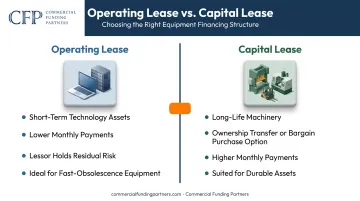
Operating leases are typically the structure built for this. They're suited to technology assets and equipment with rapid obsolescence cycles, with lower monthly costs and reduced residual-value exposure for the lessee. That setup fits equipment tied to fast-evolving technology, multi-year projects that only need an asset for part of its useful life, and deals where residual-value risk should stay with the lessor.
Preserves Balance Sheet Strength and Credit Capacity
Under current lease accounting rules (ASC 842), both operating and finance leases generally show up on the balance sheet as a right-of-use asset and lease liability. That said, an operating lease liability is typically characterized as an operating liability rather than debt, which often limits its effect on debt covenants and leverage ratios compared with a term loan.
Preserving those ratios and leaving existing bank lines untouched can decide whether the next round of financing gets approved or declined. That edge is most valuable when working capital lines, real estate, or expansion capital are already on the near-term agenda.
Sale-leaseback structures push this further. A company sells equipment it already owns, leases it back without interrupting operations, and converts trapped equity into working capital — without adding new bank debt. One documented example used a 60-month capital lease with a $1 buyout to add liquidity while preserving the borrower's existing bank relationship.
What Happens When Leasing Advantages Are Overlooked
Not every lease delivers on these benefits automatically. Structure matters, and skipping the details tends to cost businesses money later.
- Defaulting to purchase without comparing lease options ties up cash that could otherwise fund growth, payroll, or unexpected costs
- Mismatched terms erode value: a long lease on equipment that ages out quickly locks you into outdated machines; a short lease on a long-life asset drives payments higher than necessary
- Skipping the tax and accounting review before signing can mean missed deductions or unexpected balance sheet treatment
None of these are reasons to avoid leasing. They're reasons to structure it deliberately instead of accepting a generic template.
How to Get the Most Value from Equipment Leasing
Leasing works best when payment schedule, term length, and end-of-lease option match the equipment's useful life and your cash flow pattern. A one-size-fits-all lease rarely captures the full advantage.
Before finalizing anything:
- Map the equipment's useful life against the lease term. Technology assets suit shorter, flexible operating leases. Long-life machinery may justify capital lease terms.
- Review tax and accounting treatment with a qualified advisor. Deductibility and balance sheet impact depend heavily on how the lease is structured, not just what it's called.
- Get a second opinion on the underwriting. If a lease was already declined or priced poorly elsewhere, a fresh review can surface structuring fixes a first lender missed.
This is where an experienced equipment finance partner pays off. Commercial Funding Partners structures capital leases, operating leases, FMV leases, master lease programs, and sale-leasebacks around a project's cost profile and cash flow, not a generic template.
What that looks like in practice:
- CFP's free Second Opinion Review re-underwrites the deal from scratch and flags soft-cost gaps, policy limits, or specialized equipment that sank an earlier approval.
- Financing can include non-admitted costs banks often exclude (software, engineering, installation, freight, commissioning, training), often up to 100% of eligible project costs.
- The Bank Overflow Desk lets banks refer strong clients whose deals sit outside standard credit policy, without competing for the banking relationship.
- Larger or multi-vendor projects can use progress-payment facilities, construction draws, and syndicated structures up to $300 million.
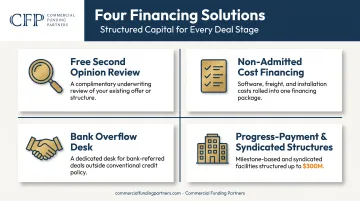
These options matter most when a project will not fit a standard bank lease: extended construction, imported equipment, or multi-phase deployments.
Conclusion
The real value of equipment leasing shows up in preserved cash flow, tax flexibility, and the ability to keep pace with changing equipment needs without overextending capital.
Those advantages compound over time, but only when lease terms are properly matched to the equipment and your business's financial cycle. Get the structure wrong, and you lose most of the benefit you were counting on.
Treat equipment leasing as an ongoing financing strategy you revisit with each major equipment need—not a decision you make once and forget.
Frequently Asked Questions
What is the 90% rule in equipment leasing?
The 90% rule was a historical test: if the present value of lease payments met or exceeded roughly 90% of the equipment’s fair value, the lease was classed as finance/capital rather than operating. Today it’s a reference point—confirm with a tax or accounting professional.
What is the 1.25% rule in equipment leasing?
This isn't a recognized accounting, tax, or industry-wide standard. If a lender references it, it's likely their internal pricing or payment-factor convention. Ask the lender directly for the formula, included fees, and residual assumptions behind the number.
What are the two types of equipment leases?
An operating lease is pay-for-use with no ownership obligation, while a capital (or finance) lease is structured with an ownership transfer or bargain purchase option at term end. The right choice depends on whether you want ownership benefits or flexibility.
Is it cheaper to lease or buy equipment?
Leasing is often less costly short-term due to lower upfront costs and smaller monthly payments. Buying or financing can be more cost-effective long-term once the asset is fully paid off, depending on how long you'll actually use the equipment.
What credit profile is typically needed to qualify for equipment leasing?
Requirements vary by lessor and transaction size. Lenders generally review financial statements, cash position, existing debt, and collateral, with larger or specialized transactions requiring a fuller financial review than standard equipment requests.
Can equipment lease payments be written off on taxes?
Many lease payments qualify as deductible business operating expenses, but this depends entirely on how the lease is structured and classified. Confirm eligibility for your specific situation with a tax advisor before signing.