Not every lease works the same way, though. The structure you choose changes your tax deductions, your balance sheet, your monthly payment, and who owns the equipment when the term ends — decisions that depend on tax strategy, project size, and end-of-term goals, not just habit.
This guide breaks down the 10 most common types of equipment leases businesses use today, how they differ, and how to match the right one to your next equipment purchase.
Key Takeaways
- Leases split into two categories: capital/finance leases (built toward ownership) and operating/true leases (built for flexibility).
- This guide covers 10 structures, from $1 buyout and FMV leases to sale-leasebacks and TRAC leases.
- 8 in 10 US businesses use leases, loans, or credit lines to acquire equipment, per ELFA's 2024 forecast.
- Matching lease type to your ownership goals and project scale matters more than familiarity.
What Is an Equipment Lease?
An equipment lease is a contract. A lessor (the entity that owns the equipment) allows a lessee (the business that needs it) to use that equipment for a set term in exchange for scheduled payments. No full purchase required upfront.
Businesses lease everything from a single forklift to $100 million automation lines, and the specifics vary by industry:
- Manufacturing plants lease robotics and production lines
- Hospitals lease imaging and diagnostic equipment
- Trucking companies lease entire vehicle fleets
- Construction firms lease excavators, cranes, and heavy machinery
That variety extends to the financing itself, not just the equipment. Equipment leasing spans multiple financing structures, and the right one depends on:
- How the IRS classifies the lease for tax purposes
- How your accountants must report it under ASC 842
- Whether you want to own the equipment at term-end or walk away
At Commercial Funding Partners (CFP), lease structuring covers deal sizes from roughly $250,000 up to $300 million: everything from a single piece of equipment to a multi-phase automation build.
Why Lease Type Matters in 2026
Lease type isn't a paperwork detail. It directly affects your monthly payment size, tax deductibility, balance sheet presentation, and who keeps the equipment when the lease ends.
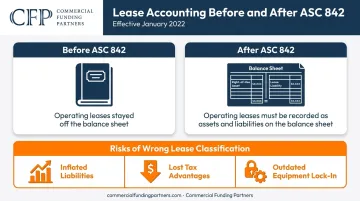
Since ASC 842 took effect for most calendar-year private companies on January 1, 2022, nearly all leases longer than 12 months now require a right-of-use asset and matching liability on the balance sheet, according to PwC's ASC 842 adoption analysis. Under the old rules, many operating leases stayed off the books entirely.
Classification still matters after that shift. Finance and operating leases carry different expense-recognition and cash-flow presentation models. Pick the wrong structure and you risk:
- Inflating liabilities on paper that auditors will flag
- Forfeiting tax advantages you were counting on
- Locking into equipment that's outdated before the term ends
Heading into 2026, the stakes are higher. Equipment costs keep climbing, projects are getting bigger (often multi-phase builds with staged installation), and lenders and auditors are scrutinizing lease classification more closely than they did a few years ago.
Types of Equipment Leases
Equipment leasing isn't one-size-fits-all. The 10 structures below exist because businesses have different ownership goals, tax situations, project sizes, and industries. Capital and operating leases are standard across nearly every sector. Municipal and progress payment leases, on the other hand, solve for specialized needs: public-sector procurement, or a $40 million automation line that takes a year to install.
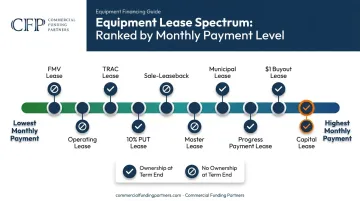
| Lease Type | Best For | Ownership at Term-End |
|---|---|---|
| Capital/Finance Lease | Long-term ownership | Yes |
| Operating Lease | Frequent upgrades | No |
| $1 Buyout Lease | Guaranteed ownership | Yes, for $1 |
| FMV Lease | Cash flow flexibility | Optional, at fair market value |
| 10% PUT Lease | Predictable buyout | Yes, at ~10% of cost |
| TRAC Lease | Fleets and heavy equipment | Varies by resale proceeds |
| Sale-Leaseback | Unlocking equity | No, lessor retains title |
| Master Lease Program | Repeat equipment needs | Varies by schedule |
| Municipal/Tax-Exempt Lease | Public entities | Typically, yes |
| Progress Payment Lease | Multi-phase builds | Varies by structure |
1. Capital Lease (Finance Lease)
A capital lease, also called a finance lease, is structured as a path to ownership. The lessee takes on the risks and rewards of owning the equipment before title even transfers, so the asset and a matching liability show up on the balance sheet from day one.
Best for: Businesses planning to keep equipment long-term and wanting depreciation and interest deductions.
Trade-off: Higher monthly payments than an operating lease, plus full responsibility for maintenance, insurance, and residual value risk. Terms are typically non-cancelable.
2. Operating Lease (True Lease)
An operating lease works more like a rental. The lessor keeps ownership, and under ASC 842's simplified treatment, the lease liability generally has a lighter footprint on the lessee's balance sheet than a finance lease would.
Best for: Companies that upgrade equipment often or want lower payments without an ownership commitment — common in technology and medical equipment, where machines become outdated fast.
Trade-off: No equity builds in the equipment. Renew enough times, and cumulative rental cost can exceed what buying outright would have cost.
3. $1 Buyout Lease
A $1 buyout lease is a capital lease variant. You make fixed payments for the full term, then purchase the equipment for a nominal $1 at the end.
Best for: Businesses certain they want ownership and looking to maximize Section 179 or bonus depreciation. For 2026, the Section 179 deduction maxes out at $2.56 million, phasing out once qualifying purchases exceed $4.09 million.
Trade-off: The highest monthly payment among common structures, since you're essentially financing the full purchase price.
4. Fair Market Value (FMV) Lease
An FMV lease is operating-style, with lower monthly payments than a capital lease and three options at term-end: buy at fair market value, renew, or return the equipment.
Best for: Companies prioritizing cash flow and flexibility, especially where technology changes fast — manufacturing automation, food and beverage processing, medical equipment.
Trade-off: Lowest payments of any structure covered here, but you won't know the exact buyout cost until fair market value gets assessed at the end.
5. 10% PUT (Purchase Upon Termination) Lease
A 10% PUT lease sets a mandatory purchase price upfront, commonly around 10% of original equipment cost, removing the guesswork of an FMV assessment.
Best for: Businesses that already know they'll keep the equipment but want lower payments than a $1 buyout lease, without gambling on future fair market value.
Trade-off: Predictable cost and moderate payments, but you can't simply walk away at term-end the way you could with an FMV or operating lease.
6. TRAC Lease (Terminal Rent Adjustment Clause)
A TRAC lease is used almost exclusively for vehicles, trucks, trailers, and heavy rolling equipment. Rather than relying on fair market value at term-end, it sets a pre-negotiated residual value upfront, then adjusts the final payment based on actual resale proceeds.
Best for: Fleet operators and heavy equipment users wanting predictable end-of-term costs with true-lease tax treatment.
Trade-off: Often cheaper than conventional vehicle financing, but under IRC Section 7701(h), it's restricted to motor vehicles built for public roads. It isn't a general-purpose equipment structure.
7. Sale-Leaseback
A sale-leaseback flips the usual order. You sell equipment you already own to a lessor, then immediately lease it back, converting equity you've built up into working capital while keeping the equipment running on your floor.
Best for: Companies needing to raise capital, improve liquidity, or free up credit lines without disrupting operations.
CFP has structured sale-leasebacks across a wide size range, including a $650,000 transaction for a healthcare provider's mobile MRI unit and a $36 million deal for a Midwest manufacturer. Trade-off: you unlock cash, but depending on how the deal is structured, you may give up some depreciation benefits you'd keep as the equipment's outright owner.
8. Master Lease Agreement / Program
A master lease is one pre-approved agreement that lets you add new equipment schedules later without renegotiating a full contract every time.
Best for: Growing companies or vendors with recurring equipment needs across multiple locations or purchase cycles.
CFP structures master lease programs for clients who expect repeat equipment purchases. Roughly 40% of CFP's clients return for additional funding after a positive first experience. Trade-off: faster future funding turnaround, but it works best once you've established a credit relationship with the lender.
9. Municipal / Tax-Exempt Lease
A municipal lease is a lease-purchase structure available only to government entities. Because it qualifies for tax-exempt interest treatment, it typically carries a lower rate than comparable taxable financing.
Best for: Municipalities, water and wastewater authorities, and public agencies financing vehicles, machinery, or infrastructure equipment.
Trade-off: Below-market rates and a non-appropriation clause that protects the municipality if funding isn't approved in a future budget cycle — but it's limited strictly to qualifying public-sector entities.
10. Progress Payment / Milestone Funding Lease
A progress payment lease disburses funds in stages, tied to installation milestones, rather than all at once at delivery. Payments can include an interest-only period while equipment is being installed and commissioned.
Best for: Large, multi-phase automation lines or infrastructure projects with extended installation timelines, where full lease payments shouldn't start before the line is actually running.
This is a specialty for CFP, which finances soft costs many banks won't book (engineering, freight, installation, and automation integration) alongside the equipment itself. Trade-off: it requires a lender experienced in staged, large-scale transactions.
How to Choose the Right Type of Equipment Lease
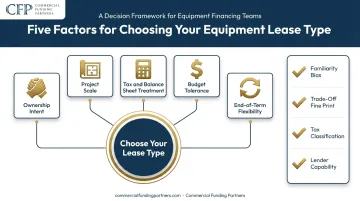
The right lease type depends on your ownership goals, tax strategy, project size, and balance sheet impact, not on which lease is most common. Consider these factors before signing anything:
- Ownership intent: Do you want to own the equipment outright, or would you rather upgrade or return it in a few years?
- Project scale: Is this a single purchase, or a multi-phase project needing progress payments as installation proceeds?
- Tax and balance sheet treatment: How will this lease affect ASC 842 reporting, depreciation eligibility, and deductibility?
- Budget tolerance: Can you handle a higher monthly payment for lower total cost, or do you need the lowest payment possible?
- End-of-term flexibility: Do you need the option to return, renew, or purchase?
What to Check Before Finalizing
- Familiarity bias: A $1 buyout lease might feel like the "safe" choice, but a lower-payment FMV or operating lease may fit your cash flow better.
- Trade-off fine print: Early termination penalties and mandatory end-of-term purchase obligations vary widely between lease types.
- Tax classification: Confirm the accounting classification before signing. This determines what shows up as a liability on your balance sheet.
- Lender capability: For large or multi-phase projects, confirm the lender can structure progress payments, milestone funding, or soft-cost financing; not every bank can accommodate an extended-build timeline.
Conclusion
Equipment leases are how businesses of nearly every size acquire the machinery, vehicles, and technology they need without tying up capital in 2026. The 10 structures above exist because businesses have different ownership goals, project sizes, and tax situations. The right choice depends on your business's cash flow, tax position, and long-term equipment plans.
Whether you're financing a single machine or a $300 million multi-phase automation project, the structure matters as much as the rate. Request a Second Opinion Review or talk with a CFP structuring specialist to identify the right lease for your next equipment purchase.
Frequently Asked Questions
What are the main types of equipment leases?
The two primary categories are capital (finance) leases and operating leases. Variations like $1 buyout, FMV, sale-leaseback, and TRAC leases are all built on these two foundations.
What are the lease classification tests for equipment leases?
Under ASC 842, a lease is a finance lease if it transfers ownership, includes a bargain purchase option, covers most of the asset's useful life, or its payments equal substantially all of its fair value. Otherwise, it's an operating lease.
What is the difference between a capital lease and an operating lease?
A capital lease puts the asset and liability on your balance sheet and leads toward ownership, with higher payments. An operating lease is rental-style, with lower payments and no ownership built in.
Can I negotiate the terms of an equipment lease?
Yes. Lease term, payment schedule, buyout price, and even progress payment structures are often negotiable with an experienced lender, especially on larger transactions.
What happens at the end of an equipment lease?
Depending on the lease type, you'll typically return the equipment, renew the lease, or purchase it — either at a fixed price, fair market value, or a nominal buyout amount.
Is leasing equipment better than buying it outright?
Leasing preserves cash flow and adds flexibility, which suits equipment that changes quickly. Buying outright can be more cost-effective for durable equipment you'll use for its entire useful life.