Introduction
Picture this: a manufacturing company needs a $2 million automated assembly line to stay competitive. The equipment would pay for itself within three years — but absorbing that cost upfront would gut working capital, delay payroll, and stall other growth initiatives. A medical group faces the same wall with a $1.5 million imaging scanner, and a construction firm needs a crane that costs more than its annual cash reserves.
This is where a direct financing lease bridges the gap. Rather than forcing a business to choose between growth and liquidity, the structure lets an equipment finance company acquire the asset and lease it back to the business: a prohibitive lump sum becomes predictable, manageable payments.
According to the Equipment Leasing and Finance Association, the U.S. equipment finance industry reached $1.34 trillion in 2023, with 82% of end users relying on some form of financing to acquire equipment or software.
This guide covers what a direct financing lease is, how it's classified under ASC 842, how it compares to other lease types, how the accounting works, and when it makes sense for your business.
Key Takeaways
- A direct financing lease is a lessor-side arrangement where an equipment finance company acquires an asset and earns interest income over the lease term
- Under ASC 842, qualification requires passing both the present value test (including third-party residual value guarantees) and the collectibility test
- Sales-type leases book selling profit at commencement; direct financing leases defer any profit and recognize only interest income over the term
- Lease classification follows a strict hierarchy: sales-type first, direct financing second, operating last — order matters for accounting treatment
- Capital-intensive businesses in manufacturing, healthcare, and construction are often the strongest candidates for this structure
What Is a Direct Financing Lease?
A direct financing lease is one where the lessor functions purely as a financier — acquiring an asset to lease it to a customer and earning a return through interest income, not through use of the asset or profit on a sale.
The Key Parties
- Lessor: Typically a financial institution or independent equipment finance company — not a manufacturer or dealer. The lessor provides capital, not product expertise.
- Lessee: The business that uses the equipment and makes structured payments over the lease term.
- Third-party residual value guarantors: In some transactions, an unrelated third party guarantees the residual value of the asset at lease end — a detail that affects ASC 842 classification.
Core Characteristics
A direct financing lease has several defining features:
- No manufacturer or dealer involvement on the lessor side
- Transfer of substantially all risks and rewards of ownership to the lessee
- No immediate profit recognized at commencement (though deferred selling profit is possible)
- Lessor earns interest income using the effective interest method throughout the lease term
- Legal ownership stays with the lessor unless a purchase option is exercised
A Real-World Example
A manufacturing company needs $2 million in automated production equipment. An equipment finance company acquires the equipment and enters into a direct financing lease with the manufacturer, who makes structured monthly payments over five years.
What each party gets:
- The manufacturer keeps working capital intact, gains immediate use of the equipment, and funds the acquisition through the revenue the equipment generates
- The finance company earns a consistent interest return over the lease term without operating or maintaining the equipment
What a Direct Financing Lease Is Not
These three lessor classifications are often confused, but they differ in a key way:
| Lease Type | Who Bears Risk | Revenue Recognition |
|---|---|---|
| Direct financing | Lessee | Interest income over lease term |
| Operating lease | Lessor | Rental income; asset stays on lessor's books |
| Sales-type lease | Lessee | Profit or loss recognized at commencement |
One more critical distinction: under ASC 842, direct financing is a lessor-only classification. Lessees classify qualifying leases as either finance or operating — there is no direct financing category on the lessee's side.
Direct Financing Lease Classification Criteria Under ASC 842
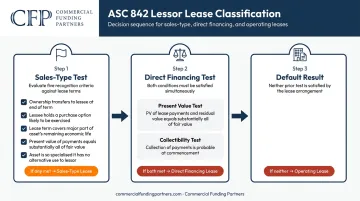
Under ASC 842, lessors must follow a strict sequential test when classifying leases. Skipping steps or applying them out of order produces incorrect accounting treatment.
The Classification Sequence
- Sales-type test first (ASC 842-10-25-2): Evaluate against five criteria — ownership transfer, purchase option reasonably certain to be exercised, lease term covering the major part of the asset's remaining economic life, present value equaling substantially all of the asset's fair value, or a specialized asset with no expected alternative use. If any one criterion is met, classify as sales-type.
- Direct financing test second (ASC 842-10-25-3): If none of the five sales-type criteria are met, assess two specific conditions.
- Operating lease result: If neither sales-type nor direct financing criteria are met, the lease is operating.
The Two Direct Financing Conditions
Condition 1 — Present Value Test: The present value of lease payments plus any residual value guaranteed by the lessee and/or an unrelated third party must equal or exceed substantially all of the underlying asset's fair value. ASC 842-10-55-2 identifies 90% or more as one reasonable interpretation of "substantially all," though no mandatory percentage is codified.
The key distinction from the sales-type test is that direct financing specifically includes third-party residual value guarantees, not just lessee guarantees.
In practice, this is the mechanism that most often triggers direct financing classification. A third party guarantees enough residual value to push the present value over the threshold — something lessee guarantees alone frequently cannot accomplish.
Condition 2 — Collectibility: It must be probable that the lessor will collect the lease payments plus any amount needed to satisfy a residual value guarantee. Collectibility is assessed only at lease commencement — changes after that date do not trigger reclassification.
The ASU 2021-05 Variable Payment Override
Even if a lease meets both direct financing conditions, it must be classified as an operating lease if:
- It contains variable lease payments that don't depend on an index or rate, and
- Sales-type or direct financing classification would produce a selling loss at commencement
When significant variable payments are excluded from the net investment calculation, recognizing a day-one loss misrepresents the economics of the arrangement. Operating classification avoids that distortion.
A Note on Fair Value and Acquisition Cost
For lessors that are not manufacturers or dealers (most independent equipment finance companies fall into this category), ASU 2019-01 provides that acquisition cost generally equals fair value when no significant time has elapsed between acquiring the asset and lease commencement.
When cost equals fair value, no selling margin arises from a cost/fair-value difference. That absence of margin directly affects whether the implicit rate produces a sales-type or direct financing result.
Direct Financing Lease vs. Sales-Type Lease vs. Operating Lease
Understanding how these three classifications differ is where most of the practical confusion lives.
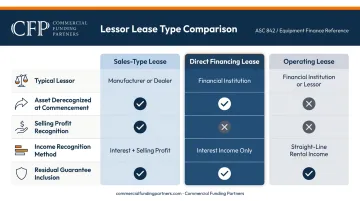
Side-by-Side Comparison
| Feature | Sales-Type | Direct Financing | Operating |
|---|---|---|---|
| Typical lessor | Manufacturer or dealer | Equipment finance company | Any lessor |
| Asset derecognized at commencement? | Yes | Yes | No |
| Selling profit at commencement | Recognized immediately | Deferred over term | None |
| Selling loss at commencement | Recognized immediately | Recognized immediately | N/A |
| Income recognition | Interest on net investment after day one | Interest producing constant periodic return | Straight-line lease income |
| Third-party residual guarantees in test | No (lessee only) | Yes | N/A |
The Profit Recognition Difference — With Numbers
Suppose a lessor carries an asset at $400,000 but the fair value is $500,000 — a $100,000 selling margin.
- Sales-type lease: The $100,000 profit is recognized at commencement, along with the cost of goods sold entry. Interest income accrues on the net investment going forward.
- Direct financing lease: The $100,000 profit is deferred and incorporated into the net investment, effectively raising the yield recognized as interest income over the life of the lease. No day-one profit hits the income statement.
- Selling loss (either type): Recognized immediately at commencement — no deferral permitted.
How Operating Leases Differ
Operating leases work differently at every level of the accounting model:
- The lessor never derecognizes the underlying asset — it stays on their books
- The asset continues to be depreciated normally over its useful life
- Lease income is recognized on a straight-line basis, not as interest
- No net investment in the lease is recorded
Most standard equipment leases with short terms or significant residual value retained by the lessor fall into this category.
A Note on IFRS 16
IFRS 16 classifies lessor leases only as finance or operating — it does not distinguish between sales-type and direct financing. For U.S.-based lessors reporting under ASC 842, the sales-type vs. direct financing distinction is real and consequential: it determines whether a profit appears on the income statement at deal close or gets spread across the lease term as interest income — which directly affects reported earnings in the year of commencement.
How Accounting Works for a Direct Financing Lease
Initial Recognition at Commencement
At lease commencement, the lessor:
- Derecognizes the underlying asset from its balance sheet
- Records the net investment in the lease, which consists of:
- The present value of future lease payments
- The present value of the unguaranteed residual asset
- Initial direct costs (deferred into the net investment)
- Less any deferred selling profit, if applicable
- Recognizes a selling loss immediately if one exists — unless ASU 2021-05's variable payment override forces operating classification instead
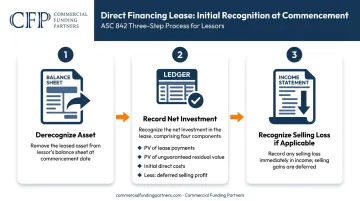
If there is deferred selling profit, it is recorded as a component of the net investment and recognized over the lease term as an adjustment to the yield — never upfront.
Subsequent Measurement: The Effective Interest Method
Under ASC 842-30-35-1, the lessor recognizes interest income each period using a constant periodic discount rate applied to the remaining net investment. As payments come in, the net investment decreases.
This contrasts with sales-type lease accounting: in a sales-type lease, the implicit rate is calculated based on fair value. In a direct financing lease with deferred selling profit, that profit is incorporated into the yield — producing a slightly different effective rate.
Variable lease payments excluded from the net investment are recognized in the period the triggering event occurs — subject to the ASU 2021-05 classification override.
Residual Value and Credit Loss Monitoring
Ongoing measurement doesn't stop at interest accrual. As long as the net investment remains on the lessor's books, it must be evaluated for credit deterioration under ASC 326-20 (the current expected credit loss, or CECL, framework).
Key scope rules under ASC 842-30 and ASU 2018-10:
- Both components are in scope — the lease receivable and the unguaranteed residual asset are assessed together, not separately
- Full net investment exposure — credit loss estimates must reflect the entire net investment, not just the cash payment stream
- CECL applies, not the older standard — the leveraged lease framework's "other-than-temporary decline" test does not apply to direct financing leases under ASC 842
Best Practices: When a Direct Financing Lease Makes Sense
For Lessees: The Right Fit
Direct financing lease structures work best for businesses that:
- Need expensive, long-lived equipment — heavy machinery, medical devices, manufacturing lines, transportation fleets
- Want to preserve working capital rather than absorb a large upfront cost
- Benefit from predictable, fixed payment structures tied to the equipment's productive life
- Operate in capital-intensive industries where equipment is central to revenue generation

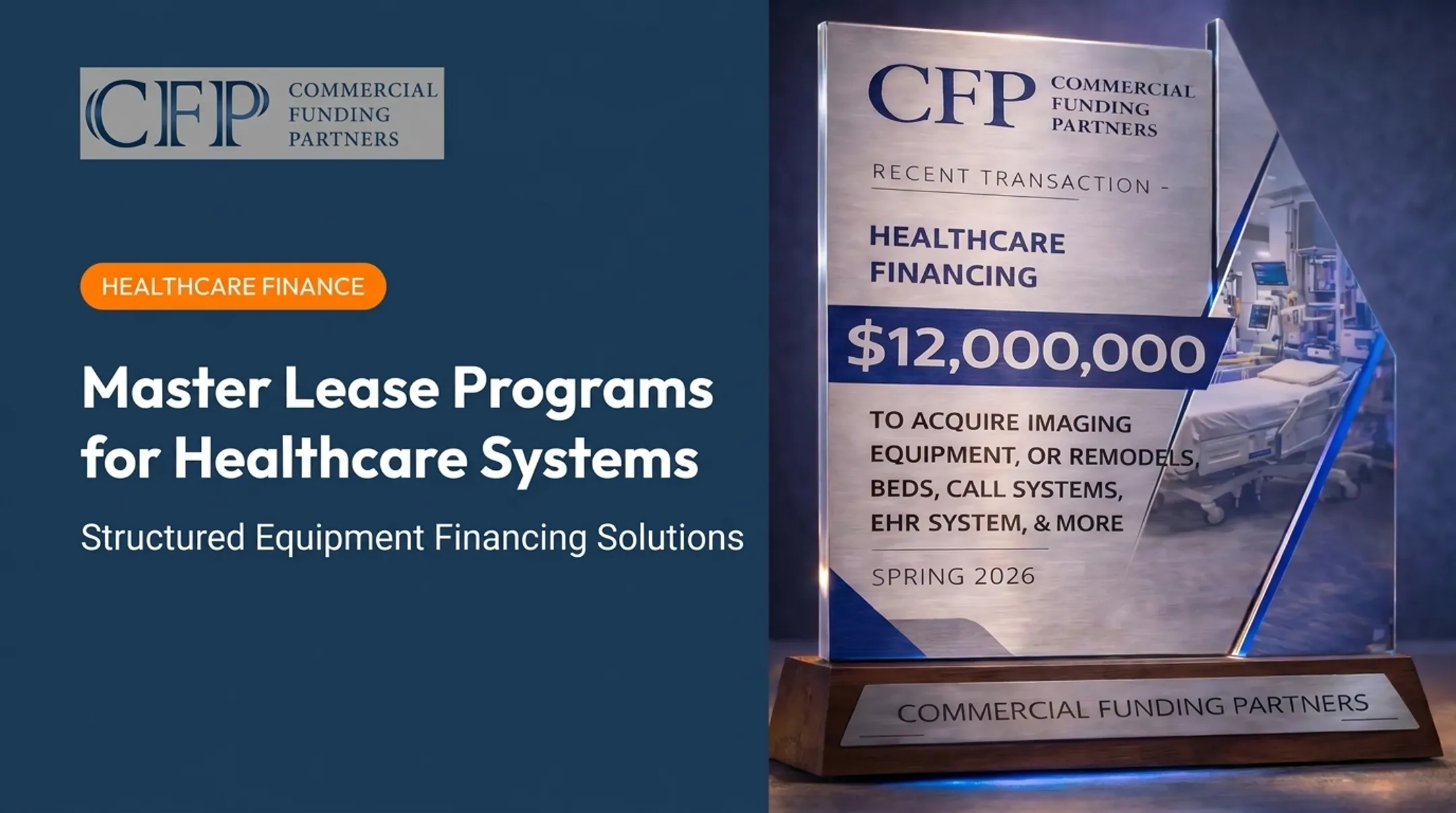
Commercial Funding Partners structured a $1.5 million capital lease over a 36-month term for a manufacturer that needed core production equipment but couldn't absorb the outright cost.
The structure preserved operational momentum, protected cash flow, and let leadership make broader capital decisions without a single large expenditure constraining them.
That demand pattern holds across sectors. Manufacturing, healthcare, construction, and energy see the highest concentration — sectors where 84% of medical equipment acquisition volume was financed in 2023 alone.
What to Look for in a Lessor
When selecting a lessor for a direct financing lease, evaluate:
- Works independently from manufacturers, dealers, and banks — no standardized product constraints shaping the deal
- Understands your specific asset type and sector, so deal terms match equipment useful life and revenue cycles
- Handles transactions scaled to your actual needs, not a one-size template
- Optimizes structure around your cash flow, not their own margin preferences
Firms like Commercial Funding Partners — which specializes in independent equipment finance across manufacturing, healthcare, construction, energy, and transportation, handling transactions from $250,000 to over $100 million — are built for this kind of deal.
For Lessors: Best Practices at Commencement and Beyond
- Verify fair value and collectibility at commencement — both feed directly into classification and net investment measurement
- Document residual value assessments and any third-party guarantee agreements with specificity — these are what typically trigger direct financing rather than sales-type classification
- Apply the sequential test correctly: sales-type first, then direct financing, then operating — skipping steps creates misclassification risk
- Build an ongoing credit loss monitoring process consistent with ASC 326-20 for the net investment
- Engage your accounting team early when variable lease payments are involved — ASU 2021-05 creates a classification override that can push qualifying leases to operating treatment
Frequently Asked Questions
What are direct financing leases?
A direct financing lease is a financing arrangement where a lessor — typically an equipment finance company — acquires an asset and leases it to a business, transferring substantially all risks and rewards of ownership while earning interest income over the lease term. No immediate profit is recognized at commencement.
What does direct financing mean?
"Direct financing" describes a lessor acting purely as a capital provider: acquiring an asset and funding the lessee's use of it through structured payments, rather than operating the asset or earning a selling profit on the transaction.
What is an example of direct financing?
A healthcare company needs a $1.5 million imaging machine. An equipment finance company purchases the machine and leases it to the healthcare company under a five-year agreement, collecting monthly payments while the healthcare company uses the equipment and the finance company earns interest income.
How is a direct financing lease different from a sales-type lease?
The key difference is profit recognition timing. Sales-type leases recognize any selling profit immediately at commencement; direct financing leases defer it over the lease term. Direct financing classification also uniquely includes third-party residual value guarantees in the present value test, which most often triggers this classification under ASC 842.
Who qualifies as a lessor in a direct financing lease?
The lessor must be a financial institution or independent equipment finance company — not a manufacturer or dealer — whose role is to provide capital by acquiring and leasing the asset, not to generate a selling margin.
Can a direct financing lease be reclassified after commencement?
Under ASC 842, lease classification is set at commencement and generally cannot be reassessed unless the lease is modified in a way that isn't treated as a separate contract. Changes in collectibility or residual value after commencement do not trigger reclassification.