Key Takeaways
- Preserve working capital by skipping large upfront purchases and directing cash to growth
- Deduct lease payments as operating expenses; some structures also qualify for Section 179
- Access current technology without absorbing the risk of obsolete owned equipment
- Shift maintenance and upgrades to the lessor to lighten operational burden
What Is Equipment Leasing
Equipment leasing is a financing arrangement where businesses pay to use equipment over a defined term without purchasing it outright. The lessor owns the asset; the lessee gains use of it under agreed terms.
Leasing covers nearly any commercial asset, including:
- Manufacturing machinery and industrial systems
- Medical and healthcare equipment
- Construction, agriculture, and material handling equipment
- Vehicles, IT systems, and related technology
According to the Equipment Leasing and Finance Association (ELFA), leases represented 26% of 2023 equipment and software acquisitions in the U.S., with 82% of surveyed acquirers using at least one financing method. Typical commercial transactions range from hundreds of thousands of dollars into the hundreds of millions.
Key Advantages of Leasing Equipment
The advantages below focus on measurable financial and operational outcomes, not theoretical benefits. Each advantage directly impacts metrics businesses track daily: cash flow, tax liability, equipment performance, risk exposure, and scalability.
Preserves Working Capital and Improves Cash Flow
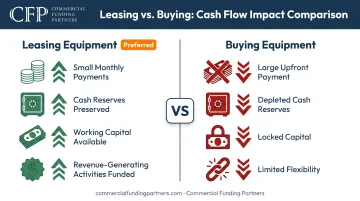
Leasing eliminates the need for large upfront capital expenditures, spreading equipment costs into predictable monthly payments. That cash stays available for inventory, payroll, marketing, expansion, or emergency reserves.
Why it matters:
- Cash remains available for revenue-generating activities rather than being locked in depreciating assets
- Federal Reserve Bank of Boston research: after a 1-point rate rise, low-cash firms’ capital stock ran ~1.5 points below the no-shock path within eight quarters
- Monthly payments align equipment costs with the revenue the equipment generates, creating better cash flow matching
- 62% of ELFA Foundation survey respondents identified cash-flow optimization as a leading equipment-finance motive
KPIs impacted:
- Working capital ratio
- Cash reserves
- Debt-to-equity ratio
- Monthly cash flow
- Liquidity position
When this advantage matters most:
- Fast-growing companies that need capital for expansion
- Businesses with seasonal revenue fluctuations
- Companies acquiring multiple pieces of equipment simultaneously
- Organizations entering new markets where cash flexibility is critical
Delivers Significant Tax Benefits
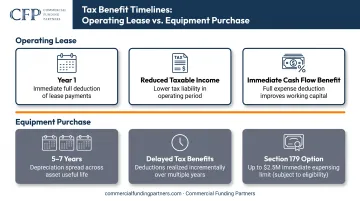
Lease payments are typically fully deductible as operating expenses (for operating leases) or can qualify for Section 179 deductions (for capital leases structured as finance leases). Immediate expensing cuts taxable income now instead of waiting on multi-year depreciation schedules, which lowers the net cost of the equipment.
Why it matters:
- Deducting the full lease payment as a business expense lowers taxable income in the current year
- For 2025 returns, the Section 179 ceiling is $2.5M (phaseout starts above $4.0M placed in service)
- Businesses gain tax benefits while preserving capital, unlike purchased equipment where the tax benefit is spread over the depreciation schedule
- 51% of ELFA survey respondents cited tax advantages as a leading reason for financing equipment
KPIs impacted:
- Effective tax rate
- Net income
- Taxable income
- Cash available after taxes
- Total cost of equipment acquisition
When this advantage matters most:
- Profitable businesses looking to reduce current-year tax liability
- Companies making large equipment investments
- Businesses in industries with rapid equipment obsolescence where accelerated deductions provide maximum value
Provides Access to Current Technology Without Obsolescence Risk
Leasing allows businesses to upgrade or replace equipment at the end of the lease term, ensuring access to the latest technology without being stuck with outdated assets. That flexibility matters most where technology moves fast: medical imaging, manufacturing automation, IT infrastructure, and telecom gear.
Why it matters:
- Avoid writing down owned assets that go obsolete before the end of their useful life
- 55% of ELFA Foundation respondents identified protection from equipment obsolescence as a leading reason to finance
- Businesses can maintain competitive advantages by always operating with current, efficient equipment rather than nursing aging assets
- Microsoft ended Windows 10 support on October 14, 2025, pushing many enterprises into costly, unplanned refresh cycles
KPIs impacted:
- Equipment efficiency rates
- Production output
- Competitive positioning
- Technology refresh cycle time
- Asset obsolescence risk
When this advantage matters most:
- Technology-dependent businesses
- Industries with rapid innovation cycles
- Companies where equipment performance directly impacts product quality or service delivery
- Organizations that must meet evolving regulatory or compliance standards
Transfers Maintenance Burden and Reduces Unpredictable Costs
Many lease agreements include maintenance coverage, shifting the responsibility and cost of repairs from the lessee to the lessor or manufacturer. This eliminates surprise repair expenses and the administrative burden of managing maintenance schedules, vendor relationships, and technician coordination.
Why it matters:
- Predictable monthly lease payments replace unpredictable maintenance costs, making budgeting more accurate
- ATRI’s 2024 study put U.S. trucking repair and maintenance at $0.202 per mile (up 3.1% YoY); maintenance-inclusive leases help lock that cost in
- Operations teams can focus on core business activities instead of equipment upkeep, repairs, and vendor management
KPIs impacted:
- Maintenance expense variance
- Equipment downtime
- Operational efficiency
- Unplanned expense incidents
- Administrative overhead
When this advantage matters most:
- Businesses with limited in-house maintenance capabilities
- Companies operating complex or specialized equipment
- Organizations with tight operating budgets that cannot absorb large unexpected repair costs
Offers Easier Approval and Greater Financing Flexibility
Leasing often requires less stringent credit approval than traditional equipment loans, and approval processes are typically faster. Specialized equipment finance partners can structure seasonal, deferred, step-up, or progress-payment terms for equipment still under construction.
Why it matters:
- Firms near bank credit limits—or with thinner institutional files—can still fund required equipment
- ELFA's May 2025 CapEx Finance Index reported a 77% overall credit approval rate among surveyed equipment finance companies
- Payment structures can match cash flow, project timelines, or revenue seasonality instead of rigid monthly schedules
KPIs impacted:
- Time to equipment acquisition
- Approval success rate
- Financing cost
- Payment timing alignment with revenue cycles
When this advantage matters most:
- Middle-market companies with limited bank capacity or shorter institutional credit files
- Companies making large equipment purchases that exceed available bank credit lines
- Businesses with seasonal revenue patterns
- Projects with extended equipment delivery or installation timelines
What Happens When You Buy Instead of Lease
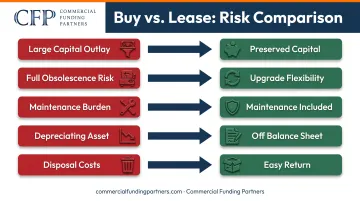
Purchasing equipment outright creates risks leasing typically avoids or reduces:
- Large upfront capital outlay drains cash reserves and limits flexibility for other opportunities
- Full obsolescence risk leaves you owning equipment that may become outdated or incompatible with new standards
- Maintenance and admin burden fall entirely on the business, with unpredictable expenses
- Depreciating asset on the balance sheet can weigh on financial ratios and borrowing capacity
- Disposal and compliance costs at retirement, including EPA universal-waste rules and Section 608 refrigerant-recovery requirements for certain commercial equipment
How to Get the Most Value from Equipment Leasing
Equipment leasing pays off when structure, partners, and exit options are planned up front. You get the most value when you:
- Compare operating and capital leases for the tax and balance sheet treatment that fits your situation
- Work with equipment finance specialists who match payments to cash flow, project timelines, or revenue cycles
- Lock in end-of-lease options early: return, upgrade, buy at fair market value, or extend
Commercial Funding Partners structures equipment leases from $250,000 to $300 million for middle-market and enterprise businesses in manufacturing, healthcare, construction, transportation, and other capital-intensive industries. With 40% of clients returning for additional funding, the long-term value shows up when the lease is structured correctly from day one.
Conclusion
Equipment leasing offers clear advantages in cash flow preservation, tax efficiency, technology access, risk mitigation, and financing flexibility. Those gains are strongest when a lease is structured around your operational and financial needs.
Leasing lets you acquire essential equipment without draining liquidity or weakening your competitive position. If you are weighing lease structures for a larger project, Commercial Funding Partners works with middle-market and enterprise teams nationwide on equipment leases and related financing from $250,000 to $300 million.
Frequently Asked Questions
Is it better to lease or buy equipment for business?
Leasing typically makes more sense when cash flow preservation, access to current technology, and flexibility matter more than long-term ownership. Buying may be better for equipment with long useful lives, minimal obsolescence risk, and when capital reserves are strong enough to absorb the upfront cost.
Can I write off equipment leases on my taxes?
Operating lease payments are typically fully tax-deductible as business expenses, while capital leases (finance leases) may allow Section 179 deductions. Businesses should consult their tax advisor to determine which lease structure delivers the best tax treatment for their situation.
What types of equipment can be leased?
Nearly any business equipment can be leased: manufacturing machinery, medical devices, construction equipment, IT systems, vehicles, and office furniture. Many lessors also cover soft costs such as software, installation, and training that banks often will not finance.
How does equipment leasing affect my balance sheet?
Under FASB ASC 842, most leases appear on the balance sheet as a right-of-use asset and a lease liability. Operating vs. finance classification still changes how expense hits the P&L and can affect key ratios and lending capacity.
What happens at the end of an equipment lease?
Typical end-of-lease options include returning the equipment, purchasing it at fair market value or a predetermined price, upgrading to newer equipment, or extending the lease term, depending on the agreement structure.
Do I need perfect credit to lease equipment?
Equipment leasing often uses more flexible credit criteria than traditional bank loans. Many specialized lessors weigh cash flow and equipment value alongside credit history and can fund projects banks decline or restrict.