Introduction
Every business acquiring equipment faces the same fork in the road: lease it or buy it. Both paths can unlock real tax deductions, but here's the catch — the tax outcome depends entirely on how the deal is structured, not what you call it on paper.
Get the structure wrong and costs compound quickly. You can miss accelerated deductions, tie up cash needed for operations, or lock into equipment you cannot upgrade on your timeline. On large machinery and automation projects, those tradeoffs are measured in six and seven figures.
This guide breaks down the tax benefits of leasing versus buying, compares them side by side, and shows how to match the structure to your cash flow, deduction timing, and upgrade plans so you capture the advantage without draining working capital.
Key Takeaways
- Capital leases and purchases make you the tax owner eligible for depreciation; operating leases deduct as rent
- Section 179 and bonus depreciation deliver large upfront write-offs only when you have taxable income to shelter
- Leasing preserves cash flow and fits industries that refresh equipment often
- IRS substance tests—not the contract label—decide if a lease is taxed as rent or a purchase
- Multiple lease structures let you match tax treatment to cash-flow priorities
Tax Benefits of Leasing Equipment
Not all leases are created equal for tax purposes. A true (operating) lease keeps the lessor as the tax owner, and your payments are deductible under IRC Section 162 as ordinary business rent. A **capital or finance lease**, by contrast, transfers the benefits and burdens of ownership to you, so you depreciate the asset the same way you would after a purchase.
The IRS doesn't care what your contract calls itself. It looks at substance: Does equity build with each payment? Is there a bargain purchase option? Are "rent" payments unusually high relative to fair value? Answer yes to enough of these, and the IRS treats it as a conditional sale, not a lease.
Why Leasing Preserves Capital
For a true operating lease, your payments are typically fully deductible as an ordinary business expense, spread predictably across the term. That predictability matters for budgeting, but the bigger draw for many businesses is cash preservation.
- Requires little to no down payment, freeing capital for operations or payroll
- Covers up to 100% of eligible project costs with providers like CFP, including installation, engineering, software, freight, and commissioning
- Avoids the large upfront debt load that comes with a purchase loan
Under ASC 842, most leases longer than 12 months still appear on your GAAP balance sheet as a right-of-use asset and liability. Book treatment and tax treatment are separate: a lease can be operating for accounting purposes while functioning as a purchase for tax purposes.
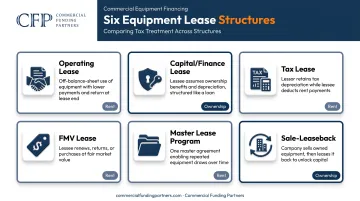
Lease structures aren't one-size-fits-all, either. Operating leases, capital/finance leases, tax leases, FMV leases, master lease programs, and sale-leasebacks all serve different goals. Commercial Funding Partners structures these arrangements around a client's tax position and cash flow needs—matching the lease type to the outcome, not a single standard product.
Use Cases of Leasing
Leasing often fits best in a few recurring scenarios:
- Fast-obsolescence industries: Technology, medical, and automated manufacturing equipment often becomes outdated within a few years. Easy upgrades matter more than ownership here.
- Lower or inconsistent taxable income: If you can't fully use a large accelerated deduction this year, spreading it across lease payments avoids wasting that tax benefit.
- Cash-conscious growth phases: Businesses scaling operations often prioritize liquidity over asset ownership.
The scale of this trend is significant. In 2023, U.S. businesses, nonprofits, and government agencies invested $2.3 trillion in plant, equipment, and software — and 57.7%, or $1.34 trillion, of that was financed through loans, leases, and lines of credit, according to ELFA's 2024 industry report. For most operators, the live question is which structure delivers the better tax and cash outcome—not whether to finance at all.
Tax Benefits of Buying Equipment
When you purchase equipment, whether with cash or financing, you become the tax owner and can claim depreciation-based deductions. This is where the biggest first-year tax savings typically live.
Section 179 and Bonus Depreciation
Section 179 allows you to fully expense qualifying equipment costs in the year it's placed in service, rather than depreciating it over several years. For tax years beginning in 2026, the maximum Section 179 election is $2,560,000, phased out dollar-for-dollar once qualifying purchases exceed $4,090,000, per IRS Revenue Procedure 2025-32.
Bonus depreciation stacks on top of Section 179. Under the One Big Beautiful Bill Act, bonus depreciation is now permanently set at 100% for qualified property acquired after January 19, 2025. Together, these two provisions let many businesses write off the entire cost of eligible equipment in Year 1.
For equipment cost that isn't fully expensed through either provision, MACRS depreciation applies next, front-loading deductions over the asset's useful life with accelerated methods like 200% declining balance.
What Else Ownership Unlocks
Buying also brings a few other tax and financial advantages:
- Interest on financed equipment (including capital leases) is generally deductible, though larger businesses face the Section 163(j) limitation tied to gross receipts
- Owned equipment becomes a tangible asset that can serve as collateral for future financing
- Owned equipment adds resale value if the business is later sold
Use Cases of Buying
Buying makes the most sense when:
- Taxable income is strong this year, so you can maximize an immediate deduction instead of spreading it thin
- Equipment has a long useful life, such as heavy machinery, construction equipment, and long-lifecycle manufacturing assets that rarely need mid-cycle upgrades
- You want to build owned assets for collateral value or eventual resale
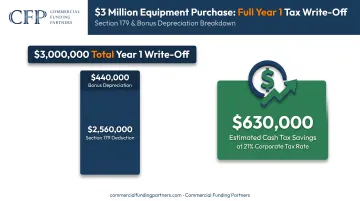
Section 179 and bonus depreciation can clear a large equipment cost in year one. One U.S. Bank Equipment Finance illustration models a $3 million equipment purchase with a $2.56 million Section 179 deduction plus $440,000 of bonus depreciation.
That full $3 million first-year write-off equals roughly $630,000 in cash tax savings at a 21% corporate rate. Actual savings depend on your entity type, tax bracket, and taxable income.
Leasing vs Buying: Quick Comparison and Which Saves More on Taxes
Quick Comparison at a Glance
| Factor | Leasing | Buying |
|---|---|---|
| Upfront cash | Little to none | Full payment or 15-20%+ down |
| Tax treatment | Rent deducted over term | Section 179/bonus depreciation can accelerate to Year 1 |
| Balance sheet | Avoids ownership, no recapture risk | Builds owned asset, usable as collateral |
| Best fit | Equipment needing frequent refreshes | Long-term, heavy-use equipment |
Which Option Fits Your Business?
The right answer depends on where your taxable income and cash position stand today, not on a general preference for owning versus renting.
- Choose an operating lease or deferred purchase if taxable income is low this year. Accelerating a large deduction against minimal income wastes much of its value.
- Choose a purchase or capital lease if you have strong taxable income to shelter and want the biggest possible Year 1 deduction.
A capital or finance lease can often capture Section 179-style deductions with minimal upfront cash. Commercial Funding Partners structures these hybrid arrangements, including sale-leasebacks and progress-payment funding, to match a company's tax and cash flow profile.
Real-World Example: Structuring Equipment Financing for Tax Efficiency
A cell phone casing manufacturer in Idaho needed to acquire costly automation equipment fast, without draining working capital or missing a lease-rate benchmark set by its own auditor. The equipment had to be funded, installed, and operational while satisfying strict accounting and tax-treatment requirements.
Commercial Funding Partners structured a $40 million, 36-month equipment lease to meet that challenge. The lease rate was calibrated to satisfy the auditor's requirement, and funding was coordinated with the vendor payment schedule to keep the automation rollout on track. CFP completed the entire deal within the client's three-week funding window, a timeline that would sink most conventional bank processes.
Deal size is secondary. Build the structure around your constraints: auditor requirements, cash position, tax treatment, and timeline. A generic template rarely fits a complex equipment project.

If you're weighing a similar decision on a large equipment project, CFP's structuring specialists typically respond within one business day to help evaluate lease-versus-buy tax scenarios and map out a structure that fits.
Conclusion
The right choice between leasing and buying depends on your taxable income, cash flow, how fast equipment becomes obsolete, and where the business is headed over the next few years.
A profitable company with strong taxable income may get more from a purchase or capital lease that captures a full Section 179 deduction. A business with tighter margins or fast-changing equipment needs may come out ahead with an operating lease.
Tie the decision to practical outcomes:
- Effective tax rate after the deduction or expense treatment
- Working capital you keep available
- Balance sheet flexibility you retain
Before you commit, run the numbers with a tax advisor and an equipment finance partner who knows your situation—not a generic rule of thumb. Commercial Funding Partners helps middle-market companies structure leases and purchases around those trade-offs.
Frequently Asked Questions
Is it better to buy or lease equipment?
It depends on your taxable income and cash position. Buying or a capital lease usually wins for profitable businesses that want to accelerate deductions. Leasing suits lower-income businesses or equipment that needs frequent upgrades.
What is the 90% rule in leasing?
It's a test that distinguishes a capital lease from an operating lease. If the present value of lease payments equals or exceeds roughly 90% of the equipment's fair market value, the lease is generally treated as a purchase for accounting purposes.
Does the $7,500 tax credit work on a lease?
Certain equipment tax credits, such as clean vehicle credits, generally go to whoever owns the asset for tax purposes, often the lessor rather than the lessee. Confirm eligibility with a tax professional based on your specific credit and lease structure.
Can I claim Section 179 on leased equipment?
Only on capital or finance leases where you're treated as the tax owner. True operating lease payments are deducted as rent and don't qualify for Section 179.
Does an equipment lease show up on my balance sheet?
Under ASC 842, most leases over 12 months appear on the balance sheet as a right-of-use asset and liability. Book treatment and tax treatment are separate: a lease can be operating for GAAP while treated as a purchase for tax purposes.
What's the difference between a capital lease and an operating lease for tax purposes?
A capital or finance lease transfers the benefits and burdens of ownership to you, enabling depreciation deductions. A true operating lease keeps the lessor as tax owner, limiting your deduction to lease payments as rent.